DATA PROTECTION TRENDS, NEWS & BACKUP TIPS
Backups Won. The Attackers Stopped Caring.
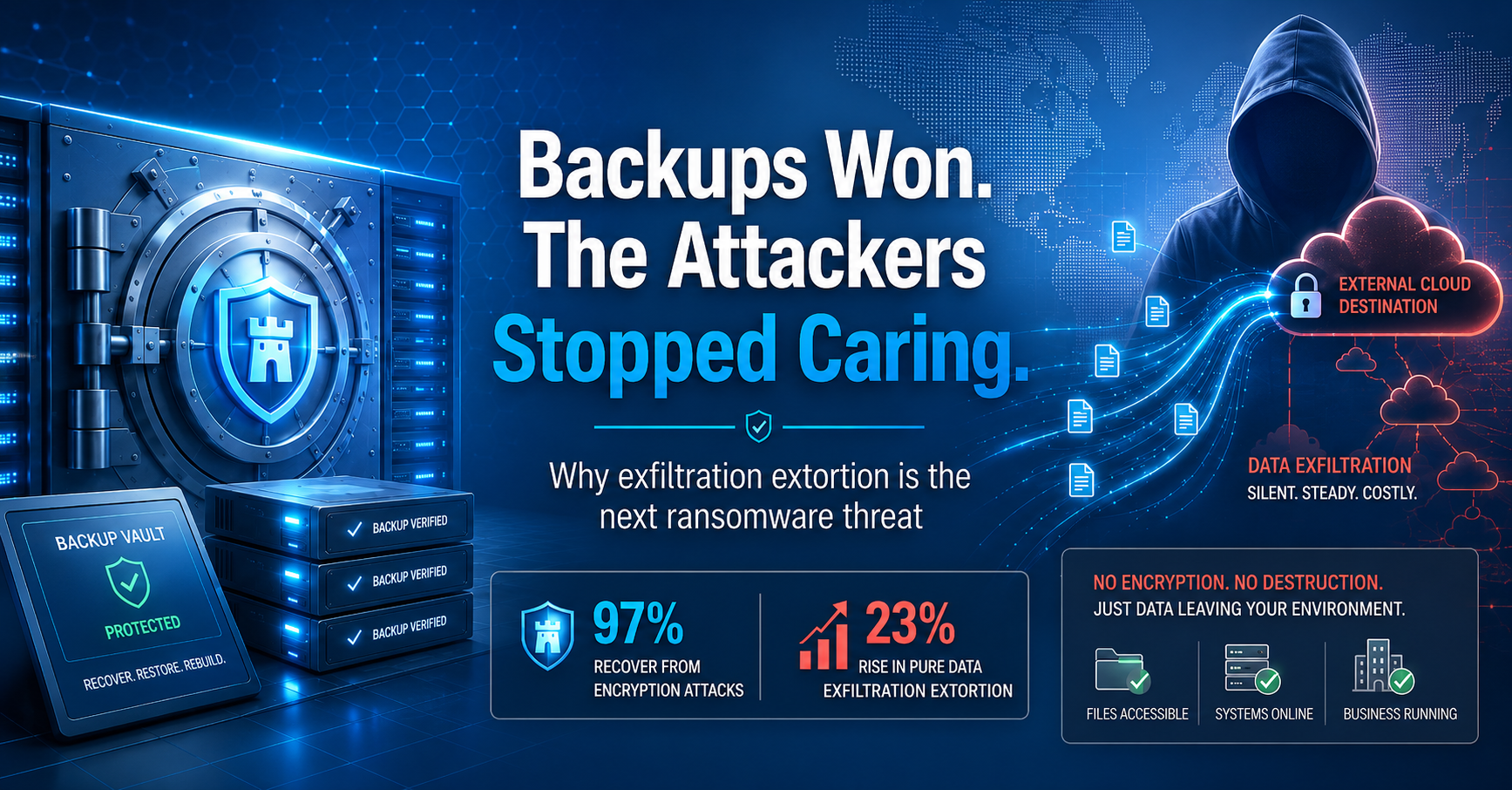
Roughly 97% of organizations with encrypted backups can now recover from a traditional ransomware attack without paying which is a genuine win for the backup industry. It may be safe to say that ransomware crews noticed, and pure data-exfiltration extortion is up 23% year over year as a result. Attackers skip encryption entirely, walk out with the data using legitimate cloud-copy tools, and go straight to threatening to publish it. Your backup posture does not have an affect on that threat. Detection at the data-movement layer and prevention controls that make data harder to exfiltrate is required to close the gap in the first place.
Key Takeaways
- 97% of organizations with properly configured backups can recover from encryption-based ransomware without paying, a decade of immutable storage and tested restore investment has worked
- Pure data-exfiltration extortion is up 23% year over year; Securelist, Morphisec, Security Magazine, and Deep Tempo all published the same finding in 2026
- Attackers using Azure Copy or similar legitimate cloud tools with stolen credentials that look like normal administrative traffic to most EDR platforms, so there is no encryption event to flag, no destructive action to alert on
- Pure exfiltration can run quietly for weeks; the first public sign is often a leak-site post, by which point the attacker has already monetized the data
- A perfect backup posture protects data from being lost but it does nothing to protect the organization from that same data being copied and published
- Two gaps most organizations have not closed: detection at the data-movement layer (volume, destination, and timing) and identity and egress controls that raise the cost of exfiltration before the data leaves
The Win That Created a New Vulnerability
The backup industry quietly won the ransomware war. Roughly 97% of organizations with encrypted backups in 2026 can recover from a traditional ransomware attack without paying. That number is the quiet success story of a decade of investment in immutable storage, air-gapped vaults, and tested restore processes.
It is also why pure data-exfiltration extortion is up 23% year over year.
Securelist, Morphisec, Security Magazine, and Deep Tempo all published the same finding in 2026. The professional ransomware crews are skipping encryption entirely, walking out with the data, and going straight to the threat-to-release stage. The leverage has shifted from the keys to your files to the keys to your reputation, and your backup posture does nothing about it.
If your security strategy still treats ransomware as primarily an encryption problem, you are defending the version of the threat that ended two years ago.
Why Encryption Became Optional
Three mechanics drive the pivot.
The economics changed. When 97% of well-prepared organizations recover from encryption without paying, encryption stopped being a reliable payday. The cost of deploying ransomware, including custom encryptors, evasion tooling, and the operational risk of triggering a noisy event, started returning less and less.
Pure exfiltration is harder to detect. Attackers using Azure Copy or other legitimate cloud-copy tools with stolen credentials look like normal administrative traffic to most EDR platforms. There is no encryption process to flag. There is no destructive action to alert on. The data leaves through authenticated channels the security stack is configured to allow.
The pressure profile is better for the attacker. Encryption produces an immediate, visible incident customers and regulators learn about quickly. Pure exfiltration can run quietly for weeks, with the first public sign being a leak site post. By then the attacker has monetized the data and the victim has lost the option to control the narrative.
Sophisticated extortion crews now treat encryption as a marketing event for ransomware-as-a-service brand recognition. The actual revenue work happens earlier and quieter, before the encryptor ever fires.
Why Your Backup Strategy Is No Longer Enough
Backup-centric strategies were the right answer for the encryption case, and they remain necessary. The encryption case is no longer the whole problem.
A perfect backup posture protects the data from being lost, but it does nothing to protect the organization from that same data being copied and published. Most boards have not heard of this update. Conversations about resilience still center on RPO, RTO, and immutable storage. Those metrics still matter, and they are also incomplete when the attacker has no plan to encrypt anything.
Closing the gap in 2026 has two parts most organizations have not operationalized.
Detection at the Data Movement Layer
Traditional EDR was built to spot malicious processes, suspicious file behavior, and known signatures. It was not designed to identify a legitimate administrative tool being used by a compromised account to transfer hundreds of gigabytes to an external cloud bucket. The signal lives in the volume, the destination, and the timing.
The detection layer has to watch for unusual API calls, unexpected cloud-copy operations, and lateral movement patterns that precede data exfiltration. The capability requires both tooling and human analysts who recognize the patterns in context. Most internal security teams cannot maintain that capability around the clock, which is why managed detection and response has become the only practical answer for businesses below enterprise scale.
Prevention Through Identity and Egress Controls
Making the data harder to walk out with is the other half.
Immutable storage limits the blast radius of a credential compromise. Identity hardening, including the elimination of standing administrative access and the enforcement of just-in-time elevation, removes the easy paths attackers use to read and copy large data sets. Egress controls and data loss prevention tooling, properly configured, can turn a quiet exfiltration into a noisy alert the detection team can catch.
None of these prevention measures stops a determined adversary on its own. Together, they raise the cost of a pure-exfiltration operation enough to discourage opportunistic attempts and give the detection layer time to act.
How CyberFortress Solves This
This is exactly what the Trinity Platform was built to handle. The recovery side delivers managed BaaS and DRaaS with immutable retention in geo-separated vaults, validated quarterly with rehearsed failover, and supported by 24/7 U.S.-based recovery specialists. The detection side delivers managed detection and response that watches for the data-movement patterns most EDR platforms miss. The prevention side handles identity isolation, egress monitoring, and the operational controls that raise the cost of an exfiltration-only attack.
What matters here is the integration. A pure-exfiltration attack succeeds when prevention, detection, and recovery are operated by different teams with different priorities. Trinity puts them under one accountable group, watching the same telemetry, with one number to call when the alert fires.
That is the operational answer no backup-only vendor can give you, and it is the difference between watching a data leak unfold on Twitter and shutting it down before it leaves your environment.
Three Questions for the Next Risk Conversation
If your security strategy was built primarily around the encryption case, take three questions into the next leadership review.
If an attacker exfiltrated a terabyte of our sensitive data tomorrow using legitimate cloud-copy tools and stolen credentials, would our detection layer catch it before the data left, and within what timeframe?
How does our current strategy address an extortion event in which no encryption occurred and the threat is purely the publication of stolen data?
Are our prevention, detection, and recovery functions managed by the same team, and if not, what would change if they were?
The decade of investment in backup discipline worked. The attackers noticed. The next phase of ransomware strategy takes the win in the encryption case and extends it to the case where encryption never happens. Most organizations are still fighting the previous war.
Frequently Asked Questions
What is data exfiltration extortion and how is it different from ransomware? Traditional ransomware encrypts the victim’s files and demands payment for the decryption key. Data exfiltration extortion skips encryption entirely. The attackers copy sensitive data out of the environment and threaten to publish it unless paid. The victim’s files are intact and operations continue normally, but the stolen data is now used as leverage. Because no encryption event occurs, the attack is harder to detect and backup-centric defenses offer no protection against the threat.
Why are ransomware attackers shifting to pure exfiltration in 2026? Three mechanics drive the shift. First, 97% of well-prepared organizations now recover from encryption without paying, making encryption a less reliable payday. Second, pure exfiltration using legitimate cloud-copy tools with stolen credentials produces no malicious process signatures for EDR platforms to flag. The data leaves through authenticated channels the security stack is configured to allow. Third, exfiltration can run quietly for weeks before the victim becomes aware, giving attackers time to monetize the data before any containment response begins.
Does a strong backup posture protect against data exfiltration extortion? No, not directly. Immutable, air-gapped backups protect against data loss from encryption and allow recovery without paying a ransom. They do not prevent attackers from copying data and threatening to publish it. An organization with a perfect backup posture and no exfiltration detection could recover its files completely while still facing an extortion demand backed by stolen data the attacker already holds. Backup remains necessary; it is no longer sufficient on its own.
How do attackers exfiltrate data without triggering security alerts? The most common method in 2026 involves legitimate cloud-copy tools such as Azure Copy and operated with stolen administrative credentials. To most EDR platforms, this traffic looks identical to normal administrative activity: authenticated, using approved tools, through allowed channels. The signal that something is wrong lives in the volume of data being transferred, the destination it is going to, and the time of day the operation runs. Signaling these behavioral patterns require a detection layer watching data movement, not just malicious processes.
What detection capability is needed to catch a pure exfiltration attack? Effective detection against exfiltration-only attacks requires monitoring for unusual API calls, unexpected cloud-copy operations, anomalous data volumes moving to external destinations, and lateral movement patterns that typically precede large data transfers. This is behavioral detection informed by context and it requires human analysts who recognize the patterns in real time, around the clock. For most businesses below enterprise scale, that capability has to come from a managed detection and response provider rather than an internal team.
How does CyberFortress address both encryption and exfiltration threats? The Trinity Platform covers both attack types under one integrated team. The recovery layer delivers managed BaaS and DRaaS with immutable, geo-separated retention and 24/7 U.S.-based recovery specialists. This is the answer to the encryption case. The detection layer delivers managed detection and response watching for data-movement patterns most EDR platforms miss. The answer to the exfiltration case. The prevention layer handles identity isolation and egress controls that raise the cost of an exfiltration attempt before data leaves the environment. The integration matters because pure-exfiltration attacks succeed most often when prevention, detection, and recovery are operated by different teams watching different telemetry.
________________________________________________
CyberFortress provides managed cyber resilience that addresses both encryption and exfiltration threats. The complete picture of ransomware in 2026, not just the version from two years ago. Contact us to assess whether your current strategy covers the exfiltration case.