DATA PROTECTION TRENDS, NEWS & BACKUP TIPS
Your Hospital Wasn’t Breached. Your Billing Vendor Was. Same Result.
In late April 2026, a clinical billing platform serving more than 200 community hospitals across the southeastern United States went offline for six days following a ransomware attack on its parent organization. None of the hospitals had been breached. The billing vendor had. The operational result was identical. Patient charges could not be processed, claims could not be submitted, and the disruption rippled through every facility that depended on the platform.
That story repeated in different forms across the first half of 2026. HIPAA Journal tracks healthcare ransomware up 36% year over year, accounting for more than one third of healthcare cyberattacks. Two named hospital attacks forced operations shutdowns, treatment cancellations, and ambulance rerouting. A May 18 IT incident may have affected 478,188 individuals across multiple providers.
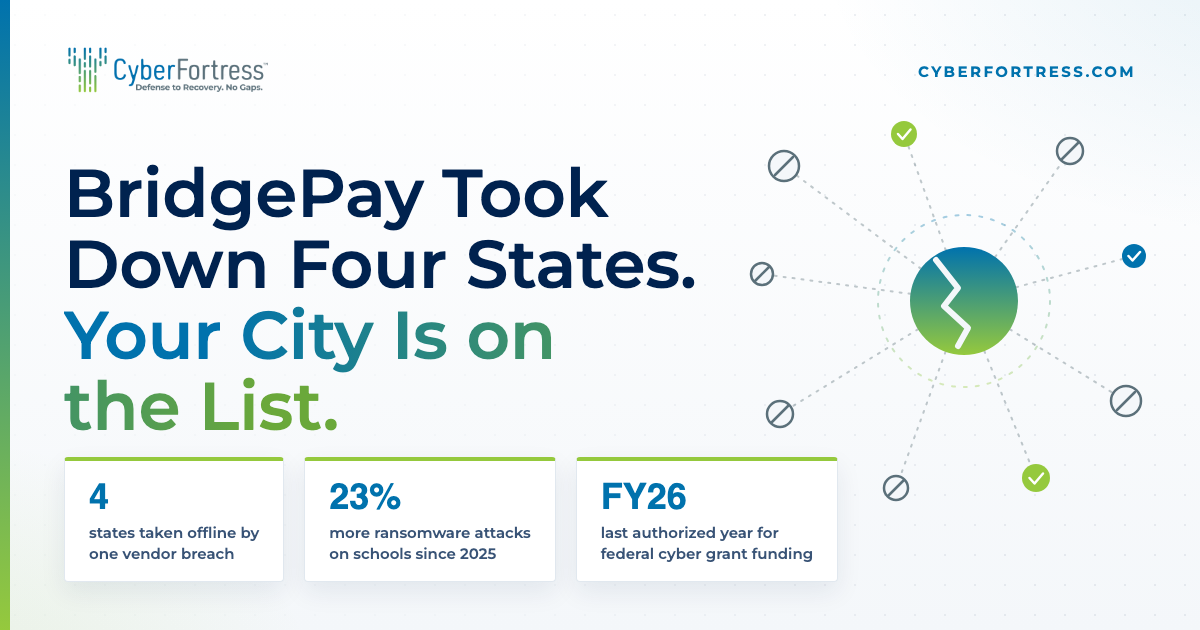
The most important change is captured in the HIMSS 2026 reporting. Ransomware groups have shifted attention upstream. Vendors, MSPs, and service partners have become the primary entry point into healthcare environments, displacing the direct hospital attack as the dominant pattern.
For years, IT or Security administrators for hospitals have invested in building the defensive perimeter, and it no longer matters.
Why Vendors Became the Entry Point
The shift to vendor-based attacks has clear strategic logic from the attacker side.
Hospitals invested. After several years of high-profile incidents and regulatory pressure, hospital security programs have matured meaningfully. Endpoint protection, identity hardening, network segmentation, and incident response capability have all improved across the sector. The cost of compromising a hospital has gone up directly as a result.
However, vendors did not invest at the same pace. The clinical billing platform, the patient scheduling system, the lab information exchange, the imaging archive, and the dozens of other specialized vendors healthcare runs on have not all kept up. Some have. Many have not.
The access is the same. A compromised (trusted) vendor with API connections, VPN tunnels, or federated identity into multiple hospitals gives the attacker the same access as a direct hospital breach, often with more reach. A single successful vendor compromise can yield exposure across 50 or 100 customer environments.
The attribution is muddier. When the vendor is breached, the hospital often discovers the incident from a vendor notification rather than from its own security tools. The incident response timeline begins later, and the hospital’s leverage to demand specific actions from the vendor is limited.
The combination has made the vendor layer the highest-yield entry point in healthcare for 2026, and most hospital security programs are not yet built for it.
What This Changes for Hospital IT
The traditional hospital security program focused on the hospital itself. The 2026 threat profile asks that program to extend in three uncomfortable directions.
Vendor risk assessment as a security function. Many hospitals have vendor risk assessment processes living in procurement and compliance. The function needs operational security inputs alongside the contract language and certificates. A vendor’s actual security posture, including their incident response capability, their patching cadence, and their recovery testing, has to be evaluated by people who can read those signals.
Visibility into vendor connections. Hospital IT teams often do not have a current inventory of which vendors have what access to which systems. Building that inventory is the prerequisite for any meaningful vendor risk management. The list tends to be longer than expected and to include connections no longer necessary.
Recovery assumptions that include vendor failure. Continuity plans have to address scenarios in which a critical vendor is unavailable for days or weeks. The fallback procedures for billing, scheduling, lab orders, and imaging need to exist on paper, get rehearsed periodically, and be ready for activation. The hospital’s clinical operations have to continue when a vendor is down, regardless of who is responsible for the outage.
What an Adequate Defense Looks Like
For most hospitals, the defensive architecture closing most of the vendor-driven attack surface combines three elements.
Independent backups of vendor-held data. Clinical data living in a SaaS vendor’s environment needs an independent backup outside that vendor. When the vendor goes down, the hospital has continued access to its own data. Critical billing records, scheduling information, and clinical metadata can be reconstructed without depending on the vendor’s recovery timeline.
Managed detection at the integration layer. The API connections, VPN tunnels, and federated identity links between hospitals and their vendors are the actual attack surface, more than the vendor’s environment in isolation. Monitoring those integrations for unusual activity, with analysts who recognize the signatures of a vendor-side compromise, is the detection function that matters most in the 2026 threat profile.
Documented vendor incident playbooks. The hospital should have a written response plan for the disclosure that a critical vendor has been breached, including communication templates, fallback activation steps, and escalation paths. The first time the hospital thinks through that scenario should be in a tabletop exercise, before a real incident forces the thinking.
How CyberFortress Solves This
This is exactly the gap CyberFortress was built to close. The Trinity Platform organizes the response into three functions that map directly onto the vendor threat: protect, detect, and recover.
Protect. Independent, managed backups keep copies of vendor-held data outside the vendor’s environment, with HIPAA-aligned controls and immutable retention in geo-separated vaults. When a vendor goes down, the hospital still holds its own billing records, scheduling data, and clinical metadata, regardless of the vendor’s recovery timeline.
Detect. Managed detection watches the integration layer between the hospital and its vendor stack, where the API connections, VPN tunnels, and federated identity links actually live. U.S.-based analysts are on call 24/7 and trained to recognize the signatures of a vendor-side compromise, so the hospital is not waiting on a vendor notification to learn it has a problem.
Recover. When an incident hits, recovery is already planned, tested, and ready to activate across both SaaS and on-premises systems, so clinical operations continue while the vendor sorts out its own environment.
The advantage is that all three sit with a single accountable team. A vendor disclosure at 11 p.m. on a Sunday does not get handed across three providers with different operating hours.
Hospital IT teams are not staffed for sustained vendor incident response. A managed partner that understands HIPAA, the clinical operations rhythm, and the regulatory disclosure timelines is the only practical answer for most health systems below the largest tier.
We are that partner.
Three Questions for the Next Hospital IT Leadership Meeting
If the 2026 vendor breach pattern has not made it into your hospital’s risk register yet, take three questions to the next IT leadership meeting.
Which third-party vendors have active connections into our clinical systems, and when did we last audit what each of them can read, write, or modify?
If a critical clinical vendor disclosed a breach affecting our patients tomorrow, what could we recover from a backup the vendor does not control, and within what timeframe?
For each critical vendor service, do we have a documented continuity plan for a multi-day vendor outage, and have our clinical operations leaders signed off on it?
Hospitals that come through the 2026 vendor wave with patient operations intact mapped their vendor dependencies before the incident and built recovery posture for the scenarios in which those vendors fail. The work is concrete, the patterns are known, and the time to do it is well before a vendor notification arrives in someone’s inbox at 11 p.m. on a Sunday.