Mid-Sized Law Firms Are Losing the 2026 Ransomware War
Mid-sized law firms are losing the 2026 ransomware war because attackers have shifted to breaching the concentrated legal-tech vendor stack (LexisNexis and DocketWise to name a few) and exposing thousands of firms at once, while most 20-to-300-attorney firms lack the security maturity to respond. Firms need independent SaaS backup, endpoint backup for remote attorneys, managed detection and response, and a documented recovery plan they’ve actually rehearsed.
Key Takeaways
- LexisNexis Legal & Professional confirmed in early 2026 that a threat actor exposed customer files, including records tied to (dot) .gov accounts such as federal judges, DOJ attorneys, and SEC staff.
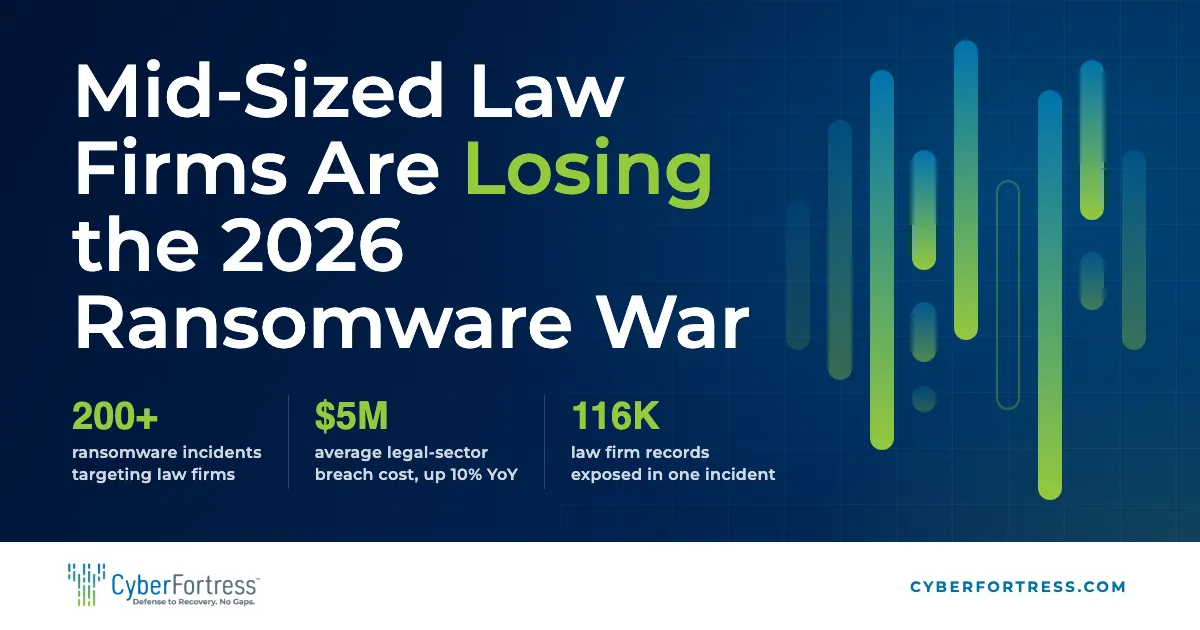
- A separate incident using valid stolen credentials affected roughly 116,000 law firm records. Halcyon’s tracking shows more than 200 ransomware incidents targeting law firms between 2025 and early 2026, with one ransomware actor alone claiming 20 firms so far this year.
- The average data-breach cost in the legal sector reached $5.08 million, up 10% year over year.
- Law firms hold concentrated, high-value data (client matters, M&A documentation, litigation strategy, privileged communications) that is valuable to ransom payers, identity-theft markets, and competitive intelligence operations alike.
- The legal-tech vendor stack known as LexisNexis, DocketWise, Westlaw, NetDocuments, iManage, and Clio are concentrated among a small number of platforms, so a single vendor breach can expose thousands of firms in days, which has now happened twice in one year.
The Vendor Breach That Reached the Federal Government
LexisNexis Legal & Professional confirmed in early 2026 that a threat actor had exposed customer files. Among them were records tied to .gov accounts, including federal judges, Department of Justice attorneys, and SEC staff. The legal research vendor nearly every firm in the country relies on had become the source of a breach that reached the federal government itself.
A few weeks later, another actor disclosed a separate incident affecting roughly 116,000 law firm records. The vector was valid stolen credentials. Halcyon’s tracking shows more than 200 ransomware incidents targeting law firms between 2025 and early 2026. Another Ransom actor, alone, has claimed 20 firms so far this year. The average data-breach cost in the legal sector reached $5.08 million, up 10% year over year.
Read those numbers as concerning as they actually are. Mid-sized law firms are struggling against a new threat in 2026. They are losing, and the loss is accelerating.
Why Law Firms Became the Premium Target
A few structural realities explain why ransomware crews shifted attention to the legal sector.
- Law firms hold concentrated, high-value data. Client matters, M&A documentation, litigation strategy, settlement information, privileged communications. The data is valuable to multiple buyer types: ransom payers, identity-theft markets, and competitive intelligence operations.
- The reputation stakes are existential. State bar associations, federal courts, and clients expect law firms to protect privileged information. A breach brings malpractice claims, professional discipline, and a client exodus no insurance policy fully covers.
The security maturity is uneven. The largest firms in the country run sophisticated security operations. The 20-to-300-attorney firms making up most of the market run lean IT teams. The data is comparable across the sector, while the defense capability is not.
The vendor stack is concentrated. LexisNexis, DocketWise, Westlaw, NetDocuments, iManage, Clio, and the other major platforms in legal tech sit between every law firm and its work. One vendor breach exposes thousands of firms in days. This is not theoretical anymore. It happened twice already this year.
A small or mid-size law firm is now one of the highest-yield, lowest-friction targets in the professional ransomware catalog. The economics work for the attacker, and the typical 2026 defense posture at a mid-sized firm does not stop them.
The Vendor Problem No Firm Can Solve Alone
Successful actors have made a point that goes beyond either platform. Law firms do not control the security posture of the SaaS platforms they depend on. When a vendor is breached, the firm’s exposure is determined by the vendor’s response, the vendor’s disclosure timing, and the vendor’s recovery decisions.
The firm has no operational visibility into the vendor’s security program until something goes wrong. By then the vendor is making decisions on the firm’s behalf, under time pressure, in negotiations the firm cannot influence.
What the firm can change is its own posture for when the vendor breach happens. Hold an independent backup of the data stored in the vendor’s platform. Document a response plan for a vendor disclosure. Keep a partner on call for the night the breach hits the news.
Firms that survive a vendor breach in 2026 are the ones that prepared for it specifically. Everyone else rebuilds from scratch.
What a Real Defense Looks Like for the Typical Firm
For a 20-to-300-attorney firm, the architecture closing most of the 2026 attack surface is well understood and increasingly affordable.
SaaS backup with independent retention. Critical work product in Microsoft 365, NetDocuments, iManage, or Clio needs an independent backup outside the vendor through SaaS backup and recovery. With retention controlled by the firm rather than the platform. When the next DocketWise-style incident arrives, the firm’s data is recoverable regardless of the vendor’s decisions.
Endpoint backup for laptops and remote attorneys. Modern legal work happens on laptops, often outside the office. The endpoints holding privileged work product need their own backup posture through LiveVault server backup and recovery, including coverage of synced cloud folders. Ransomware on an attorney’s laptop should not produce data loss at the firm level.
Managed detection and response. Few firms in the 20-to-300-attorney range can staff a 24/7 security operation internally. Managed detection and response delivers the same monitoring through a partner, with analysts who recognize the early steps in a credential-theft or ransomware attack and act in minutes rather than hours.
Documented recovery procedures. The firm’s response plan for a ransomware incident or vendor breach should be written down, reviewed quarterly, and rehearsed annually. Plans that exist only in the IT director’s head do not work at 2 a.m. on a holiday weekend, which is when most ransomware events fire.
How CyberFortress Solves This
This is exactly the gap CyberFortress was built to close. Managed SaaS backup covers Microsoft 365 and the major legal SaaS platforms with immutable retention in geo-separated vaults. Endpoint backup handles laptops and synced cloud folders for the remote and hybrid attorney workforce. Managed detection and response watches the environment around the clock, with U.S.-based analysts who recognize the attack patterns active in the legal sector right now. The Trinity Platform brings detection, response, and recovery into a single operating model, so a 50-attorney firm gets the operational posture of a much larger security team without building it internally.
The fit is the whole point. Legal IT teams do not need an enterprise security stack. They need a managed partner who understands the threat environment, the compliance obligations, and the operational rhythm of a law firm, and who answers the phone when the incident happens.
Three Questions for the Next Partner Meeting
If this all sounds uncomfortably familiar, take these three questions into the next partner or operations meeting.
- For each SaaS platform our firm depends on, do we hold an independent backup copy in storage we control, and what is its retention?
- If our most senior attorney’s laptop were encrypted on a Saturday night, what could we restore that the attacker could not reach, and within what timeframe?
- If a major legal-tech vendor disclosed a breach affecting our data tomorrow, who would we call within the first hour, and would they answer?
Firms that get through 2026 without a damaging incident decided this quarter to act on the questions above. Firms that wait until after an incident end up as case studies in next year’s trade press. The choice is straightforward, and the clock is running.
Frequently Asked Questions
Why are law firms being targeted by ransomware more in 2026? Law firms hold concentrated, high-value data: client matters, M&A documentation, litigation strategy, and privileged communications. That’s valuable to multiple buyer types including ransom payers, identity-theft markets, and competitive intelligence operations. Meanwhile, the largest firms run sophisticated security operations while 20-to-300-attorney firms often run lean IT teams, creating an uneven defense landscape against the same threat level.
What happened in the LexisNexis breach, and why does it matter to my firm? LexisNexis Legal & Professional confirmed in early 2026 that a threat actor exposed customer files, including records tied to .gov accounts such as federal judges, DOJ attorneys, and SEC staff. It shows that a single legal-tech vendor breach can reach far beyond the vendor itself, exposing thousands of firms that rely on that platform.
Can my law firm control the security of the SaaS platforms we use, like NetDocuments or Clio? No. Law firms don’t control the security posture of the SaaS platforms they depend on, and when a vendor is breached, the firm’s exposure is determined by the vendor’s response and disclosure timing, not the firm’s own actions. What a firm can control is holding an independent backup of that data and having a documented response plan ready before the breach happens.
What is a reasonable ransomware defense budget for a mid-sized law firm? For a 20-to-300-attorney firm, the core architecture includes SaaS backup with independent retention, endpoint backup for laptops and remote attorneys, managed detection and response, and a documented, quarterly-reviewed recovery plan. Capability increasingly affordable through managed partners rather than building an enterprise security stack in-house.
How much does a data breach cost a law firm on average? The average data-breach cost in the legal sector reached $5.08 million in 2026, up 10% year over year, not counting reputational damage, malpractice claims, professional discipline, or client attrition that insurance doesn’t fully cover.
How does CyberFortress help law firms defend against ransomware and vendor breaches? CyberFortress provides managed SaaS backup covering Microsoft 365 and major legal SaaS platforms with immutable retention in geo-separated vaults, endpoint backup for attorney laptops and synced cloud folders, and 24/7 managed detection and response, all unified through the Trinity Platform so a 50-attorney firm gets enterprise-level security operations without building it internally.
CyberFortress provides SaaS and endpoint backup built for law firms managing privileged client data. Contact us to find out what your firm could restore if a legal-tech vendor were breached tomorrow.
A backup you have never restored is a guess. Trinity turns it into proof.
Seven questions show where your recovery plan stands today. Or skip ahead and talk to a CyberFortress recovery specialist about your environment.
More from the Fortress
-
Whose Database Is Your Data In?
FulcrumSec published roughly 8.8 million people’s data from Manchester Airports Group over the first weekend of September 2026,…
-
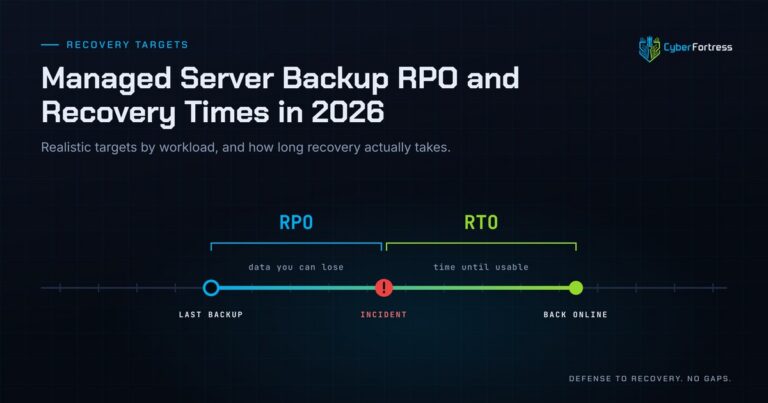
Managed Server Backup RPO and Recovery Times in 2026
For a 200-person company in 2026, a reasonable managed server backup posture is a 15-minute to 4-hour RPO…
-
Outsourcing Server Backups in 2026 Full Guide
Outsourcing server backups works when the contract covers monitoring, remediation, verified restore testing, immutable offsite storage, and assisted…
-
You Can’t Out-Patch an Attacker That Adapts in 31 Seconds
Researchers have documented what they are calling JadePuffer: a ransomware operation reportedly run end-to-end by an autonomous LLM…