Your Backups Are the Target, Not the Safety Net
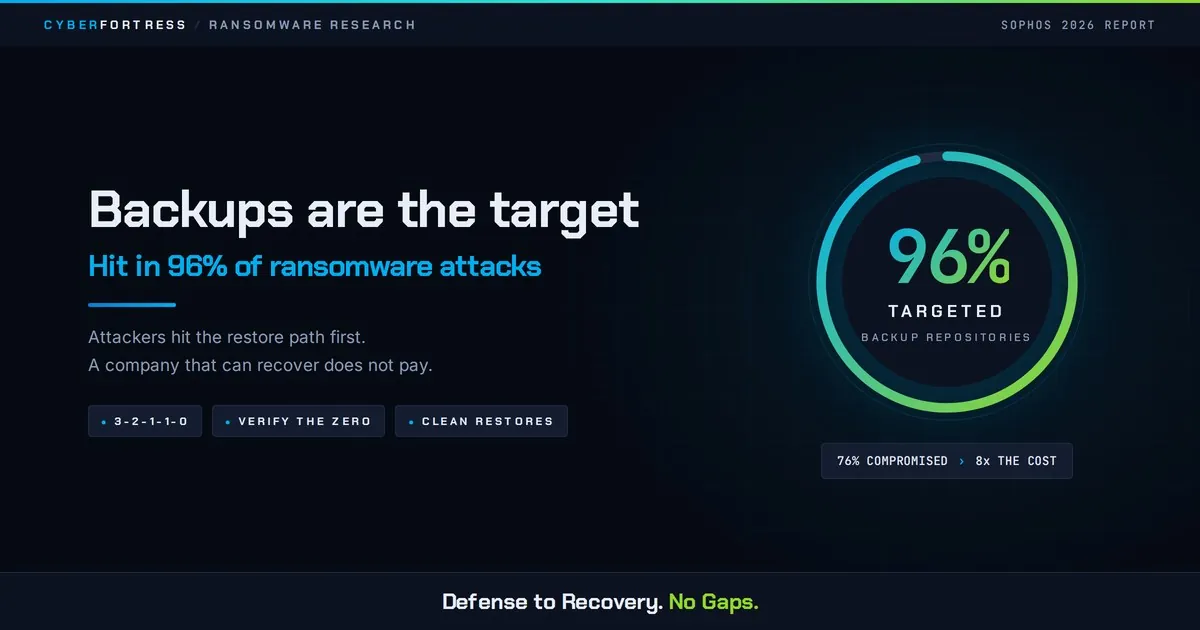
Ransomware groups go after your backup repository before they go after your production data. Sophos’ State of Ransomware 2026 report puts a number on it: backup repositories are targeted in 96% of attacks, and attackers succeed in compromising them 76% of the time. The organizations that keep working backups still recover through them in 66% of encrypted-data cases. The ones whose backups get compromised pay recovery costs roughly 8x higher, against an average total incident cost that has climbed to $1.7 million.
A victim with a working restore path does not pay the ransom, so the restore path has become the first target, not the last resort.
Why Do Ransomware Groups Hit Backups First?
Direct answer: Attackers target backup infrastructure early in the intrusion because destroying or encrypting the restore path removes the victim’s only alternative to paying. A company that can recover on its own has no reason to negotiate.
Modern ransomware operators spend their initial access window on reconnaissance. They map the network, identify backup servers and repositories, and disable or encrypt those systems before they ever touch production data. By the time the ransom note appears, the safety net is often already gone. Backup infrastructure now gets the same threat-modeling attention as domain controllers and identity systems, and for most attacks, it is the primary target.
Why Can’t Weekly Backup Reviews Keep Pace With an Hours-Long Attack?
Direct answer: A backup posture that is checked weekly gets discovered at restore time, not before, because the average time from initial access to encryption is now measured in hours, not weeks.
If a company reviews backup health once a week, and an attacker can move from initial access to full encryption in a single business day, the review cycle and the attack cycle are not operating on the same clock. A misconfigured repository, a failed replication job, or a quietly expired retention policy can sit undiscovered for days. The first time anyone notices is the first time anyone needs it, and that is the worst possible moment to find out.
The fix is moving backup verification from a periodic task to a continuous one.
What Does Immutability Actually Guarantee, and What Doesn’t It?
Direct answer: Immutable storage guarantees that stored data cannot be altered or deleted within a retention window. It does not guarantee that a restore will complete, that the recovered application will actually boot, or that the recovered data is clean.
The industry has converged hard on the 3-2-1-1-0 framework this year, and for good reason: three copies of data, on two different media types, with one copy offsite, one copy immutable or air-gapped, and zero errors on recovery verification. Most organizations that adopt the framework stop at the immutable copy. That protects the bytes. It says nothing about the process built on top of them.
Immutability answers “can this data be changed.” It does not answer “will this data actually bring the business back online.” Those are different questions, and the second one is the one that matters at 2am during an active incident. This is also the piece almost nobody operates: the zero in 3-2-1-1-0 is a verification requirement, not a storage requirement, and verification is the step most backup strategies skip.
A backup that has never been restored is not a safety net. It is a hypothesis about a safety net.
How CyberFortress Solves This
This is exactly what CyberFortress was built to fix. Our Managed BaaS and Managed DRaaS deliver immutable, geo-separated retention with quarterly rehearsed failover, governed by a trust domain separate from the customer’s production environment. That covers the storage half of the 3-2-1-1-0 framework.
The Trinity Platform is built to solve this too: the verification gap that immutability alone cannot touch. Instead of an annual restore test, Trinity runs recovery drills continuously and reports a Recovery Score that reflects what a passing drill actually looks like, not what a storage vendor promises. It screens recovered data for dormant ransomware before that data goes back into production, so a restore does not become a re-infection. And it tracks immutable coverage as a live, measured percentage across the environment instead of an assumption made once during setup and never revisited.
The first time you test a restore should never be during a live attack. Don’t promise recovery. Prove it. That is the discipline Trinity was built to enforce, and it is why CyberFortress pairs the platform with 24/7 U.S.-based recovery specialists who answer the phone when the drill turns real.
We give the specific architectural answer.
If you want to know where your own organization stands against this data, our Ransomware Readiness Audit answers the exact question the Sophos numbers raise: could you recover without paying? It is a fast, low-cost, AI-led assessment, and for organizations where the audit surfaces structural gaps rather than configuration fixes, the natural next step is a Recovery Architecture Review with a CyberFortress engineer.
Three Questions Worth Asking
- When was the last time someone actually restored a production system from backup, rather than confirmed the backup job completed?
- If your backup repository were encrypted alongside production tonight, what would recovery cost, and does that number match the $1.7 million industry average, or exceed it?
- Does your immutable storage get verified as recoverable on a schedule, or is it verified once at implementation and assumed reliable ever since?
Frequently Asked Questions
What percentage of ransomware attacks target backups? Sophos’ State of Ransomware 2026 report found that backup repositories are targeted in 96% of ransomware attacks, and attackers successfully compromise those backups in 76% of cases.
How much more does ransomware recovery cost when backups are compromised? Organizations whose backups were compromised during a ransomware attack faced recovery costs roughly 8 times higher than organizations with intact, working backups, against an average total incident cost of $1.7 million.
Is immutable backup storage enough to guarantee ransomware recovery? No. Immutable storage prevents stored data from being altered or deleted, but it does not verify that a restore will complete, that an application will come back online, or that the recovered data is free of dormant ransomware. Recovery verification is a separate discipline from storage immutability.
What is the 3-2-1-1-0 backup framework? It calls for three copies of data, on two different media types, with one copy stored offsite, one copy immutable or air-gapped, and zero errors confirmed during recovery verification. The final digit, the verification requirement, is the part most organizations skip.
How often should you test a restore? Continuously, not annually. Because attacks now move from initial access to encryption in hours, a weekly or yearly review cycle discovers problems at restore time. Continuous recovery drills surface a misconfiguration or failed job before an incident does.
The organizations that survive the next wave of ransomware are the ones that turned that guess into a measurement before an attacker forced the question.
A backup you have never restored is a guess. Trinity turns it into proof.
Seven questions show where your recovery plan stands today. Or skip ahead and talk to a CyberFortress recovery specialist about your environment.
More from the Fortress
-
Whose Database Is Your Data In?
FulcrumSec published roughly 8.8 million people’s data from Manchester Airports Group over the first weekend of September 2026,…
-
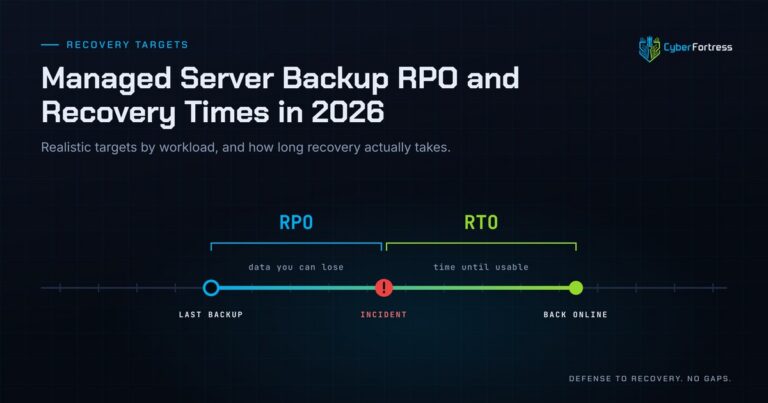
Managed Server Backup RPO and Recovery Times in 2026
For a 200-person company in 2026, a reasonable managed server backup posture is a 15-minute to 4-hour RPO…
-
Outsourcing Server Backups in 2026 Full Guide
Outsourcing server backups works when the contract covers monitoring, remediation, verified restore testing, immutable offsite storage, and assisted…
-
You Can’t Out-Patch an Attacker That Adapts in 31 Seconds
Researchers have documented what they are calling JadePuffer: a ransomware operation reportedly run end-to-end by an autonomous LLM…