Outsourcing Server Backups in 2026 Full Guide
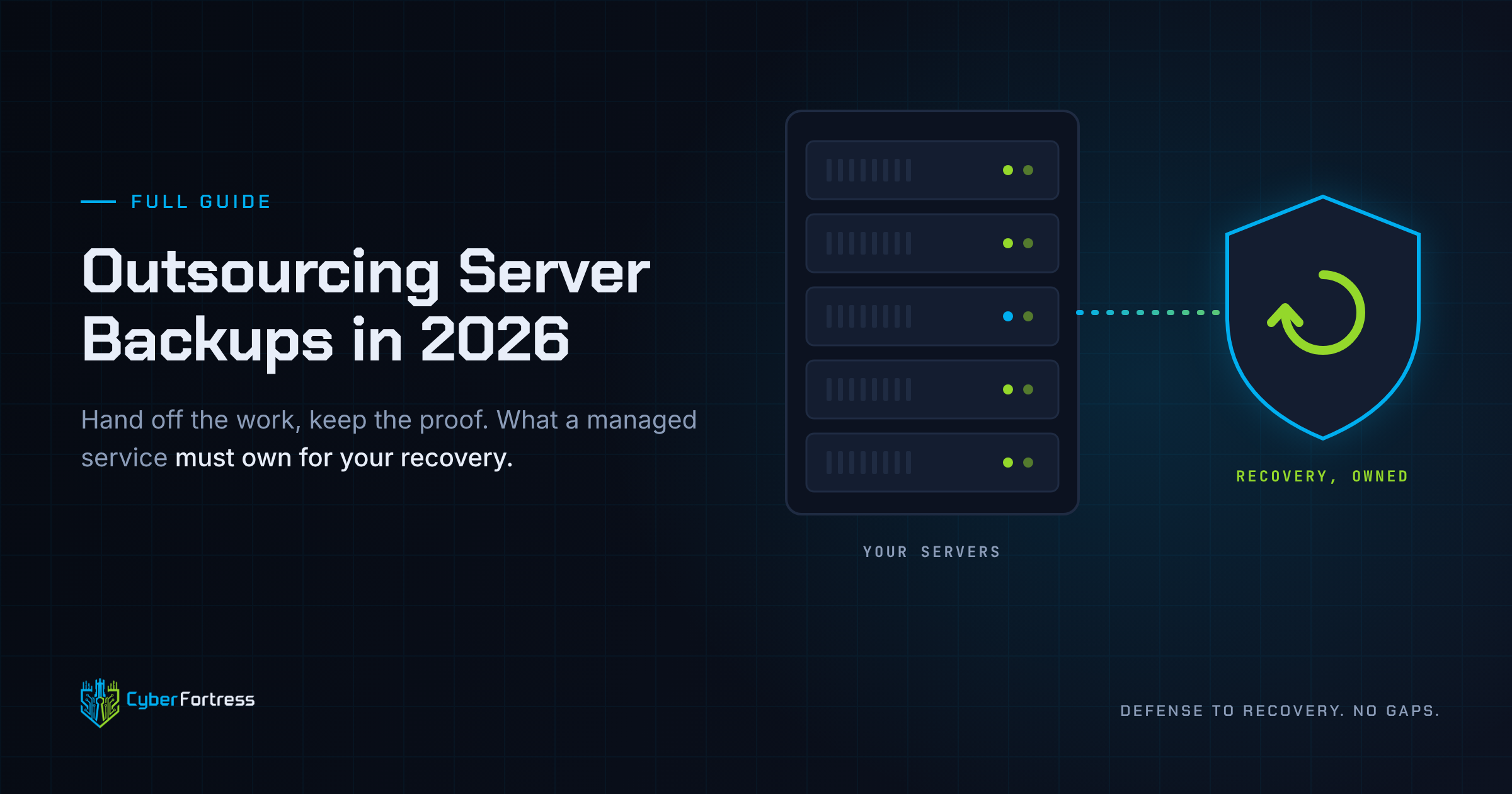
Outsourcing server backups works when the contract covers monitoring, remediation, verified restore testing, immutable offsite storage, and assisted recovery, with stated RPO and RTO per workload class. It fails when it is storage with a support email address. The question that separates the two is whether someone is accountable for your recovery.
What does a managed server backup service include?
- Discovery and onboarding of physical servers, virtual machines, and cloud workloads, with a documented protection policy per workload class.
- Scheduled backups with automation for retries, agent health, and credential rotation.
- Local copies for fast restore plus immutable offsite copies for ransomware and site loss.
- Continuous monitoring with human remediation of failures.
- Periodic recovery verification and documented test restores.
- Assisted recovery during an incident, with a named escalation path.
- Reporting suitable for audits, insurers, and customer security reviews.
Anything missing from that list is work that quietly stays on your team, whatever the contract is called.
When should you outsource rather than build?
Outsource when your team is under-resourced relative to the environment, when compliance requires evidence you cannot easily produce, when nobody has practiced a full recovery, or when backup work keeps losing to project work.
Build in-house when you have dedicated data protection staff, strict data residency constraints that no provider satisfies, or an environment so unusual that generic tooling does not fit. Most mid-market teams sit clearly on the outsourcing side and resist it out of pride. The environment does not care either way.
How do you evaluate providers?
Ask for numbers, per workload class
RPO and RTO for databases, application servers, file shares, and endpoints. A single blended figure is a marketing number.
Ask how failures are handled
Who sees the alert, how quickly they act, and what happens on the third consecutive failure. Request a sample of last month’s remediation log, because a provider who monitors properly has one ready.
Ask how recovery is proven
Frequency of automated verification, frequency of full test restores, and whether you receive the results in writing.
Ask who can delete your data
Immutability mechanism, retention lock duration, and whether your own admin credentials can override it. The correct answer is that they cannot, and any hesitation here tells you the rest.
Ask what recovery costs
Whether assisted recovery, egress, and emergency support are included or billed. Get it in the contract. Sales decks do not survive an incident.
Ask how you leave
Data format, retrieval window, and cost on exit. A confident provider answers this without hesitation.
What does it cost, and how should you budget?
Managed server backup is typically priced per server, per virtual machine, or per protected terabyte, with retention tiers layered on top.
Budget against the alternative. DIY licensing plus storage plus the staff hours to monitor, test, and recover, plus the cost of the recovery you have not rehearsed. That last line has no invoice until the day it has all of them.
How do you keep control after outsourcing?
Retain your own console visibility, approve retention and scope changes, review monthly reporting, run at least one restore test yourself each year, and keep the exit clause current.
Outsourcing the work is sensible. Outsourcing the oversight is how organizations discover problems during an incident, from the provider, at 2 a.m.
Frequently asked questions
Is outsourced backup less secure than in-house? Not usually. A managed service typically improves credential isolation and immutability, both of which are common weaknesses in self-managed deployments.
How long does onboarding take? For a typical mid-market environment, expect days for initial coverage, with tuning over the first month. Ask for a specific plan with dates on it.
Next step
CyberFortress runs managed server backup with stated numbers per workload class, immutable offsite copies, and a specialist who leads the recovery.
Talk to a Recovery Specialist · Test Your Fortress
Related reading: Backup and recovery: internal IT or services provider
A backup you have never restored is a guess. Trinity turns it into proof.
Seven questions show where your recovery plan stands today. Or skip ahead and talk to a CyberFortress recovery specialist about your environment.
More from the Fortress
-
Whose Database Is Your Data In?
FulcrumSec published roughly 8.8 million people’s data from Manchester Airports Group over the first weekend of September 2026,…
-
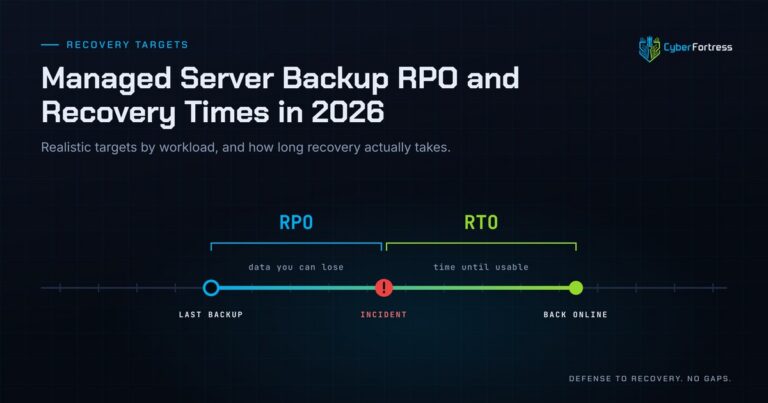
Managed Server Backup RPO and Recovery Times in 2026
For a 200-person company in 2026, a reasonable managed server backup posture is a 15-minute to 4-hour RPO…
-
Outsourcing Server Backups in 2026 Full Guide
Outsourcing server backups works when the contract covers monitoring, remediation, verified restore testing, immutable offsite storage, and assisted…
-
You Can’t Out-Patch an Attacker That Adapts in 31 Seconds
Researchers have documented what they are calling JadePuffer: a ransomware operation reportedly run end-to-end by an autonomous LLM…