61% of Companies Don’t Trust Their Backups to Actually Restore. They’re Right Not To.

Only 39% of UK businesses say they are fully confident they could recover their cloud data after a cyberattack. Backup adoption, meanwhile, is nearly universal. Almost everyone is backing something up. Fewer than four in ten believe it would actually come back.
That gap has a name now: the recovery confidence gap. It is quietly becoming the defining cyber resilience story of 2026, and it deserves more attention than it gets, because the 61% who lack confidence are not badly run organizations making an obvious mistake. Their doubt is rational. A dashboard that reports a completed backup job is answering a narrow question. It is not answering the question that matters during an actual incident: can this system come back, in the state the business needs, in the time the business has.
Why Doesn’t a Green Dashboard Mean a Working Recovery?
Backup software is built to answer one question: did the job complete. It is not built to answer the harder one: would this restore actually work, right now, for this system, at the scale an incident demands. Those are different claims, and the gap between them is where the recovery confidence number comes from.
Several specific failure modes live inside that gap, and none of them show up as red on a status dashboard:
- Coverage drift. An agent was never installed on a workload provisioned after the initial rollout, so the system has been unprotected since the day it went live, and every subsequent report has looked clean.
- Silent staleness. A job has been failing quietly for months, retrying against the same error, with the failure buried in a log nobody checks unless they go looking.
- Location risk. A backup is technically valid but stored onsite only, which means it is exposed to the same event, whether that is ransomware, fire, or hardware failure, that took down the primary system.
- Retention drift. Retention windows have aged past what the recovery runbook assumes, so the point in time the plan calls for no longer exists when someone needs it.
- The application-layer gap. Files restore. The application built on top of them does not, because dependencies, configurations, and integrations were never part of the test.
Each of these produces a technically successful backup and a practically useless recovery. That is the core of the confidence gap: coverage measures whether something was saved. Confidence requires knowing whether it can be brought back.
What Does the Right Answer Look Like?
Confidence is a number to be produced, and it has to be produced the same way every other operational metric is: by testing, measuring, and updating it when conditions change.
That means treating recovery readiness as a resilience signal, not a checkbox. Backup health, immutable coverage, drill results, and open gaps all roll into a single, continuously updated picture of how a system would actually perform under pressure, along with the specific weaknesses dragging that picture down and what closing each one is worth. The first time anyone tests a restore should never be during a live attack. It should be a routine, scheduled event that produces evidence, not an emergency improvisation that produces surprises.
One early adopter of this approach, a mid-market financial services firm, had a dashboard reporting success for months. Its first real proof-of-restore test told a different story: several critical systems could not be restored cleanly, and a full recovery would have run into days, well past the window that triggers regulatory reporting obligations. The backups existed. The recovery did not, not in any form the business could have used. That is the gap in a single anecdote, and it is why “backed up” and “recoverable” have to be treated as two separate claims that each require their own proof.
How CyberFortress Solves This
This is exactly what CyberFortress was built to fix. Backups fail. Restores fail more often, and most organizations only discover which category they are in after it is too late to matter.
The Trinity Platform’s Recovery Score consolidates hundreds of resilience signals, spanning backup health, immutable coverage, drill outcomes, and open gaps, into a single figure that moves when something real changes, along with a breakdown of what is dragging it down and what fixing it is worth. Recovery Assurance sits underneath that score as the proof mechanism: automated recovery drills that test whether systems actually come back clean, not whether a job checkbox turned green. Don’t promise recovery. Prove it.
That is paired with our Managed BaaS and DRaaS, delivering immutable, air-gapped, geo-separated retention and validated, quarterly-rehearsed failover, so the recovery a business is counting on has been tested before the day it is needed. We give the specific architectural answer.
Where Does Your Organization Stand?
Take these three questions into the next leadership meeting:
- When did you last successfully restore a critical system from backup, start to finish, and confirm the application layer worked, not just the files?
- Do you know your current Recovery Score, or is “we take backups” the extent of what leadership has been told?
- If a regulator asked how long full recovery would take right now, would the answer come from a tested drill or from an assumption in a document nobody has re-run this year?
Frequently Asked Questions
What is the recovery confidence gap? It is the difference between the percentage of businesses that back up their data (nearly universal) and the percentage that believe those backups would actually restore in a real incident (under 40% in recent UK research). The gap exists because backup completion and recovery capability are measured differently, and most organizations only measure the first one.
Why does a successful backup job not guarantee a successful recovery? Backup software confirms a job ran and data was written. It does not confirm the data is complete, clean, uncorrupted, stored somewhere accessible during an incident, or usable at the application level rather than just the file level. Each of those requires a separate test.
How often should recovery be tested? Recovery should be tested on a recurring, scheduled basis, not only after an incident forces the question. Monthly verified restore testing, as opposed to an annual tabletop exercise, is the standard that produces real confidence rather than assumed confidence.
What is a Recovery Score? A Recovery Score is a consolidated resilience metric that combines backup health, immutable coverage, drill results, and open gaps into a single number, updated as conditions change, alongside the specific issues affecting it and what resolving each one is worth.
What is the difference between “backed up” and “recoverable”? “Backed up” means data was saved and a job completed. “Recoverable” means that data can be restored clean, complete, and usable, at the application level, within the time the business needs. They are two separate claims, and only testing proves the second one.
A green dashboard has never once stopped a ransomware negotiation. Proof of a working restore has. The organizations that close this gap before an incident forces the question are the ones that get to have a short, boring postmortem. The ones that do not get a long one, usually in front of a board that assumed the backups were fine because nobody had ever told them otherwise.
A backup you have never restored is a guess. Trinity turns it into proof.
Seven questions show where your recovery plan stands today. Or skip ahead and talk to a CyberFortress recovery specialist about your environment.
More from the Fortress
-

Whose Database Is Your Data In?
FulcrumSec published roughly 8.8 million people’s data from Manchester Airports Group over the first weekend of September 2026,…
-
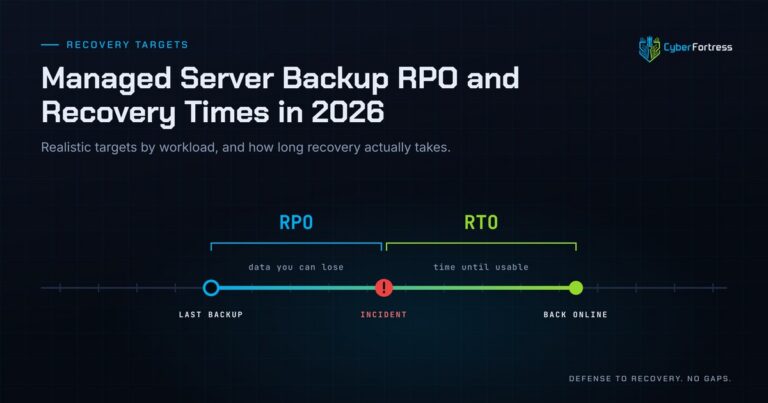
Managed Server Backup RPO and Recovery Times in 2026
For a 200-person company in 2026, a reasonable managed server backup posture is a 15-minute to 4-hour RPO…
-
Outsourcing Server Backups in 2026 Full Guide
Outsourcing server backups works when the contract covers monitoring, remediation, verified restore testing, immutable offsite storage, and assisted…
-
You Can’t Out-Patch an Attacker That Adapts in 31 Seconds
Researchers have documented what they are calling JadePuffer: a ransomware operation reportedly run end-to-end by an autonomous LLM…