DATA PROTECTION TRENDS, NEWS & BACKUP TIPS
BridgePay Took Down Four States. Your City Is on the List.
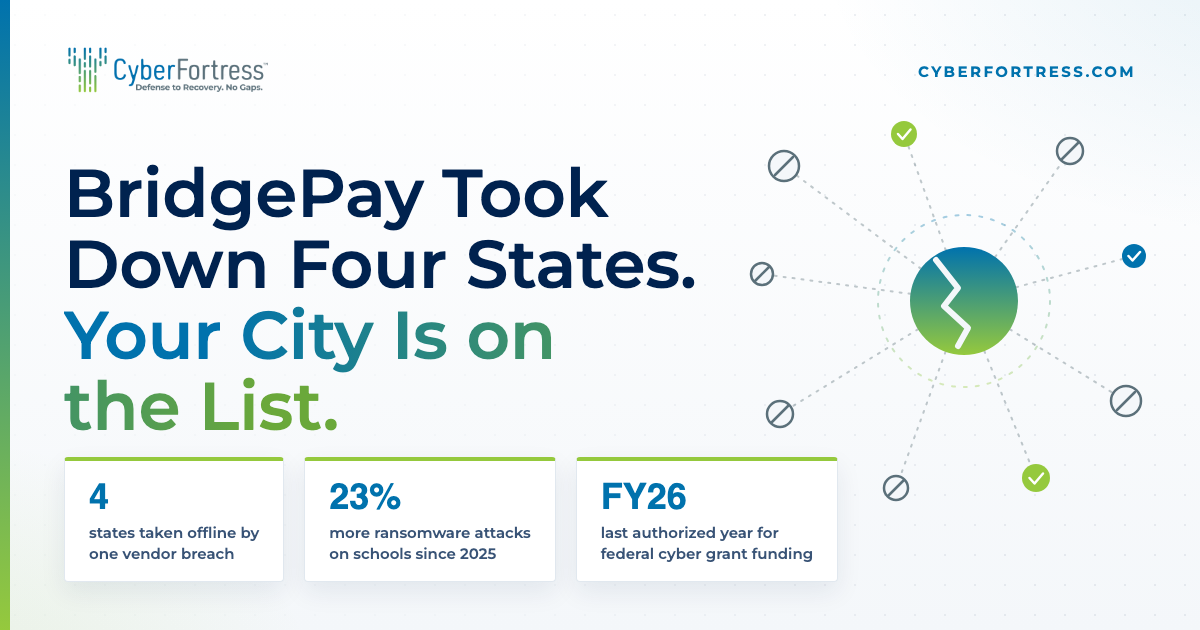
A ransomware attack on third-party payment processor BridgePay Network Solutions earlier this year took out credit-card payment systems for cities, utilities, and at least one county across four states. The municipalities themselves had not been breached. The processor had. Residents standing at the counter trying to pay their water bills did not care.
That is the operational reality of municipal IT in 2026. The vendor breach has become the city breach, the school district breach, the county breach. The chain of dependencies has grown long, and a single failure in a third-party processor can take an entire region offline.
If you run IT for a city, a county, a school district, or a utility, the BridgePay outage is the dress rehearsal for an incident your residents are going to remember.
Why Local Government Is in a Hard Spot
A few realities define the 2026 picture for municipal and county IT leaders.
The threat is intensifying. NASCIO and Deloitte’s 2026 cybersecurity study documents worsening conditions across the state and local sector. Ransomware incidents targeting schools, colleges, and universities are up 23% since January 2025. The threat actors targeting local government are the same professional operations targeting Fortune 500 companies. County IT directors are working with a fraction of the defenses.
The funding is uncertain. The State and Local Cybersecurity Grant Program is currently authorized only through fiscal year 2026. Local IT leaders are making 2027 and 2028 plans without knowing whether the federal funding stream will continue at the same level.
The vendor stack is concentrated. Payment processors, permit systems, utility billing platforms, 311 systems, court records, and tax collection software all run on a small number of vendors serving hundreds or thousands of municipalities each. One vendor breach, like BridgePay, ripples through a meaningful share of the country’s local government services in days.
The political pressure is constant. When residents cannot pay their bills, register their cars, or attend a court hearing, the calls go to elected officials, not to IT. The IT director’s incident response timeline gets compressed by political pressure the same IT director has no control over.
What BridgePay Actually Demonstrated
The BridgePay incident is the clearest recent case study in vendor-driven municipal disruption.
The processor was breached. Its systems went offline. The cities, utilities, and counties using the processor lost their ability to take credit-card payments. The municipalities themselves had done nothing wrong, had not been breached, and had no operational control over the situation. Their residents experienced an outage anyway.
For elected officials trying to explain what happened, the answer was uncomfortable. A vendor decision made years earlier had created a dependency nobody had stress-tested. The recovery plan for the city’s payment system assumed the vendor would be available. The vendor was not available, and the plan ran out.
The legal, financial, and operational reasons to use specialized processors and platforms are sound, and they will not change. What does have to change is the assumption that those vendors will always be available. The municipality’s continuity plan has to specify what happens during the window when they are not.
What a Vendor-Resilient Municipal Posture Looks Like
The architecture and operational practices closing most of this gap are well understood, even where the funding to deploy them has been intermittent.
Independent backup of vendor-held data. Municipal data living in a SaaS payment platform, permit system, or court records system needs an independent backup outside the vendor’s environment. When the vendor goes down, the municipality still has access to its records, transaction history, and operational data through a copy it controls.
Documented failover for critical services. For each critical resident-facing service, the municipality should have a documented manual or alternate-vendor process activatable within hours. Tax payment systems can fall back to mailed checks and walk-in payments. Permit systems can fall back to paper applications. Utility billing can fall back to flat-rate emergency invoicing. The fallback should be written down, rehearsed, and ready.
Vendor risk assessment as a procurement requirement. Procurement processes should include security and recovery posture questions as binding evaluation criteria, with specific answers required from vendors. Vendors that cannot describe their incident response, notification timelines, and recovery testing should not pass evaluation.
A 24/7 recovery partner. Municipal IT teams are rarely staffed for round-the-clock incident response. A managed recovery partner who can execute restores, coordinate vendor relationships, and operate during the political pressure window is the practical answer for most local governments.
How CyberFortress Solves This
This is exactly the problem the CyberFortress Trinity Platform was built for. Trinity brings detection, response, and recovery into a single operating model, so a small municipal IT department gets the operational capability of a much larger security organization without the headcount. Inside that model, managed BaaS, DRaaS, and SaaS backup deliver immutable retention in geo-separated, air-gapped vaults, with monthly restore validation and 24/7 U.S.-based recovery specialists. When a vendor goes down, Trinity is the difference between scrambling across disconnected tools and executing a single rehearsed playbook.
The alignment with public sector reality is what matters. A county IT director facing a vendor breach at 6 p.m. on a Friday needs a partner who picks up the phone, understands the political stakes, and can begin a restore before the weekend news cycle. The marketing language matters less than the answer to that question.
We pick up the phone.
Three Questions for Every Municipal IT Leader
If the BridgePay incident landed somewhere uncomfortable, take three questions into the next council briefing or operations review.
For each critical vendor that holds municipal data or processes resident transactions, what is our documented continuity plan during a multi-day vendor outage, and has the council seen it?
If our payment processor or permit vendor were breached tomorrow, what could we restore from a copy we control, and how long would it take to resume services for residents?
When the next federal SLCGP funding cycle is decided, will our current cybersecurity posture be sustainable at the funding level we receive, and what does the contingency plan look like if it is not?
Municipalities that come through the next wave of vendor breaches with their reputations intact built continuity plans assuming the vendor would fail. BridgePay just made that assumption mandatory.