DATA PROTECTION TRENDS, NEWS & BACKUP TIPS
Foxconn Just Lost 8 Terabytes. Your Supply Chain Is Next.
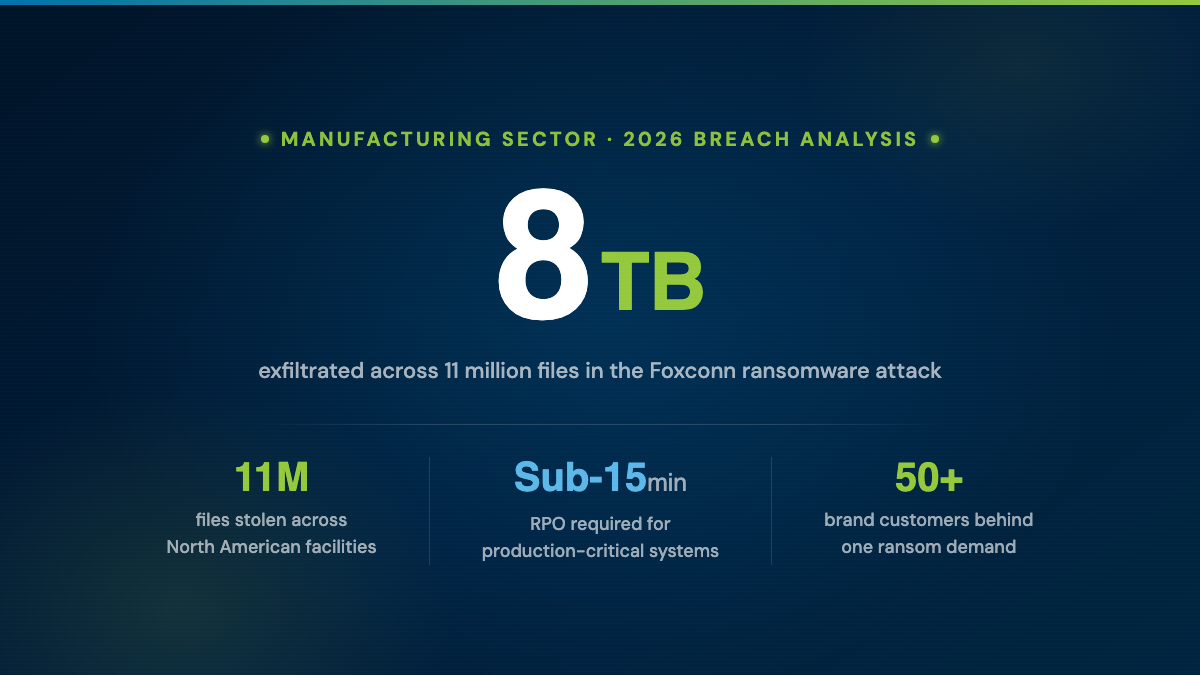
On May 12, 2026, ransomware crew Nitrogen breached Foxconn, exfiltrated 8TB across 11 million files, and disrupted production at multiple North American facilities. This ransomware attack exposed why contract manufacturers and their suppliers are now premium ransomware targets. The defenses that work are sub-15-minute recovery points, immutable air-gapped backups unreachable by stolen credentials, and rehearsed failover before an attack happens.
Key Takeaways
- Nitrogen ransomware (a Conti-2 derivative) breached Foxconn on May 12, 2026; 8TB, 11 million files, production disruptions across North America
- Customers include Apple, Nvidia, Intel, Google, and Dell — product roadmaps in those files are now unrecoverable
- One hour of unplanned production downtime at a contract manufacturer can cost six figures; ransomware recovery runs longer than hardware failures because the environment must be validated before restart
- Ransomware crews routinely escalate to backup-admin privileges before deploying the encryptor. A backup reachable from a domain admin account will be destroyed first
- The factories that came back online fastest in 2025–2026 incidents had rehearsed failover before the attack — everyone else discovered the gaps mid-recovery
- Three mandatory architecture requirements in 2026: sub-15-minute RPO, immutable air-gapped recovery copies, quarterly validated failover
On May 12, 2026, Foxconn confirmed what cybersecurity reporters had been writing for days. A ransomware crew called Nitrogen, a Conti-2 derivative, which has been active since 2023, breached the world’s largest electronics contract manufacturer, exfiltrated 8 TB across 11 million files, and disrupted production at several North American facilities.
Foxconn said the affected factories were “resuming normal production.”
That language was written by a PR team. Apple, Nvidia, Intel, Google, and Dell all run product lines through Foxconn. None of them are resuming anything normal. The product roadmaps embedded in those 11 million files are now somewhere they cannot be retrieved, and the production schedules driving billion-dollar consumer launches just slipped by an undisclosed amount.
If you operate a contract manufacturer, supply a brand-name OEM, or run a tier-two factory feeding a tier-one supplier, the Foxconn attack is the most expensive object lesson available in 2026. Disaster recovery and production continuity are one discipline now. The ones still treating them as two will pay for the difference.
The Real Cost of a Production-Floor Ransomware Event
A single hour of unplanned production downtime at a contract manufacturer can cost six figures by itself. The full bill arrives later. Customers delay their own builds. Just-in-time inventories run out. Penalty clauses fire. Sales commitments slip. The brand-name customer at the top of the chain chooses between accepting the delay and finding a second source, and the second source rarely gives the original supplier its volume back.
A ransomware event makes the math worse in two ways. Recovery runs longer than a typical hardware failure because the production environment is contaminated and has to be validated before it goes back into service. The exfiltrated data is worse than a clean encryption event because design documents, supplier contracts, and pricing data have a long resale tail in the criminal market.
Foxconn is the public version of a math problem manufacturing CIOs have been carrying privately for years. The math just got an audit trail.
Why Manufacturing Is the Target Now
A few realities explain why ransomware crews treat manufacturing as a premium hunting ground.
Downtime tolerance is low. A factory cannot pause for two weeks while IT runs a restore. Every hour costs real money, and the ransom negotiation pressure starts the moment the encryption fires.
The IT-OT boundary is porous. Modern factories run on industrial control systems sharing networks, identity, and credentials with the IT environment ransomware actors have been compromising for a decade. A breach that starts in a corporate workstation reaches the production floor faster than most security teams realize.
The supply chain multiplies the leverage. A contract manufacturer with 50 brand-name customers is 50 stacked extortion targets behind one ransom demand. Pay or do not pay, the attacker has commercial leverage somewhere in the chain.
Manufacturing has moved up the victim count, and there is no sign the trend slows down before 2027.
What a Real Recovery Posture Looks Like
The architecture that defeats a Nitrogen-class attack is well understood. It is not cheap, and it is dramatically cheaper than the alternative that played out at Foxconn and at West Pharmaceutical in the same window.
Sub-15-minute RPO for production-critical systems. Recovery points measured in 24 hours mean a day of production data is gone every time. That is no longer absorbable in environments running ERP, MES, and OT telemetry continuously.
Immutable, air-gapped recovery copies. The recovery copy of production-critical systems has to live somewhere ransomware cannot reach with stolen credentials. The Nitrogen crew, like Conti before it, routinely escalates to backup-admin privileges before deploying the encryptor. A backup reachable from a domain administrator account is a backup the attacker will reach first.
Validated failover, rehearsed every quarter. A failover plan that has never run under realistic conditions is a hypothesis. The factories that came back online quickly in 2025 and 2026 events had rehearsed the failover before the attack. Everyone else discovered the gaps mid-recovery.
24/7 recovery support with manufacturing context. Ransomware on factory floors happens overnight, on weekends, during shift changes. Recovery support has to be available at those moments, with operators who understand production realities. Internal staffing rarely makes that math work for any plant below the largest tier.
How CyberFortress Solves This
This is exactly what CyberFortress was built to fix. Managed BaaS and DRaaS deliver sub-15-minute RPO targets with immutable retention in geo-separated, air-gapped vaults, validated quarterly with rehearsed failover, and supported by 24/7 U.S.-based recovery specialists. The Trinity Platform brings that recovery capability together with managed detection and response, so the IT-OT boundary gets monitored by one team accountable for both prevention and recovery.
The customers who run plants through our recovery infrastructure share a common operating reality. The recovery copy is unreachable from the production environment. The failover has already been tested. The team running the recovery is awake when the attack hits.
That is what survives Nitrogen, and what keeps a contract manufacturer in business after the brand-name customers start asking hard questions about supplier resilience.
Three Questions for the Next Operations Review
If the Foxconn attack landed somewhere uncomfortable, take three questions into the next operations review.
- If our most critical production system were encrypted on a Saturday night, what is our actual time to a verified, clean operational restore, and what does that number cost us in supply commitments?
- Where does the recovery copy of our production data live, and would a single compromised credential in our environment reach both the production copy and the recovery copy?
- When did we last rehearse a full failover under realistic ransomware conditions, and how did the actual recovery time compare to the target?
The brand-name OEMs are already asking those questions in supplier reviews. The contract manufacturers who can answer them keep the relationships. The ones who cannot get replaced.
Frequently Asked Questions
What happened in the Foxconn ransomware attack in 2026?
On May 12, 2026, ransomware crew Nitrogen ( a Conti-2 derivative) breached Foxconn, the world’s largest electronics contract manufacturer. Attackers exfiltrated 8TB across 11 million files and disrupted production at multiple North American facilities serving customers including Apple, Nvidia, Intel, Google, and Dell.
Why are manufacturers targeted by ransomware more than other industries?
Three factors make manufacturing a premium ransomware target: downtime is extremely expensive (a single production hour can cost six figures), industrial control systems share networks with the IT environment ransomware actors already know how to compromise, and a contract manufacturer with dozens of brand-name customers gives attackers stacked leverage across the entire supply chain.
What is RPO and why does it matter for manufacturing ransomware recovery?
RPO (Recovery Point Objective) is how much data you lose between your last clean backup and the moment of an attack. A 24-hour RPO means a full day of ERP records, production schedules, and OT telemetry is unrecoverable. For manufacturers, sub-15-minute RPO is the 2026 standard because anything longer translates directly into lost production data and extended downtime.
How do ransomware crews like Nitrogen destroy backups?
Modern ransomware crews routinely escalate to backup-admin privileges before deploying the encryptor. If your backup storage is reachable from a domain administrator account — as most on-premises backup systems are — the attacker destroys the backup first, then encrypts production. Immutable, air-gapped backups stored in isolated vaults with separate credentials are the only reliable defense against this tactic.
What should a contract manufacturer do to protect against supply chain ransomware attacks?
Three architecture requirements matter most: a sub-15-minute RPO for production-critical systems, immutable air-gapped backup copies unreachable from production credentials, and quarterly rehearsed failover testing so recovery gaps are discovered before an attack rather than during one. For most manufacturers below the largest tier, a managed provider like CyberFortress is the most practical path to all three.
How is CyberFortress different from managing disaster recovery in-house for a manufacturing company?
CyberFortress provides 24/7 U.S.-based recovery specialists, immutable geo-separated backup vaults that ransomware cannot reach with stolen credentials, and quarterly validated failover. These are capabilities that most internal IT teams cannot staff or maintain continuously. The Trinity Platform also unifies backup recovery with managed detection and response, so the IT-OT boundary is monitored by a single team accountable for both prevention and recovery.
CyberFortress provides managed cyber resilience for manufacturing and industrial companies. Contact our team to assess your current recovery posture.