DATA PROTECTION TRENDS, NEWS & BACKUP TIPS
Your Backup Admin Is the New Crown Jewel. Attackers Already Know.
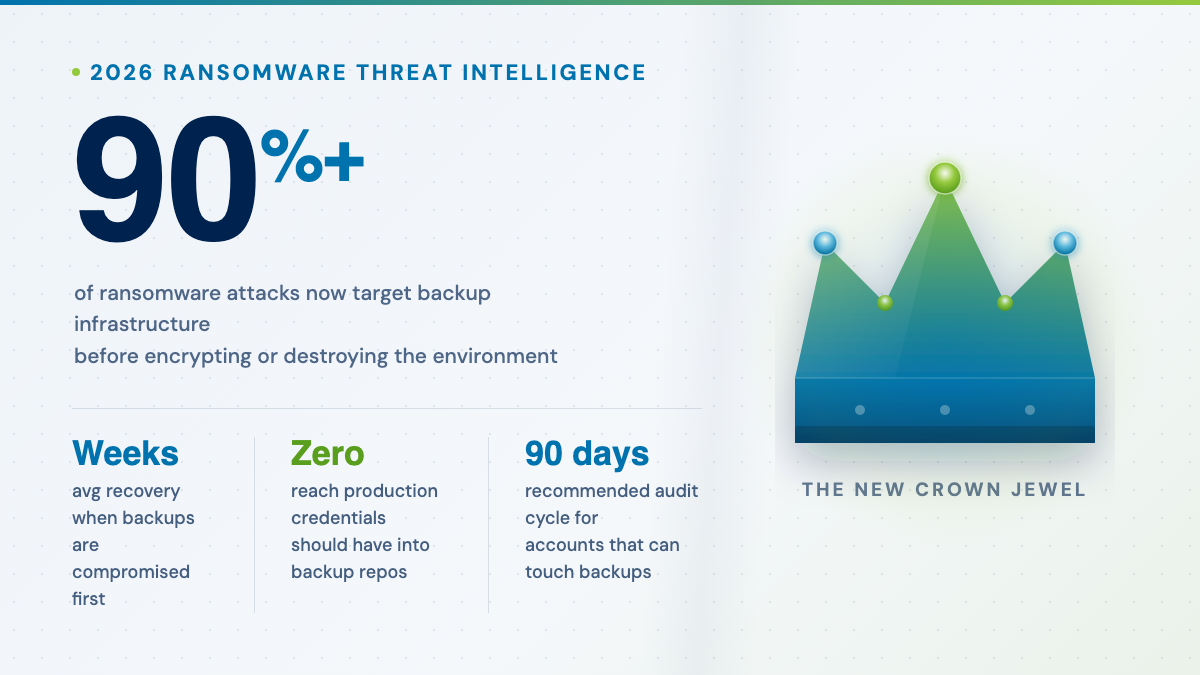
More than 90% of modern ransomware attacks target backup infrastructure before encrypting production. They are destroying the recovery copy which removes the only exit that doesn’t involve paying the ransom. The architecture that survives this requires immutable storage the production environment cannot disable, identity and network isolation for the backup console, and geo-separated air-gapped recovery copies in a separate trust domain from the rest of the business.
Key Takeaways
- 90%+ of modern ransomware attacks (Conti, LockBit, BlackCat, ALPHV, and their 2026 successors) deliberately escalate to backup-admin privileges before deploying the encryptor
- A domain admin can cause damage that backup infrastructure reverses. A backup admin can destroy the backup itself then removing the reversal option entirely
- CISA’s May 2026 cPanel zero-day reporting confirmed the pattern in real time: attackers wiped server backups before turning to production systems
- The dwell phase matters: attackers quietly corrupt snapshots, shorten retention policies, and unset immutability flags for days before the ransom note appears, so the backup chain is already compromised when the defender reaches for it
- Three architecture requirements that defeat the 2026 attack chain: immutability enforced by the storage system itself (not defeatable by production credentials), network and identity isolation for the backup repository, and geo-separated air-gapped recovery copies
- The accounts that can touch the backup are a larger category than most organizations have mapped and that gap is exactly where attackers operate
For twenty years, defenders treated their network domain controller as the crown jewel of the network: it had to be protected at all costs. If the attacker reached domain admin, the company was owned by the actor. Defense strategies focused on protecting that one privileged path.
The crown jewel has moved in today’s world: the backup admin account is now the crown jewel that needs to be protected.
More than 90% of modern ransomware attacks attempt to discover, disable, or destroy backup infrastructure before encrypting or destroying the environment. The Hacker News, Blocks & Files, N-able, SentinelOne, and QNAP have all converged on the same number. Conti, LockBit, BlackCat, ALPHV, and their 2026 successors all routinely escalate to backup-admin privileges as a deliberate phase of the engagement.
CISA’s reporting from the May 2026 cPanel zero-day campaign confirmed it in real time. DFIR teams pulled into those incidents watched attackers wipe server backups before turning their attention to production systems.
This is the default behavior of professional ransomware in 2026. If you designed your backup architecture five years ago, the attackers have already read your playbook.
How the Engagement Actually Unfolds
The modern attack chain looks meaningfully different from what most disaster recovery plans were designed to handle.
Initial access arrives through phishing, a stolen credential, or an exploited vulnerability. The first hours are quiet. The attacker establishes a foothold, harvests additional credentials, and starts moving laterally to map the environment.
Within a day or two, the attacker reaches a privileged account. Domain admin matters, and so does the backup administrator account, the storage admin account, and the cloud subscription owner. The attacker takes all of them when they are available.
The backup infrastructure becomes the next target. Operators look for backup software, locate the recovery repositories, identify retention policies, and quietly tamper with what they can reach. Recent snapshots get corrupted. Retention policies get shortened or disabled. Immutability flags get unset where the configuration allows. Some campaigns wait several days between this step and the next, to make sure the changes are baked into the backup chain.
The encryption fires only after the backup posture has been compromised. By the time the ransom note appears, the recovery plan is already in pieces. The defender’s first instinct, restore from backup, runs into a backup chain the attacker has been editing for a week.
That sequence is why recovery times in 2026 ransomware events run in weeks rather than hours.
Why the Backup Console Outranks the Domain Controller
A domain admin can do significant damage, and the damage is reversible from a good backup. A backup admin can destroy or modify the backup itself, which removes the reversal option entirely. Once the recovery copy is compromised, every other defense layer is operating without a safety net.
The same logic applies to storage administrators, hypervisor administrators with backup repository access, and any cloud account holder with subscription-level rights to immutable storage. The category of “accounts that can touch the backup” is larger than most organizations have mapped, and that gap is exactly where attackers operate.
If you have not done this exercise recently, the inventory of accounts that can read, modify, or delete the backup is the single most valuable security audit available in 2026.
What a Modern Backup Architecture Looks Like
The architectural pattern that defeats the 2026 attack chain has three components.
Immutability the production environment cannot disable. Write-once-read-many storage, once configured, has to be unreachable from the credentials available inside the production network. A backup that becomes mutable when a domain admin asks is not really immutable. The immutability flag has to be enforced by the storage system itself, governed by a separate trust domain.
Network and identity isolation. The backup repository should not share the network, the identity provider, or the administrative tooling of the production environment. A compromised domain credential in production should get the attacker zero reach into the backup repository. That property converts the backup console from a single point of failure into a genuine independent recovery layer.
Geo-separation and air-gapping. Physical separation and logical air-gapping add resilience against both ransomware and natural disasters. Geographic separation also matters because some 2026 attacks have begun targeting specific cloud regions, and a backup that lives in the same region as production inherits the same region-level risk.
Each property is incomplete on its own, and together they form the baseline expectation for any business holding meaningful data in 2026. Anything less leaves the backup console exposed.
How CyberFortress Solves This
This is exactly what CyberFortress was built to fix. Managed BaaS and DRaaS deliver immutable retention in geo-separated, air-gapped vaults, governed by a separate trust domain from the customer’s production environment. Administrative access to the backup repository is isolated from production credentials. The Trinity Platform brings detection and response into the same operating model, so anomalous activity around the backup console raises an alert before it produces a compromised recovery.
The trust boundary is the whole point. A managed backup service that uses the customer’s identity provider for backup administration carries the same risk as an internal deployment. A managed backup service with isolated identity, network, and administrative tooling carries a fundamentally different risk profile. Customers should be able to ask the question and get a specific architectural answer rather than a marketing one.
We give the specific architectural answer.
Three Questions for the Next Backup Architecture Review
If your backup design predates the 2026 attack patterns, take three questions into the next architecture review.
Which accounts in our environment can read, modify, or delete the recovery copy of our critical systems, and have we audited that list in the last 90 days?
If a domain administrator credential were stolen tomorrow, could the attacker use it to disable immutability, shorten retention, or corrupt recent snapshots in the backup repository?
When did we last test a full restore under the assumption that the backup chain had been tampered with during the dwell phase, and what did the actual recovery time look like?
The defenders who keep recovery options open through the next wave of ransomware will be the ones who treated the backup console as a primary target before the attackers did. Most defenders still treat it as a secondary system. Closing that gap is the work of the next quarter, and it is the difference between a Monday morning that resumes operations and a Monday morning that does not.
Frequently Asked Questions
Why do ransomware attackers target backup systems before encrypting production data?
Destroying or corrupting the backup removes the victim’s primary exit from the attack, that is a clean restore. Making payment the only remaining option. More than 90% of modern ransomware engagements include a deliberate phase of escalating to backup-admin privileges and tampering with recovery copies before the encryption fires. By the time the ransom note appears, the backup chain has often already been compromised for days.
What is the difference between a backup admin account and a domain admin account in terms of ransomware risk?
A domain admin can do significant damage, but that damage is reversible from a good backup. A backup admin can destroy or modify the backup itself, which removes the reversal option entirely. This is why the backup admin account is now the higher-value target and why backup admin credentials need to be isolated from the production identity environment.
What does “immutable backup” actually mean, and can ransomware defeat it?
Immutable backup means the stored data cannot be altered or deleted for a defined retention period. Whether ransomware can defeat it depends entirely on where the immutability is enforced: if it is a policy setting that a domain admin can change, ransomware that escalates to domain admin can disable it. True immutability is enforced by the storage system itself, in a separate trust domain from the production environment, where no production credential has administrative rights.
What is an air-gapped backup, and why does it matter for ransomware recovery?
An air-gapped backup is a recovery copy that is logically or physically isolated from the production network. This means ransomware that spreads across the production environment cannot reach it. Combined with geo-separation (storing the copy in a different physical location or cloud region), air-gapping ensures that a ransomware event affecting production cannot simultaneously destroy the recovery option.
How do I know if my current backup architecture is vulnerable to the 2026 attack chain?
Start with one question: can a compromised domain administrator credential in your production environment reach, modify, or delete your backup repository? If the answer is yes or if you are not certain then it’s possible your backup architecture shares its trust boundary with production. Making it vulnerable to the standard escalation pattern used by Conti, LockBit, BlackCat, and their successors. An audit of which accounts can touch the backup, conducted in the last 90 days, is the fastest way to map the actual exposure.
How does CyberFortress protect backup infrastructure from ransomware attackers?
CyberFortress stores recovery copies in immutable, air-gapped, geo-separated vaults governed by a separate trust domain from the customer’s production environment. This means compromised production credentials give an attacker zero reach into the backup repository. The Trinity Platform pairs that recovery architecture with 24/7 Managed Detection and Response, so anomalous activity around the backup console raises an alert during the dwell phase, before the backup chain is compromised. Customers can ask for the specific architectural answer on identity isolation and trust boundaries, not just a marketing assurance.
CyberFortress provides managed cyber resilience for businesses that cannot afford to lose their recovery options. Contact our team to audit your current backup trust boundary.