DATA PROTECTION TRENDS, NEWS & BACKUP TIPS
When the EHR Goes Dark: Healthcare Recovery as a Patient Safety Decision
The first thing that happens in a clinic when the electronic health record goes down is the front desk gets quiet. Then a nurse asks where the patient’s allergy list is. Then a clinician decides whether to delay an infusion. Then someone at the back of the line wonders why their appointment hasn’t been confirmed.
By the time a healthcare ransomware incident is two hours old, dozens of small decisions have been made by people working without the data they need. By the time it is two weeks old, those decisions have stacked up into something much harder to measure than a regulatory fine.
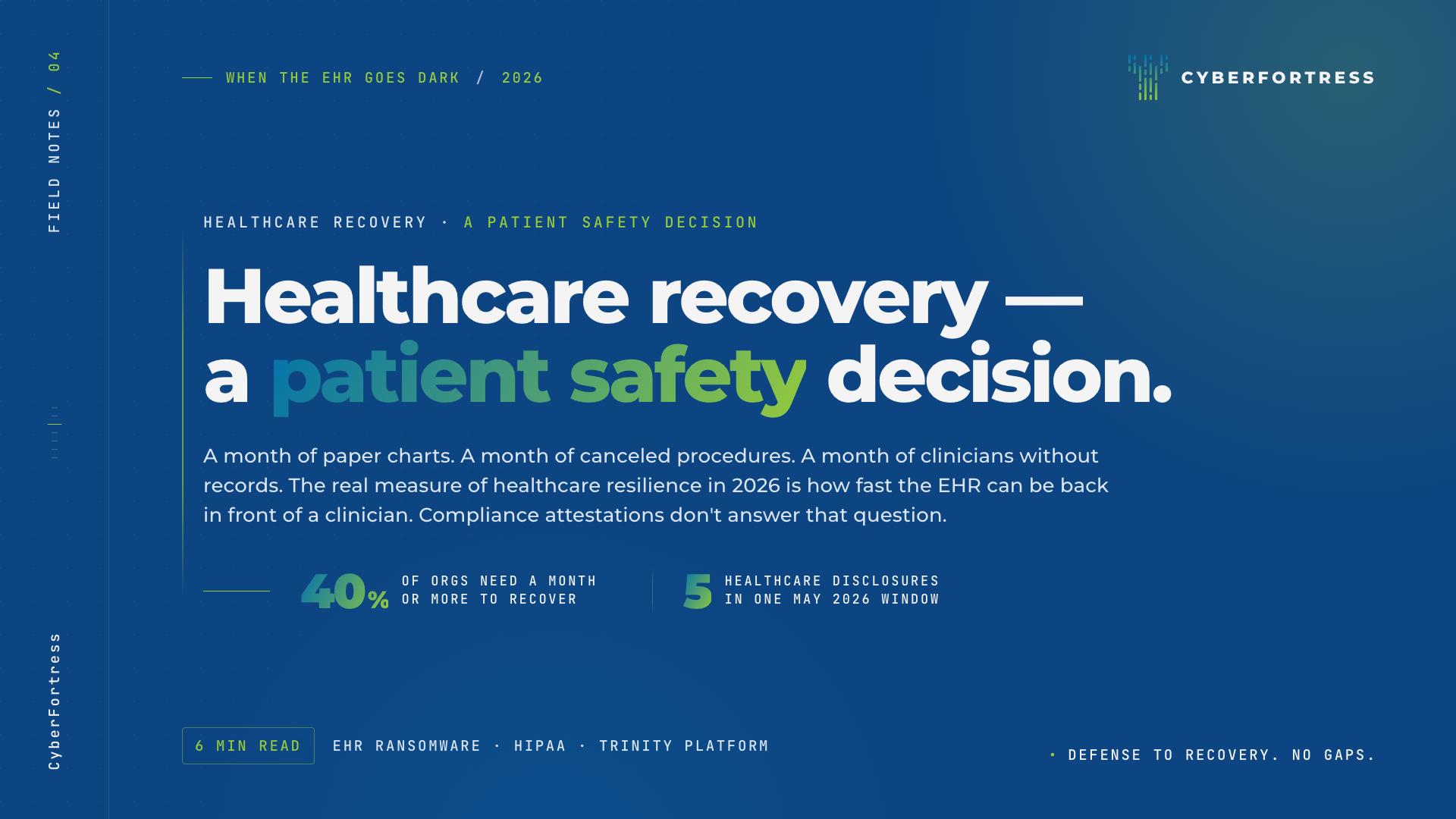
May 2026 has been the kind of month that brings this into focus. RXNT, an EHR software vendor, disclosed a breach affecting patient data across multiple provider clients between March 1 and 3. Western Orthopaedics, Community Health Systems CA, Tri-Cities Gastroenterology, and Integrated Pain Associates all announced incidents in the same window. The patterns differ in detail, but the operating impact looks similar: clinicians without records, schedules thrown into manual mode, families calling to confirm appointments nobody can verify.
The Compliance Frame Is Doing Less Work Than It Used To
Healthcare conversations about backup and recovery have lived inside a HIPAA frame for so long that the frame has started to obscure what is actually at stake. Compliance is part of why healthcare organizations back up records, but it is the smaller part. The larger part is that records are how patients receive correct, timely care.
That distinction matters because compliance frames produce compliance behaviors. Quarterly attestations get filed. Backup retention policies get documented. Audits get passed. None of those activities answers the only question that counts in the moment of a real ransomware incident, which is whether the records can be back in front of a clinician fast enough to keep patients safe.
Industry reporting from earlier this year found that roughly 40% of organizations take a month or more to recover from a healthcare ransomware incident. A month of paper charts. A month of canceled procedures. A month of clinicians doing their jobs with the wrong information or no information at all. That number is the actual measure of resilience for a healthcare IT organization in 2026, and most regulatory frameworks have not caught up to it.
How Modern Attackers Treat Healthcare Backup
The attacker techniques relevant to healthcare in 2026 have one thing in common. They treat the backup repository as a primary target rather than a backstop.
Operators dwell in environments long enough to identify backup software, locate the recovery points, and tamper with them before deploying ransomware. Snapshots get deleted using stolen credentials before the encryption phase begins. Recent restore points get quietly corrupted, so the restore fails when the IT team finally tries to run it. By the time the incident response team arrives, the recovery plan is in pieces.
For a healthcare organization, the practical implication is uncomfortable. A backup repository sharing the same network, identity provider, and administrative accounts as the EHR is something an attacker with one stolen credential can erase on the way to the ransom note. Calling it a recovery plan is generous.
What Patient-Safe Recovery Looks Like
The architecture that survives a 2026 ransomware incident in a healthcare environment has three components, each of which eventually translates into something a patient feels.
Air-gapped immutable backups. Patient records have to live somewhere ransomware cannot reach with stolen credentials. Immutable, write-once-read-many storage in a geo-separated, identity-isolated vault is now baseline architecture for any organization with HIPAA-protected data. What matters here is the property it enables: an attacker who compromises the production environment cannot also compromise the recovery copy. That property is the difference between a multi-week outage and a same-day restore.
Monthly restore testing against ransomware scenarios. Healthcare recovery plans have historically been tested against hardware failures and natural disasters, scenarios that don’t capture how an adversary actually behaves. A monthly drill that simulates a ransomware incident, with corrupted recent snapshots and the production environment treated as untrusted, is the only way to find out whether the recovery plan works under conditions that resemble what is actually happening across the industry right now.
A 24/7 escalation path with clinical-aware support on the other end. Healthcare ransomware tends to fire on weekends, holidays, and overnight, when on-site IT staff is at its thinnest. The recovery clock starts when the incident is declared, regardless of the time on the wall. Recovery support that is awake on a Saturday night, understands the operational urgency of an EHR outage, and has authority to act is the difference between a four-hour restore and a four-week one.
How CyberFortress Approaches Healthcare Recovery
CyberFortress was built around recoverability in environments where downtime translates directly into operational and patient impact. Managed BaaS and DRaaS come with HIPAA-aligned controls, immutable retention in air-gapped vaults, monthly restore validation as part of the service, and 24/7 U.S.-based recovery specialists on call. The Trinity Platform brings that recovery capability together with managed detection and response, so protect, detect, and recover are owned by a single team accountable for the outcome.
Healthcare organizations that survived ransomware incidents in 2025 and 2026 share a common pattern: the recovery copy was unreachable from the production environment, the restore had been rehearsed, and the team running it was awake when the incident happened.
Three Questions Worth Asking
If you run IT or security for a healthcare organization, three questions are worth taking into your next leadership conversation.
If our EHR went offline tonight and our most recent backups had been tampered with, what could we restore that the attacker could not reach, and have we drilled that path in the last 30 days?
How many hours could our clinicians operate safely without record access, and how does that number compare to our actual recovery time in a tested ransomware scenario?
When the attack happens at 2 a.m. on a holiday weekend, who picks up the phone, and what authority do they have to start the restore?
Compliance frameworks will keep setting the regulatory floor for healthcare data protection. The work that decides whether a patient receives the right medication on the day of an attack is recovery, built as a discipline well before the EHR ever goes dark.