DATA PROTECTION TRENDS, NEWS & BACKUP TIPS
Three Seconds of Audio. One $25 Million Wire Transfer.
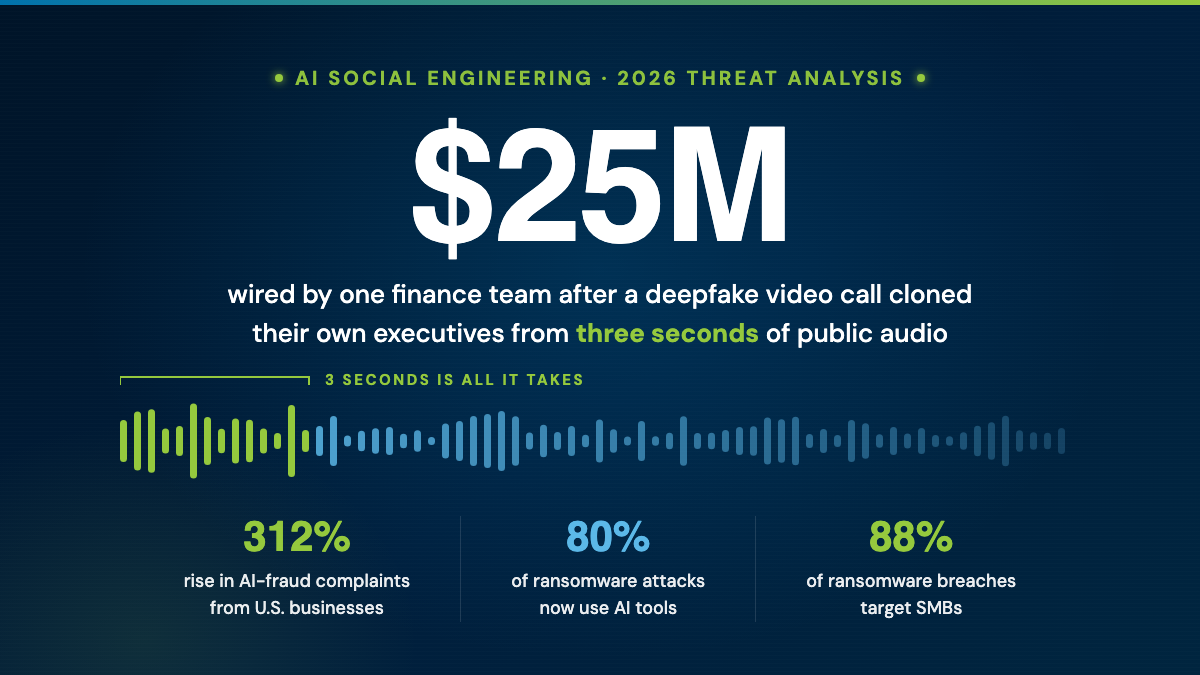
That is the math of AI-augmented social engineering in 2026. A modern voice-clone model needs three to ten seconds of clean audio to produce a convincing impersonation of any specific person. A LinkedIn intro video, a conference keynote, a voicemail greeting. The training set is everywhere. The production cost has collapsed to a few dollars per impersonation. And earlier this year, that math produced a single multinational finance team approving a multi-million-dollar transfer to an outside actor, after being deceived by a deepfake video call they believed to be their own senior executives: people this team had worked with for years
The defensive playbook most organizations built in 2018 was designed for email-based phishing and known malicious attachments, which is still important. However, it’s not enough today.
The FBI’s Internet Crime Complaint Center reported a 312% rise in AI-fraud complaints from U.S. businesses between 2024 and 2026. The Hacker News reports 80% of ransomware attacks use AI tools at some phase. Microsoft’s SMB research adds the kicker: 88% of ransomware breaches now target small and mid-sized businesses, and social-engineering phone calls have overtaken malicious attachments as the most common initial entry point.
If you are still running 2018 defenses against 2026 attacks, the data is not on your side.
The New AI-Augmented Kill Chain
Modern AI-augmented attacks tend to follow a recognizable pattern combining several technologies.
Reconnaissance is faster and more thorough. Large language models scrape, summarize, and correlate public information about a target organization, its executives, and its vendor relationships in minutes. The attacker arrives at the call with current context, accurate names, and plausible reasons for the contact.
Identity impersonation is convincing. Voice clones generated from public audio pass casual phone conversations. Deepfake video passes short live video calls, particularly when the caller has a plausible explanation for poor lighting or a quick call. The technical bar to detect either by ear or by eye is now more difficult than most untrained employees can clear in real time.
The pretext is well-crafted. AI-assisted message generation produces emails, texts, and call scripts that match the target’s communication style. The grammatical and tonal cues that used to flag a phishing attempt are largely gone.
The pressure is calibrated. The attacker uses AI-summarized context to apply pressure that feels organizationally plausible. A finance team member who would have hesitated at a generic urgent request often does not hesitate when the caller knows the name of the deal, the name of the counterparty, and the approximate transfer amount that would be reasonable.
The result is a 2026 social engineering attack that succeeds against employees who have been trained on every previous version of the threat.
Traditional Controls Are No Longer Enough
Multi-factor authentication, email filtering, and security awareness training still matter. Each closes a specific class of attack that would otherwise succeed. None of them on its own is adequate for the AI-augmented threat.
MFA closes credential reuse but does nothing about a finance team member initiating a wire transfer they believe to be authorized. Email filtering catches malicious attachments but does nothing about a phone call. Security awareness training raises the floor on what employees notice, and AI-generated pretexts have grown plausible enough to slip past the trained ones too.
The completion of the defensive posture in 2026 has three additions most organizations have not yet operationalized.
Addition #1: Process Controls That Account for Impersonation
The most important defensive change is procedural. High-stakes actions, including wire transfers, vendor payment changes, credential resets, and access grants, need approval workflows that do not depend on identity recognition over a phone call or a video call.
A wire transfer above a defined threshold should require an out-of-band confirmation through a separate channel, with the approving party reaching out using a known phone number from the directory rather than the number the caller provided. A vendor payment account change should trigger a verification call to a documented contact at the vendor, rather than to any number provided in the request. A credential reset for a senior employee should require physical or hardware-token verification, rather than a manager’s verbal approval.
These controls are not new, and they have been historically optional. In 2026 they are mandatory baseline for any business that wants to survive an AI-augmented social engineering attempt.
Addition #2: Detection at the Identity and Behavior Layer
Managed detection and response in 2026 must include behavioral monitoring at the identity layer.
Unusual login locations, sudden privilege escalation, anomalous data access patterns, and out-of-hours administrative actions all need monitoring that ties back to a human analyst team. The signal that an AI-augmented social engineering attack succeeded often shows up first in the behavioral telemetry rather than in any single piece of malicious content. The team watching the telemetry needs to act in minutes when the signal appears.
For most businesses below enterprise scale, the in-house staffing math does not work. A 24/7 monitoring capability with experienced analysts is the only practical answer, delivered through a managed partner with current threat intelligence.
Addition #3: Recovery Readiness for Successful Social Engineering
The third addition assumes some attacks will succeed. A finance team that approves a fraudulent wire after a deepfake call needs a fast response capability that limits the damage. An IT team that issues a credential reset to an impersonator needs a path to revoke the access before the attacker uses it. An executive whose video likeness has been cloned needs a disclosure protocol that protects the organization’s standing with regulators and customers.
Recovery readiness for AI-augmented attacks looks similar to recovery readiness for ransomware: documented procedures, rehearsed responses, immutable records that support investigation, and a partner on call when the incident is fresh.
CyberFortress Solves These Problems for You
This is exactly what the CyberFortress Trinity Platform was built to handle, end to end. Trinity runs prevention, detection, and recovery as one tightly integrated system operated by one accountable team, which is the specific architecture the 2026 threat demands.
Prevention starts with what an impersonator can reach after a successful pretext. Air-gapped, immutable vaults and identity-isolated architecture keep backup data and administrative credentials in a separate trust domain, so a cloned voice that talks its way into one credential reset never gets a path to the recovery infrastructure. Detection is managed detection and response with behavioral monitoring at the identity layer, watched by U.S.-based analysts on call 24/7. Recovery is Managed BaaS and DRaaS, including immutable retention that supports forensic investigation after a social engineering incident.
The integration is the point. The alert raised by an unusual login at 3 a.m. on a Saturday gets handled by the same group that can isolate the account and begin a recovery action in the same hour, with no ticket handed to a second vendor and no waiting for a third.
AI-augmented attacks compress the window between initial compromise and material damage to hours instead of days. Defenders who handle prevention, detection, and recovery as separate functions rarely move fast enough through the handoffs. A single accountable team moves faster.
We are that team.
Three Questions for the Next Executive Review
If the AI-augmented threat has not surfaced as a board-level conversation yet, bring three questions in.
For each high-stakes financial or access action, what is our out-of-band verification process, and would it survive a deepfake video call from a known executive?
If a finance team member approved a fraudulent wire today, how quickly would our detection systems and our partners be able to limit the damage?
What is our communications and recovery plan for the disclosure that an AI-impersonation attack succeeded against our organization, and have we rehearsed it?
The defenders who weather the next wave of AI-augmented social engineering treat the technology as a threat profile and build process and detection capability before the incident, rather than after. The ones who wait until after end up explaining a fraudulent wire to a board that was hoping never to have this conversation.