DATA PROTECTION TRENDS, NEWS & BACKUP TIPS
Beyond PCI: What ShinyHunters’ April Spree Says About Retail Resilience
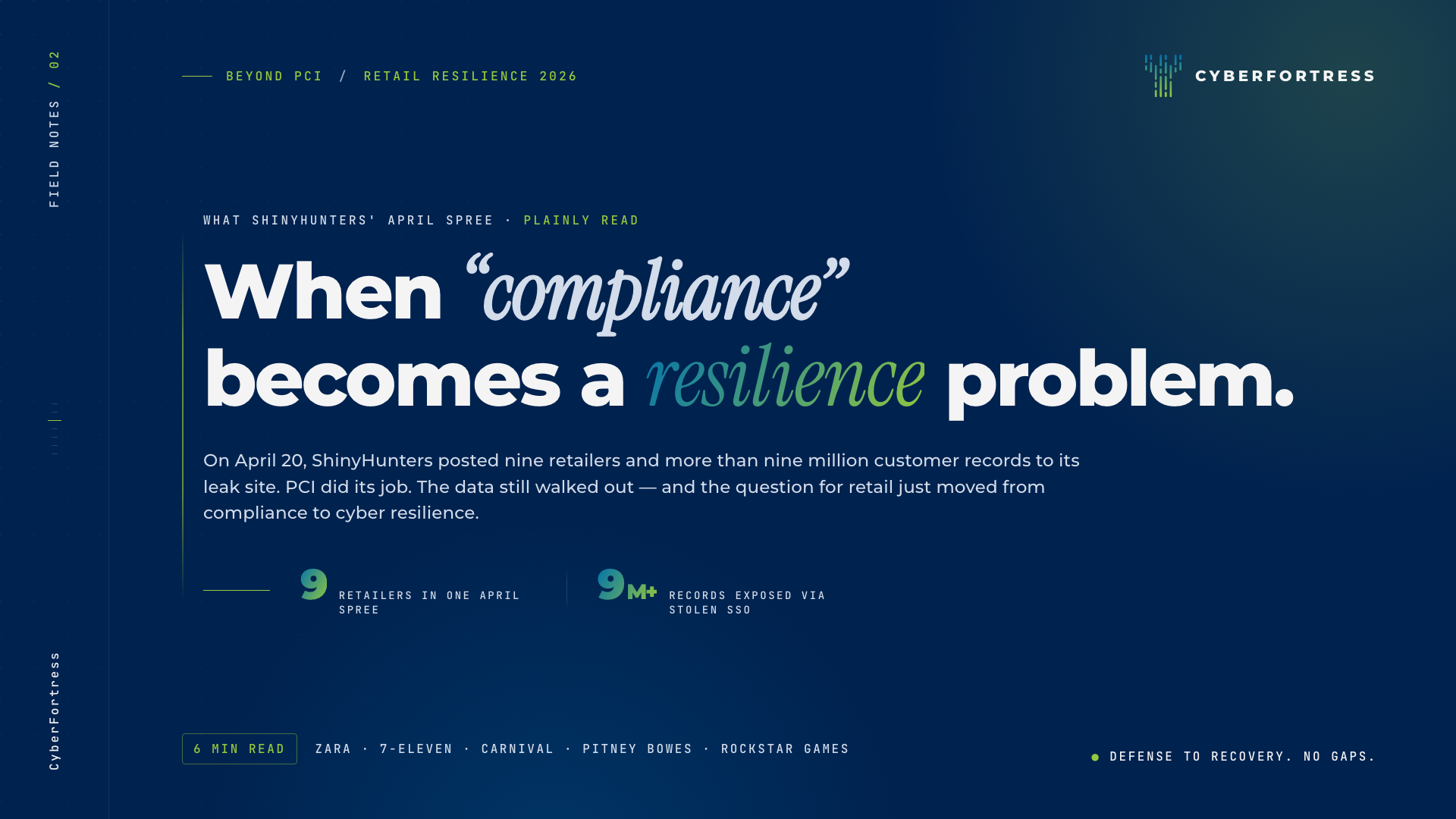
When the cyber extortion group ShinyHunters posted nine major brands to its leak site on April 20, the lineup read like a tour of modern consumer life. Zara, 7-Eleven, Pitney Bowes, Carnival, Rockstar Games. More than nine million records in play. Ransom demanded by the next morning.
By now the playbook is familiar. A phone call to a help desk. A convincing voice impersonating IT. An employee handing over single sign-on credentials. A pivot into Salesforce, Snowflake, or BigQuery. Then quiet, methodical exfiltration.
The attack required no encryption and no ransom note on a domain controller. The leverage was the data itself, sitting on a leak site with a deadline ticking next to it.
For anyone running security or operations at a retailer, that detail matters. It changes the question we should be asking.
The Perimeter Moved Faster Than the Defenses
For two decades, retail security has been organized around the cardholder data environment. PCI DSS gave the industry a vocabulary, a checklist, and a framework for protecting payment information at the point of sale. Tokenization, segmentation, and firewalls did real work. They still do.
But the data ShinyHunters wants today rarely lives inside that perimeter. Customer profiles live in CRM. Loyalty data lives in cloud warehouses. Marketing analytics, support histories, address books, transaction summaries. They sit in dozens of SaaS platforms reached through a federated identity layer that an attacker can compromise with a phone call.
That is the uncomfortable truth at the center of this incident. PCI controls performed as designed, and the data still walked out. The breach happened somewhere compliance wasn’t looking, inside systems the standard was never written to cover.
Even a well-run audit measures conformance to a standard, not resilience. Those are separate questions, and most retailers haven’t fully answered the second one.
Why Data Extortion Hits Differently
The shift from ransomware to pure data extortion deserves more attention than it gets. Encryption attacks were brutal, but they were visible. Systems went down. Operations halted. Incident response teams knew within minutes that something had gone wrong.
Data theft is quieter. By the time a brand sees its name on a leak site, the exfiltration is finished, the timeline belongs to the attacker, and the conversation has already moved to a public stage. Customers often learn about the breach from headlines, regulators learn about it from customers, and the first hour of response plays out in front of an audience.
Recovery in this environment has more to do with restoring customer trust than restoring transactions, and the clock belongs to whoever publishes first.
Reframing the Problem as Cyber Resilience
The conversation in retail security needs a new center of gravity, and it’s already taking shape in CISO communities and boardrooms. The center is cyber resilience.
Resilience accepts that breaches will occur. It plans for the moment after the alert. It treats the ability to protect, detect, and recover as the real measure of a security program, rather than the ability to keep every attacker outside every door.
The three pillars sound simple. In practice they ask hard questions of any retail organization.
Protect means the data that matters most has to live somewhere an attacker cannot reach with stolen credentials. Air-gapped storage, immutable backups, and identity-isolated vaults have become baseline expectations for any business holding millions of customer records.
Detect means watching the SaaS and identity layers with the same seriousness once reserved for the data center. Suspicious logins, new device enrollments, unusual API calls, and lateral movement across federated apps all need monitoring that ties back to a human team capable of acting in minutes.
Recover means knowing, before the incident, that backups are clean, restorable, and tested. Plenty of organizations discover the gap in their recovery plan during the recovery itself, when there is no time left to add rigor to a process that only matters under pressure.
Where the Trinity Platform Fits
This is the gap CyberFortress built the Trinity Platform to close. Trinity brings protect, detect, and recover into one operational view rather than three disconnected tools.
On the protect side, Veeam-powered backups land in immutable, geo-separated storage with policy-driven retention that survives credential compromise. On the detect side, integrated 24/7 managed detection and response watches endpoints, servers, and cloud workloads for the behavioral signals that precede a Salesforce or Snowflake breach. On the recover side, validated restore testing and orchestrated failover give teams a rehearsed path back to clean data, measured in minutes.
What matters here is the posture as much as the toolset. Cyber resilience as a unified discipline, owned end to end, instead of a hand-off between vendors who don’t share context.
A Practical Starting Point for Retail Leaders
For retail executives reading the ShinyHunters coverage and wondering where to begin, three questions are worth sitting with this quarter.
Where does our most sensitive customer data actually live, and who has the keys to it? In most retailers, the honest answer involves more SaaS platforms than the security team has fully mapped.
If our identity provider were compromised tomorrow, what could we restore from a backup the attacker cannot reach? The answer should be specific, tested, and documented.
How quickly could we tell customers, regulators, and partners what happened, and would that answer hold up under scrutiny? Resilience includes the communications layer, alongside the technical one.
These are the questions a board will ask the morning after a leak site goes live with your brand on it, and they deserve answers well before that morning arrives.
Compliance Is the Floor, Not the Ceiling
PCI, CCPA, and GDPR will continue to define the regulatory floor for retail data protection. That floor is necessary, but it has never been sufficient on its own, because regulations always lag the threat models that produced them.
The retailers who weather the next ShinyHunters-style campaign will be the ones who treated compliance as a starting line rather than a finish line, and who built data resilience into the way they think about data, identity, and recovery.
The work is concrete and the playbook is well understood. The right time to begin is before the email from the leak site arrives.