What Is MDR (Managed Detection and Response)?
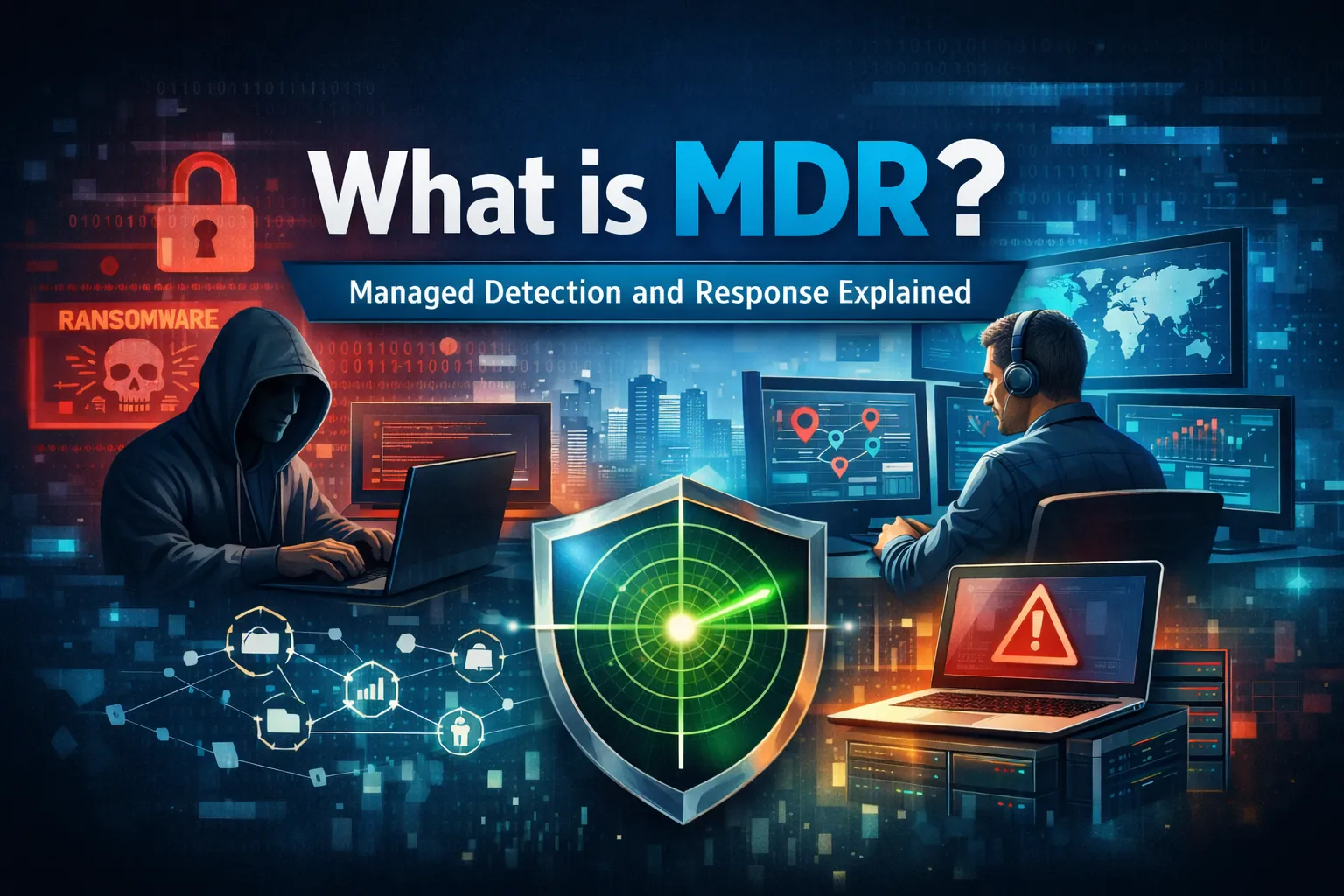
Managed Detection and Response (MDR) is a cybersecurity service that combines threat-detection technology with human security analysts who monitor, investigate, and respond to threats on an organization’s behalf, 24 hours a day. It differs from a traditional MSSP or SIEM because the provider does not just alert you, it investigates the alert and takes or directs containment action.
Key Takeaways
- MDR pairs security monitoring technology with skilled analysts who act as an extension of your team, providing around-the-clock coverage without building an in-house security operations center.
- The defining feature is response. When a threat is confirmed the provider contains it by isolating an infected machine, cutting off a malicious process, or blocking attacker access, rather than forwarding an alert and waiting.
- Prevention alone is insufficient because no defense is fully reliable, and modern ransomware groups combine data theft, extortion, and rapid lateral movement that can disrupt operations before an internal team responds.
- MDR solves two structural problems for stretched IT teams: the cybersecurity skills shortage that makes a 24/7 in-house SOC unrealistic, and alert overload, where genuine threats hide among thousands of daily alerts and log entries.
- A quality MDR service has four components: 24/7 continuous monitoring across logs, network traffic, endpoints, and cloud; threat detection and analysis including proactive threat hunting; incident response and containment; and ongoing security guidance that hardens the environment over time.
- CyberFortress MDR pairs detection and response with the company’s data backup and recovery expertise, so a confirmed incident flows from containment into coordinated restoration rather than a handoff to a separate vendor.
Detection Is Only Half the Service
In today’s cybersecurity landscape, threats are evolving rapidly and becoming more sophisticated. Organizations of all sizes are asking: What is MDR and do we need it? Managed Detection and Response (MDR) is an increasingly popular approach to help businesses stay ahead of cyberattacks.
In this article, we’ll explain MDR in accessible terms, explore why it’s important in today’s threat environment, outline its key components (like threat detection, incident response, and continuous monitoring), and clarify how MDR differs from traditional security solutions like MSSPs or SIEM tools. Finally, we’ll highlight how CyberFortress provides MDR and the value it brings to your organization.
Understanding Managed Detection and Response (MDR)
Managed Detection and Response (MDR) is a cybersecurity service that combines advanced threat-detection technology with human expertise to monitor, detect, and respond to cyber threats on an organization’s behalf. In essence, an MDR provider acts as an extension of your security team, watching over your IT environment 24/7 and stepping in to investigate and contain threats as they arise. This service provides both the tools (such as security monitoring platforms) and the skilled security analysts needed to analyze alerts and take action. By having external experts remotely watching for intrusions and responding in real time, companies can get around-the-clock protection without having to build a full in-house security operations center.
MDR combines technology with an expert team that monitors, investigates, and responds on your behalf. This means you are onboarding a team of security professionals equipped with threat intelligence and response playbooks to keep your systems safe. MDR services help organizations monitor, detect, analyze, and respond to cyber threats that slip past preventive defenses. In other words, MDR gives you a dedicated partner to not only warn you when something is wrong, but also to help fix the problem immediately. This approach to threat management makes MDR a valuable subset of managed security services, focused on active detection and rapid response.
Why MDR Is Important in Today’s Cybersecurity Landscape
Modern cyber threats like ransomware and targeted attacks move incredibly fast and can catch traditional defenses off guard. For example, ransomware groups have become highly professionalized. Many ransomware attacks now involve data theft, extortion demands, and rapid lateral movement through a network that disrupts operations before the victim’s team can respond.
In this environment, early detection and quick containment are absolutely critical to minimize damage. Prevention alone (firewalls, antivirus, etc.) is no longer enough; no defense is 100% foolproof, so organizations must be ready to spot and stop intrusions in progress. The speed at which you can detect suspicious activity and respond has a direct impact on the business outcome of an incident. MDR services are built to provide that speed, with experts and monitoring systems that can catch threats in minutes rather than months, limiting the window of opportunity for attackers.
Another reason MDR has become essential is the challenge of staffing and alert overload. Many IT teams today are stretched thin, facing a well-documented cybersecurity skills shortage. Maintaining a 24×7 in-house security operations center (SOC) with skilled analysts is unrealistic for most organizations, both in terms of cost and available talent. At the same time, even with security tools in place, companies often get overwhelmed by thousands of alerts and log data each day. It’s easy to miss real threats amidst this noise.
MDR directly addresses this by providing dedicated expert personnel working around the clock to watch your environment, and it leverages advanced analytics and automation to filter out false alarms and focus on real threats. In short, MDR fills the gap for organizations that lack a 24/7 security team by supplying continuous monitoring and rapid incident response capabilities as a managed service. This allows businesses to drastically improve their threat detection and response maturity without having to hire a large security staff or burden existing teams with impossible around-the-clock duties.
Key Components of an MDR Service
A quality MDR service typically encompasses several core components that work together to keep your organization safe. Key elements include:
- 24/7 Continuous Monitoring: The MDR team provides around-the-clock surveillance of your systems and networks, so threats can be spotted at any time, even on weekends or at 3 AM. Security experts monitor logs, network traffic, endpoints, and cloud environments in real time, ensuring that nothing unusual goes unnoticed. This continuous monitoring is critical to detect attacks as early as possible.
- Threat Detection and Analysis: MDR providers use advanced security tools (such as endpoint detection and response (EDR) software, intrusion detection systems, and threat intelligence feeds) to identify suspicious activities or anomalies. More importantly, skilled analysts investigate alerts to determine if they are genuine threats or benign events. Instead of burdening your IT team with countless alerts, the MDR analysts triage and analyze incidents to separate the signal from the noise. They employ techniques like behavioral analysis and correlation across multiple data sources to catch stealthy attackers. Many MDR services also perform proactive threat hunting, actively looking for hidden signs of attackers in your environment, rather than waiting for automated alerts to trigger.
- Incident Response and Containment: When a real threat is confirmed, the MDR service takes or guides action. This is a defining feature of MDR. The provider’s incident response team will work to contain the threat (for example, isolating an infected machine, cutting off a malicious process, or blocking attacker access) and help remediate the incident. They will notify your team with clear, prioritized instructions on what to do next, such as forcing a password reset or applying a specific security patch. In essence, MDR means you have expert responders on-call to mitigate damage in real time, limiting the impact of an attack. They often provide detailed remediation recommendations and even assist in the recovery process after an incident.
- Security Guidance and Improvement: Beyond just watching and reacting, a good MDR service will continuously help improve your security posture. Providers deliver reports and insights about the threats they encountered and how to strengthen defenses going forward. For example, they might highlight recurring vulnerabilities or misconfigurations and recommend fixes. This guidance helps your organization learn from incidents and harden systems over time. MDR essentially creates a feedback loop for ongoing improvement, so your security gets better every month rather than remaining static. Some MDR providers include threat intelligence updates and regular reviews to adjust monitoring to your specific environment, ensuring the protection adapts as your IT environment changes.
All these components, continuous monitoring, threat detection (with hunting and analysis), incident response, and ongoing security improvement, work in tandem as part of an MDR service. The outcome is a managed defense that not only identifies threats quickly but also helps you contain and recover from them with expert help.
CyberFortress MDR: How We Deliver Value
At CyberFortress, we offer our own Managed Detection and Response service designed to give clients peace of mind in the face of modern cyber threats. CyberFortress MDR combines advanced threat monitoring technology with our company’s renowned expertise in data backup and recovery. This unique combination means that not only do we detect and respond to attacks around the clock, but we also ensure that if an incident (like a ransomware attack) does occur, you have the guidance and support to recover your data and keep your business running with minimal disruption. In other words, CyberFortress MDR is about end-to-end protection, from early detection of an intrusion all the way through system recovery, so you’re covered at every stage of a cyber incident.
When a threat is confirmed, CyberFortress’s incident responders move quickly to contain it. Our MDR team will isolate affected systems, neutralize malware, or take other immediate actions as appropriate, and then guide your IT staff through remediation steps. One of our core values is providing practical, clear guidance during incidents. We understand that during a cyber crisis, your team needs calm and actionable expertise, not jargon. CyberFortress MDR analysts communicate directly with your team, explaining what’s happening and what steps to take in plain language, so you can make decisions confidently and fast. Because our company has deep roots in data protection and disaster recovery, we also help coordinate safe recovery procedures after an attack is stopped.For example, if systems need to be restored from backups, our experts (the “recovery people”) are on hand to ensure that process goes smoothly. This holistic approach, integrating detection, response, and recovery through the Trinity Platform, is a major advantage of choosing CyberFortress..
Strengthening Your Security with MDR
In summary, Managed Detection and Response is a practical and proactive answer to the cybersecurity challenges organizations face today. It provides continuous threat watching and expert incident response that can dramatically reduce the risk of a breach turning into a business disaster. For IT decision-makers, MDR offers a way to bolster defenses without overburdening internal teams, effectively giving you a round-the-clock security operations center as a service. By catching threats early and reacting decisively, MDR minimizes damage and helps keep your business running smoothly despite the evolving threat landscape.
If you’re looking to strengthen your security posture, MDR is well worth considering and CyberFortress is here to help. Our Managed Detection and Response service delivers the 24/7 protection, expertise, and peace of mind that modern organizations need. Contact CyberFortress today to learn more or schedule a demo of our MDR capabilities. Let us show you how we can help detect threats sooner, respond faster, and ultimately defend what matters most to your business in the face of cyber threats.
Frequently Asked Questions
What is MDR in cybersecurity? Managed Detection and Response is a service that combines advanced threat-detection technology with human security expertise to monitor, detect, and respond to cyber threats on an organization’s behalf. The provider supplies both the monitoring platform and the skilled analysts who investigate alerts and take action, giving a business around-the-clock protection without building an internal security operations center.
What is the difference between MDR and an MSSP? An MSSP typically manages security tools and forwards alerts, leaving investigation and response to the customer’s team. MDR includes the investigation and the response, so analysts determine whether an alert is a genuine threat and then contain it by isolating an infected machine, cutting off a malicious process, or blocking attacker access.
What is the difference between MDR and SIEM? A SIEM is a technology platform that aggregates and correlates log data, and it still requires people to interpret the output and act on it. MDR is a service that includes the people, so the analysis, triage, threat hunting, and containment are delivered as an outcome rather than as a tool your team has to operate.
What is the difference between MDR and EDR? EDR is software that detects and records suspicious activity on endpoints. MDR is the managed service wrapped around detection tooling, which may include EDR, adding 24/7 human monitoring, investigation, proactive threat hunting, and response. EDR generates the signal, and MDR is what turns the signal into action.
What is included in an MDR service? Four core components: 24/7 continuous monitoring of systems, networks, endpoints, and cloud environments; threat detection and analysis where analysts triage alerts and conduct proactive threat hunting; incident response and containment when a real threat is confirmed; and ongoing security guidance with reporting that hardens the environment over time.
Does my business need MDR? MDR is most valuable for organizations that cannot realistically staff a 24/7 security operations center, which covers most businesses below enterprise scale, and for teams overwhelmed by alert volume. Because attacks are frequently timed for nights, weekends, and holidays, coverage that stops at the end of the business day leaves the window attackers deliberately choose.
CyberFortress provides managed detection and response with 24/7 U.S.-based analysts and recovery under the same team. Contact us to find out what your provider is authorized to do when a threat is confirmed at 3 a.m.
A backup you have never restored is a guess. Trinity turns it into proof.
Seven questions show where your recovery plan stands today. Or skip ahead and talk to a CyberFortress recovery specialist about your environment.
More from the Fortress
-
Whose Database Is Your Data In?
FulcrumSec published roughly 8.8 million people’s data from Manchester Airports Group over the first weekend of September 2026,…
-
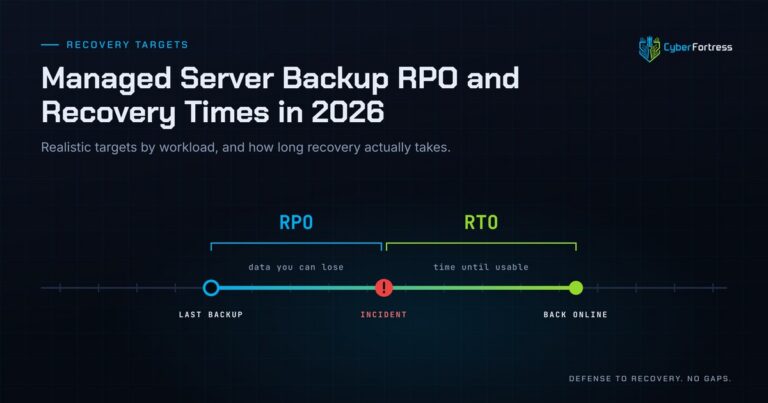
Managed Server Backup RPO and Recovery Times in 2026
For a 200-person company in 2026, a reasonable managed server backup posture is a 15-minute to 4-hour RPO…
-
Outsourcing Server Backups in 2026 Full Guide
Outsourcing server backups works when the contract covers monitoring, remediation, verified restore testing, immutable offsite storage, and assisted…
-
You Can’t Out-Patch an Attacker That Adapts in 31 Seconds
Researchers have documented what they are calling JadePuffer: a ransomware operation reportedly run end-to-end by an autonomous LLM…