DATA PROTECTION TRENDS, NEWS & BACKUP TIPS
When Ransomware Shuts Down Care: What the UMMC Disruption Teaches Healthcare Leaders About Resilience
In late February 2026, public reporting described how a ransomware attack disrupted operations at the University of Mississippi Medical Center (UMMC), forcing the closure of clinics statewide and the cancellation of elective procedures. Hospitals and emergency departments remained open, but teams had to fall back on manual, paper-based downtime workflows while investigators worked to understand the scope of the intrusion and whether sensitive patient information was accessed.
For healthcare organizations, this kind of event is not an abstract “IT outage.” It affects patients who need time-sensitive care, clinicians trying to coordinate treatment, and administrators balancing safety, compliance, and continuity. The lesson is clear: resilience has to be measured by time to restore critical services, not only time to detect an incident.
What happened
According to the Associated Press, a ransomware attack led UMMC to close all of its roughly three dozen clinics across Mississippi and cancel elective procedures for multiple days, while continuing hospital and emergency services. Staff reverted to manual documentation as systems were taken down to contain the incident, and the organization investigated whether patient data had been compromised. The FBI was involved as part of the response.
Mississippi Today further reported that the cyberattack compromised the health system’s IT network and forced the shutdown of systems supporting electronic health records used for appointments, medical histories, test results, and billing. It also described how UMMC continued serving patients through manual downtime procedures while recovery efforts continued.
Why this matters for healthcare and other regulated industries
Healthcare downtime has a direct human cost. When outpatient clinics close, chemotherapy, imaging, follow-ups, and elective surgeries do not simply get delayed on a calendar. Care plans get disrupted, risk increases, and clinical teams lose the speed and coordination they rely on.
There is also a second-order impact:
- Operational strain: Paper workflows slow triage, orders, documentation, and coordination across departments.
- Brand and community trust: Patients judge reliability through experience, especially during stressful moments.
- Compliance exposure: Any investigation into potential data access introduces legal, regulatory, and communications burdens.
This is why modern resilience programs focus on a single outcome: restoring critical patient services safely and quickly, even while an incident is still being investigated.
Key takeaways for resilience leaders
1) “Time to restore” is the metric that matters in a crisis
Detection is important, but in healthcare you need a plan for what happens when systems are intentionally taken offline to contain an intrusion. UMMC’s experience highlights that continuity depends on how quickly you can bring essential systems back or fail over to a clean environment.
Action: Define your “critical services list” in operational terms (ED intake, EHR access, imaging, lab, pharmacy, scheduling, revenue cycle), then attach a realistic RTO and RPO to each service based on clinical risk.
2) Downtime procedures are necessary, but they are not a strategy
Pen-and-paper workflows can keep care moving, but they are a last resort. They increase workload and friction at the exact moment your staff is under pressure.
Action: Treat downtime procedures as a bridge, then invest in the capabilities that shorten the bridge: orchestrated failover, tested restores, and ready-to-run recovery playbooks.
3) Backups must be protected, monitored, and recoverable
Ransomware groups often try to compromise backups or administrative paths that control them. Even when backups exist, recovery can fail if the environment is not monitored for suspicious activity, if immutability is not enforced, or if restore testing is inconsistent.
Action: Ensure backups are encrypted, immutable, and regularly tested. Add monitoring that watches for abnormal behavior in backup infrastructure (unusual deletions, credential misuse, mass job failures).
4) Practice is the difference between a plan and a response
In an incident, teams do not have time to debate runbooks or discover gaps in permissions, network paths, or dependency mapping.
Action: Run quarterly recovery exercises that include application owners, IT, security, and operations leadership. Measure results against real RTO/RPO targets, then remediate what fails.
A practical resilience blueprint for healthcare organizations
If you are reviewing your own readiness after seeing incidents like UMMC’s, this checklist is a strong starting point:
- Map critical services to systems and dependencies
Include EHR, identity, DNS, network segmentation, storage, imaging, lab, and integrations. - Set realistic RTO/RPO targets by service line
Tie targets to patient safety and operational impact, not generic IT tiers. - Implement orchestrated failover for priority systems
Pre-stage clean recovery environments and automate failover steps where possible. - Harden and monitor the backup environment
Encrypt backups, enforce immutability, isolate admin access, and monitor continuously. - Test restores under pressure conditions
Do not only test “can it restore,” test “can we restore fast enough with the staff we have.” - Validate incident communications and escalation paths
Confirm how clinical leaders, legal, compliance, and PR coordinate when systems are down.
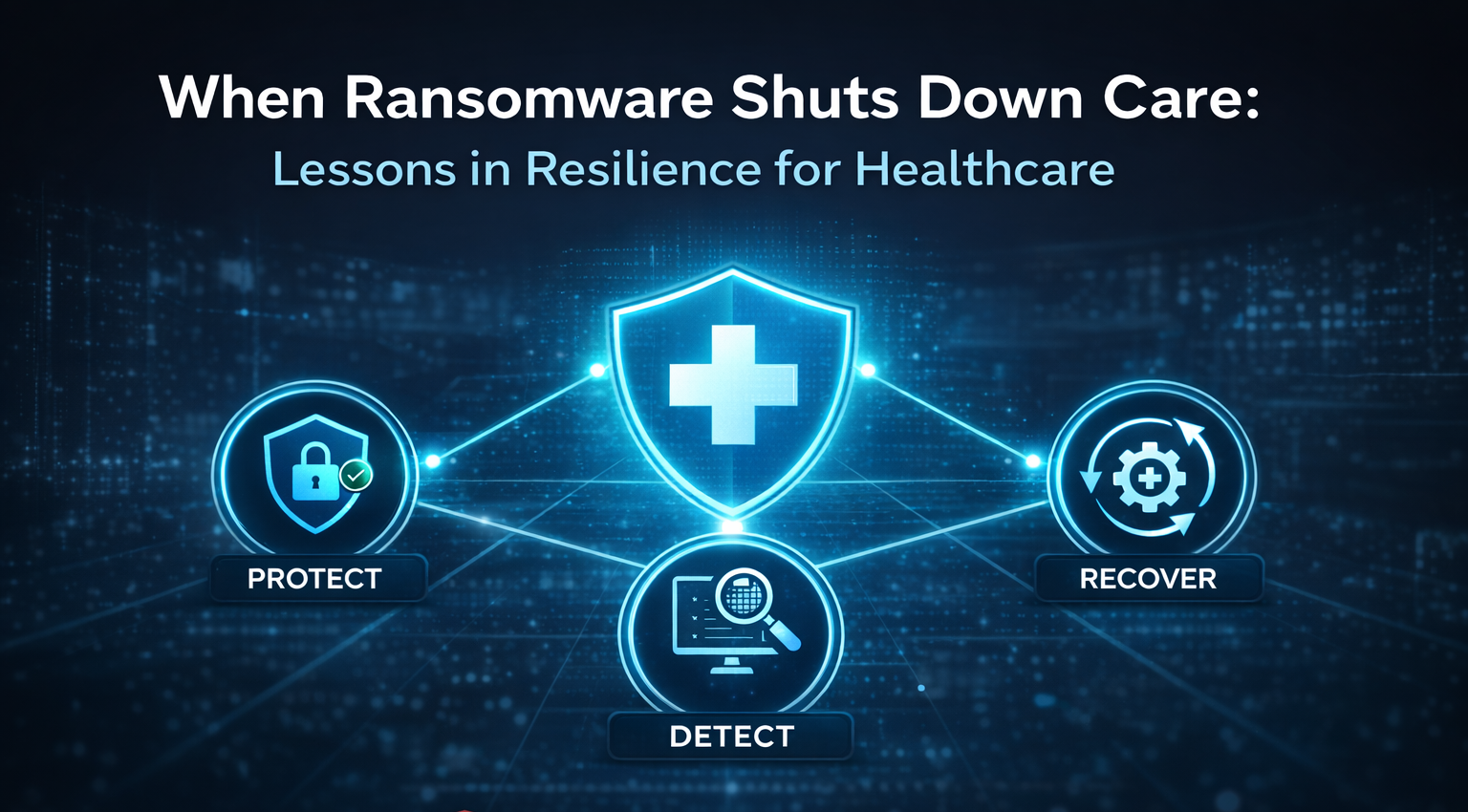
How CyberFortress supports Protect, Detect, and Recover for Healthcare Organizations
Protect: Strengthen the environment and safeguard recovery paths
Ransomware groups frequently aim to disrupt operations and compromise recovery options. CyberFortress helps organizations protect what matters most in a crisis by hardening backup and recovery foundations, enforcing encryption and immutability, and designing recovery architectures that reduce single points of failure.
BaaS (Backup as a Service)
Encrypted backups designed for recoverability, with immutability options and operational support to help ensure recovery copies remain usable when production systems are under attack.
Professional Services
BC/DR planning, application dependency mapping, and recovery testing to make sure RTO/RPO targets are realistic and executable under pressure.
Detect: Find the threat early and contain it with MDR
In healthcare, minutes matter. Early detection can reduce operational disruption, limit lateral movement, and prevent attackers from reaching privileged systems and backup infrastructure.
Managed Detection and Response (MDR)
24/7 monitoring and investigation across endpoints, servers, identity, and network signals, with guided response actions to contain threats quickly. MDR also supports resilience by helping detect suspicious behavior that targets backup systems, administrative credentials, and recovery tooling.
Recover: Restore clinical services quickly and safely
When containment requires systems to be isolated or shut down, recovery becomes the determining factor for patient care continuity. CyberFortress focuses on restoring critical services with repeatable workflows and real support throughout the event.
DRaaS (Disaster Recovery as a Service)
Orchestrated failover and rapid restoration of priority systems, designed to reduce downtime and help bring essential services back online in a controlled manner.
When MDR and recovery are integrated, security actions and recovery actions reinforce each other. MDR helps identify the scope of compromise and supports containment decisions. BaaS protects recovery data and gives you clean restore points. DRaaS helps you fail over and restore operations when production must stay isolated. Professional Services ensures the full plan is tested, realistic, and ready before an incident forces a manual scramble.
In healthcare and other regulated industries, resilience is proven in restoration of critical services, not in slide decks. Protect, Detect, and Recover has to function as one coordinated motion. CyberFortress brings those pieces together so teams can contain threats quickly, maintain confidence in recovery data, and restore patient care operations with a plan that has been tested before the pressure is real.