The Hidden Risk in AI-Generated Code (And How to Close It)
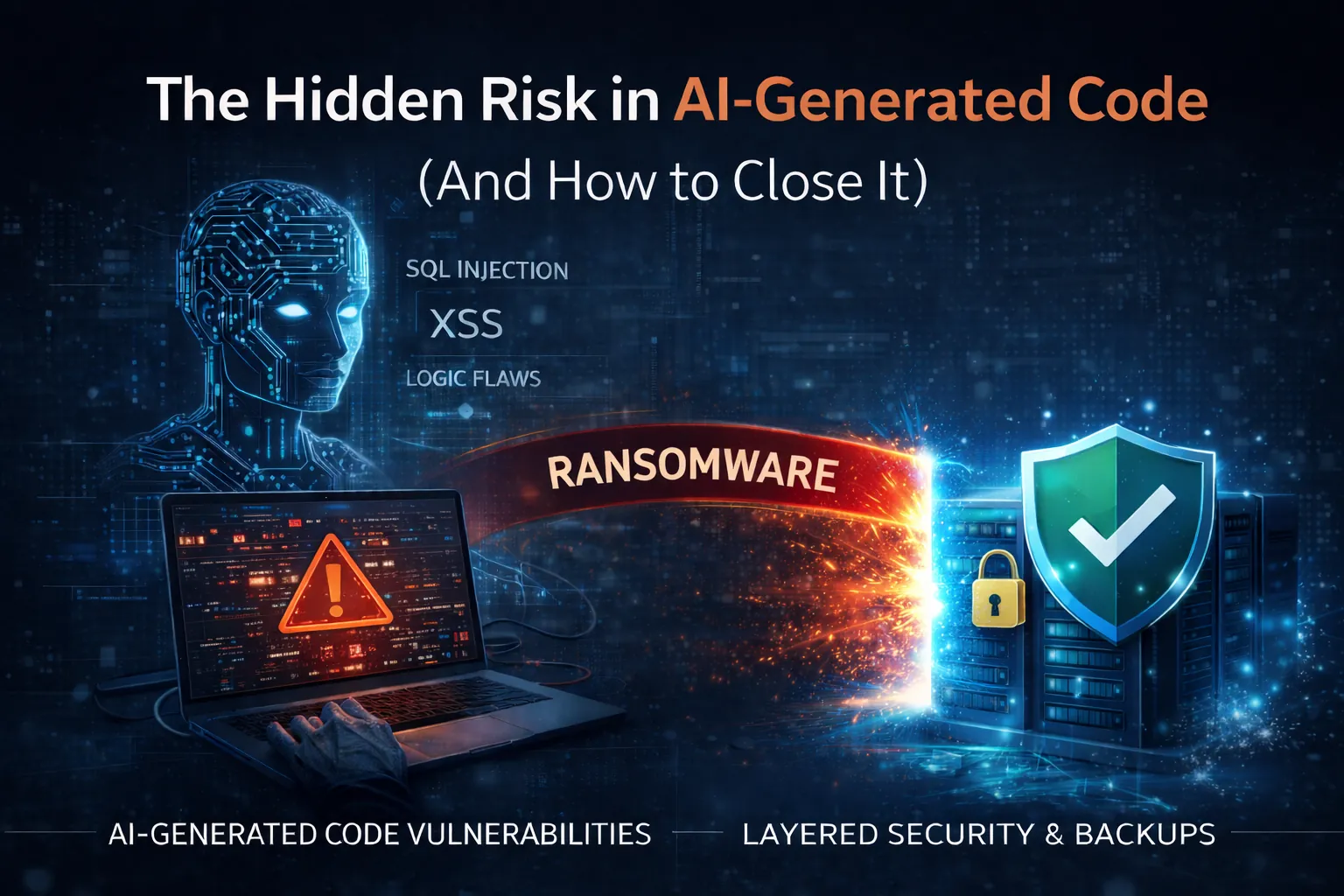
AI-generated code introduces SQL injection, XSS, and subtle logic flaws that static scanning cannot fully catch, and those flaws have become direct on-ramps for ransomware operators who are themselves using AI. CrowdStrike’s 2026 Global Threat Report found AI-enabled attacks surged 89% year over year while average eCrime breakout time collapsed to 29 minutes, so the practical defense pairs 24/7 managed detection with immutable backups that a compromised environment cannot reach.
Key Takeaways
- CrowdStrike’s 2026 Global Threat Report found AI-enabled attacks surged 89% year over year, average eCrime breakout time collapsed to 29 minutes, and the fastest observed breakout clocked in at 27 seconds.
- Anthropic’s August 2025 Threat Intelligence Report documented multiple cases of cybercriminals using Claude to build production-grade ransomware and adversaries have exploited vulnerabilities in AI development platforms to establish persistence and deploy ransomware.
- Traditional static scanning catches known patterns but cannot guarantee safety for novel logic produced by LLMs, particularly when that code ships at the speed of vibe coding.
- Initial access through an AI-generated flaw leads to credential theft, lateral movement, and either encryption or double-extortion, putting customer PII, intellectual property, financial records, and operational telemetry at risk.
- CyberFortress Managed BaaS powered by Veeam delivers backups as often as every 15 minutes with a +1 copy under native WORM immutability via Veeam Object Lock, Amazon S3, or Azure Blob, making recovery copies unchangeable by ransomware, admins, or compromised accounts.
- Server Backup and Recovery supports up to 96 daily recovery points following the 3-2-1-1-0 rule: three copies, two media types, one offsite, one immutable or air-gapped copy, and zero errors verified through automated testing.
The Adversary Is Using the Same Tools You Are
The vulnerabilities that come with AI-generated code (SQL injection, XSS, and subtler logic flaws) don’t exist in isolation. In today’s threat landscape, they’ve become direct on-ramps for ransomware operators who are themselves using AI to move faster than ever before.
Anthropic’s August 2025 Threat Intelligence Report documented multiple cases of cybercriminals using Claude to build production-grade ransomware. CrowdStrike’s 2026 Global Threat Report puts hard numbers to the problem: adversaries exploited vulnerabilities in AI development platforms to establish persistence and deploy ransomware; AI-enabled attacks surged 89% year-over-year; and average eCrime breakout time collapsed to just 29 minutes, with the fastest observed clocking in at 27 seconds.
From a data protection standpoint, the consequences are straightforward:
- Initial access through an AI-generated flaw leads to credential theft, lateral movement, and either encryption or double-extortion.
- The data at risk is exactly what your AI-accelerated applications now process: customer PII, intellectual property, financial records, and operational telemetry.
- Traditional static scanning catches known patterns but cannot guarantee safety for novel logic produced by LLMs, especially when that code is deployed at the speed of “vibe coding.”
That’s where a managed MDR service, tightly integrated with immutable data backup and resilience tools, becomes the practical layered defense for filling those unknown security gaps.
DeepSeas Endpoint MDR by CyberFortress: 24/7 Prevention and Rapid Containment
CyberFortress MDR, powered by DeepSeas, delivers continuous endpoint monitoring, AI-driven behavioral analytics, threat hunting, and expert-led response across your entire environment. It shrinks detection time from months to minutes and actively contains threats in real time: isolating compromised devices, blocking encryption routines, stopping lateral movement, and preventing data exfiltration before ransomware can spread or reach your backups.
CyberFortress Data Backup and Resilience Tools: The Untouchable Recovery Layer
When paired with DeepSeas Endpoint MDR, CyberFortress’s full suite of backup solutions creates true defense-in-depth. MDR stops attacks at the source; the backups ensure that even if an attack slips through (or originates from an AI-generated vulnerability), you always have clean, ransomware-proof copies ready for fast recovery. That means no ransom payment, minimal downtime, and no data loss.
Here’s how each CyberFortress backup tool contributes when combined with DeepSeas Endpoint MDR:
- Endpoint Backup and Recovery ($15 per device/month): Endpoint backup and recovery protects laptops, desktops, and remote workstations with military-grade AES-256 encryption (customer-controlled keys), remote management, and self-service restore options. DeepSeas MDR catches threats on the device before encryption begins; if needed, you can recover anywhere-to-anywhere, even to a replacement machine, from clean backups.
- Managed Cloud Backup as a Service (BaaS) Powered by Veeam: Managed BaaS powered by Veeam delivers frequent backups (as often as every 15 minutes) to local disk or on-premises appliances, plus a secondary offsite or cloud copy. The critical +1 copy uses native WORM immutability via Veeam Object Lock, Amazon S3, Azure Blob, or equivalent, making backups literally unchangeable by ransomware, admins, or compromised accounts. DeepSeas MDR prevents threats from ever reaching these copies; if one does get through, automated SureBackup verification and journal-based recovery guarantee clean restores.
- Managed Disaster Recovery as a Service (DRaaS) Powered by Veeam: Managed DRaaS powered by Veeam orchestrates one-click failover and full environment restoration in the cloud. Combined with DeepSeas containment, this delivers near-zero RTO and supports bare-metal restores, turning a ransomware event into a tested, rapid recovery exercise rather than a business-halting crisis.
- SaaS Backup and Recovery (Microsoft 365, Salesforce, and other cloud apps): Provides instant, one-click recovery of deleted or encrypted SaaS data, often in under 15 minutes. DeepSeas MDR protects the endpoints accessing these platforms, while immutable SaaS backups ensure exfiltrated or corrupted cloud data can be restored cleanly without paying attackers.
- Server Backup and Recovery: LiveVault server backup and recovery supports physical and virtual servers with up to 96 daily recovery points. When DeepSeas Endpoint MDR blocks spread to servers, these backups remain pristine and ready, following the industry-standard 3-2-1-1-0 rule (3 copies, 2 media types, 1 offsite, 1 immutable/air-gapped copy, 0 errors via automated testing).
All CyberFortress backups emphasize immutability (WORM storage as an airtight vault), geo-redundancy, regular recovery drills, and expert human support. Air-gapped options and MFA-protected management further isolate the +1 copy from any network attack surface.
Prevention + Resilience = Real Ransomware Defense
DeepSeas Endpoint MDR is the active shield: it detects and neutralizes attacks originating from flawed AI-generated code within minutes. CyberFortress’s backups are the insurance policy, keeping clean data available even if prevention is momentarily bypassed. Together they:
- Block data extraction and encryption at the endpoint
- Ensure attackers cannot tamper with or delete recovery copies
- Enable rapid, verified restores with minimal or zero downtime
- Reduce or eliminate ransom payments and compliance risk (HIPAA, SEC, GDPR)
- Turn the unknown security gaps of fast AI development into manageable, recoverable incidents
AI coding tools dramatically accelerate development and, as the evidence shows, can accelerate both the creation of vulnerable code and the attacks that exploit it. Static scanning, secure prompting, and human review remain essential, but they are no longer sufficient on their own.
A well-run DeepSeas Endpoint MDR service tightly integrated with CyberFortress backups turns those gaps into a managed, monitored, and rapidly recoverable environment. It does not replace good development hygiene; it completes it from the moment code hits production.
With AI-generated code flooding the pipeline, the organizations that will thrive are those that pair acceleration with layered, expert-backed defense, especially when the adversary is already using the same tools against them. Talk to CyberFortress about securing AI-generated code at your organization.
Frequently Asked Questions
What security risks does AI-generated code introduce? SQL injection, cross-site scripting, and subtler logic flaws that are harder to catch because the code is novel rather than copied from known patterns. These vulnerabilities become entry points for credential theft, lateral movement, and either encryption or double-extortion ransomware.
Can static code scanning catch vulnerabilities in AI-generated code? Static scanning catches known patterns but cannot guarantee safety for novel logic produced by large language models, especially when that code reaches production at the speed of vibe coding. Secure prompting and human review remain essential without being sufficient on their own.
How fast are AI-enabled ransomware attacks moving in 2026? CrowdStrike’s 2026 Global Threat Report found AI-enabled attacks surged 89% year over year, with average eCrime breakout time collapsing to 29 minutes and the fastest observed breakout at 27 seconds. That timeline leaves no room for a response process that depends on business-hours staffing.
Are criminals actually using AI to build ransomware? Yes. Anthropic’s August 2025 Threat Intelligence Report documented multiple cases of cybercriminals using Claude to build production-grade ransomware, and CrowdStrike observed adversaries exploiting vulnerabilities in AI development platforms to establish persistence and deploy ransomware.
What is the 3-2-1-1-0 backup rule? Three copies of data, on two media types, with one offsite, one immutable or air-gapped copy, and zero errors verified through automated testing. The immutable copy is what survives an attacker who has compromised production credentials.
How do MDR and immutable backup work together against AI-driven attacks? Managed detection acts as the active shield, isolating compromised devices, blocking encryption routines, and stopping lateral movement before ransomware reaches the backups. Immutable backups are the layer that holds when prevention is bypassed, ensuring clean copies remain available so recovery does not depend on paying a ransom.
CyberFortress provides 24/7 managed detection paired with immutable, WORM-protected backups for environments shipping AI-generated code. Contact us to turn the unknown gaps in your pipeline into recoverable incidents.
A backup you have never restored is a guess. Trinity turns it into proof.
Seven questions show where your recovery plan stands today. Or skip ahead and talk to a CyberFortress recovery specialist about your environment.
More from the Fortress
-
Whose Database Is Your Data In?
FulcrumSec published roughly 8.8 million people’s data from Manchester Airports Group over the first weekend of September 2026,…
-
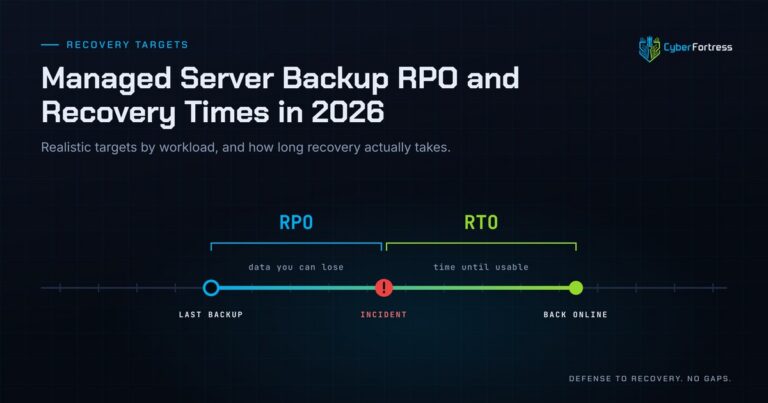
Managed Server Backup RPO and Recovery Times in 2026
For a 200-person company in 2026, a reasonable managed server backup posture is a 15-minute to 4-hour RPO…
-
Outsourcing Server Backups in 2026 Full Guide
Outsourcing server backups works when the contract covers monitoring, remediation, verified restore testing, immutable offsite storage, and assisted…
-
You Can’t Out-Patch an Attacker That Adapts in 31 Seconds
Researchers have documented what they are calling JadePuffer: a ransomware operation reportedly run end-to-end by an autonomous LLM…