How to Compare Managed and Self Managed Backup
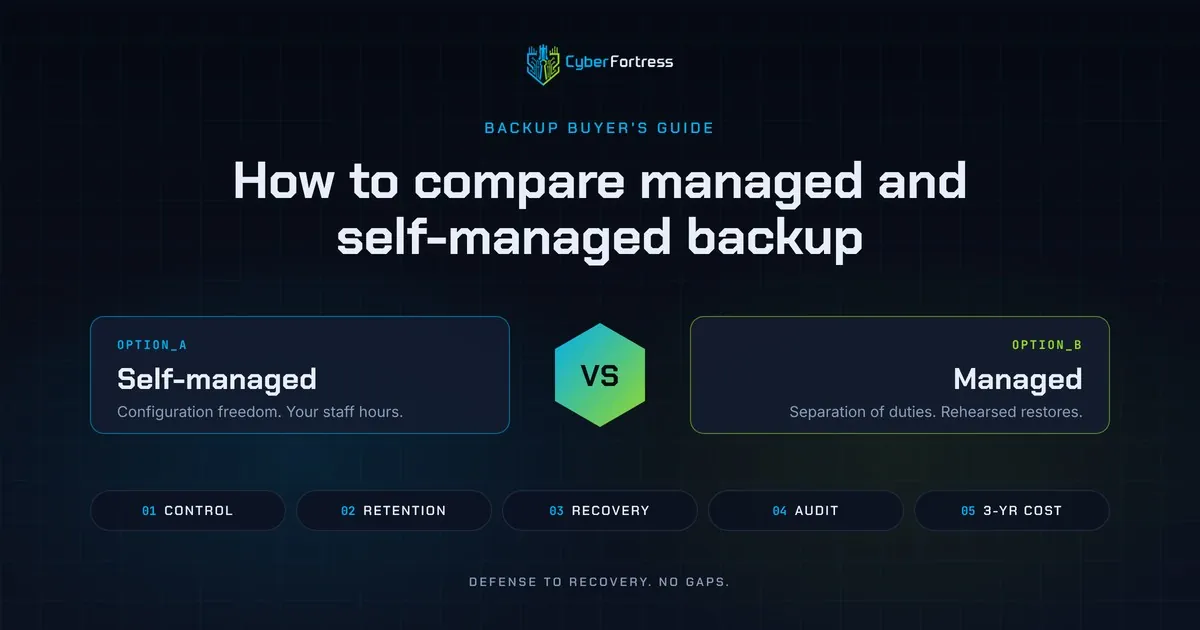
Compare the two on five dimensions, in this order: control, retention and immutability, recovery capability, audit readiness, and total cost including labor. Score each dimension against your own requirements rather than a feature list, and the decision usually resolves before you reach price.
Step 1: Write down what you must be able to prove
Start with obligations. List the frameworks that apply, the retention each one requires, the evidence your auditors requested last cycle, and any customer contract terms about data protection.
This becomes the scoring rubric, and it stops the comparison from being built out of vendor marketing categories. Every evaluation that starts with a feature matrix ends up buying features.
Step 2: Score control honestly
Control is not the same as possession. Ask, for each option: who holds the encryption keys, who can change retention, who can delete data, who can initiate a restore, and where the data physically resides.
Self-managed usually wins on configuration freedom. Managed often wins on separation of duties which is the thing auditors test.
Step 3: Compare retention and immutability side by side
Maximum retention available and the cost of extending it.
Whether immutability is enforced by the storage layer or only by policy.
Whether an administrator can shorten retention or delete locked copies.
How deletion requests are logged and how long logs are kept.
Whether legal hold can be applied to specific data sets.
Policy-enforced immutability holds until the day someone with the right credentials decides otherwise, which is precisely the day it was meant to protect you.
Step 4: Compare recovery, not backup
Backup capability is nearly commoditized. Recovery capability is where the options separate. For each option, establish the realistic time to restore a single file, a full server, a virtual machine, and a whole site, and establish who performs each of those. Then ask when that was last demonstrated.
A self-managed platform with excellent features and no rehearsed recovery is weaker than a managed service with average features and monthly tested restores.
Step 5: Compare audit readiness
Ask what evidence each option produces without manual effort: scope reports showing every protected workload, retention configuration history, verified restore results, access and deletion logs, and immutability attestation.
If producing audit evidence takes a person a week, that week belongs in the comparison.
Step 6: Build the real cost model
Self-managed cost equals licensing, plus storage,infrastructure, staff hours for monitoring, testing, patching, and recovery, plus the risk-weighted cost of an unrehearsed recovery.
Managed cost equals the subscription plus your oversight time.
Compare those totals over three years because that is the horizon on which staffing assumptions break. The engineer who owns backup today has a different job in eighteen months.
Step 7: Decide then write down the trigger to revisit
Choose the option that scores higher against your rubric, and record the conditions that would change the answer: a headcount change, a new compliance framework, an acquisition, or a failed audit.
Backup strategy fails quietly when nobody revisits a decision made under different conditions. Put a date on it.
Frequently asked questions
Can we run a hybrid model? Yes. Many mid-market teams do. Self-manage the workloads you understand deeply and outsource the rest then keep one policy engine and one reporting layer so scope stays visible.
Does self-managed backup satisfy data compliance requirements? It can. Compliance depends on documented scope, retention, immutability, access control, and tested recovery, all of which are achievable in-house if someone owns them.
Next step
CyberFortress scores well on the dimension most evaluations skip: somebody is accountable for the recovery, and the restores are timed before you need them.
Test Your Fortress · Prove Your Recovery
Related reading: Cloud vs on-prem backup for mid-market companies
A backup you have never restored is a guess. Trinity turns it into proof.
Seven questions show where your recovery plan stands today. Or skip ahead and talk to a CyberFortress recovery specialist about your environment.
More from the Fortress
-
Whose Database Is Your Data In?
FulcrumSec published roughly 8.8 million people’s data from Manchester Airports Group over the first weekend of September 2026,…
-
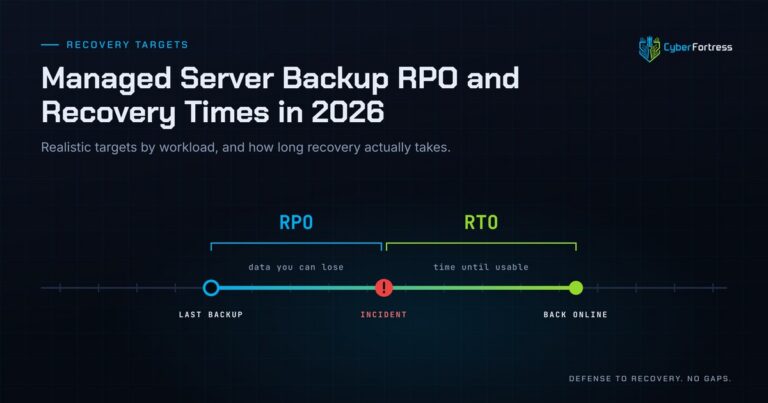
Managed Server Backup RPO and Recovery Times in 2026
For a 200-person company in 2026, a reasonable managed server backup posture is a 15-minute to 4-hour RPO…
-
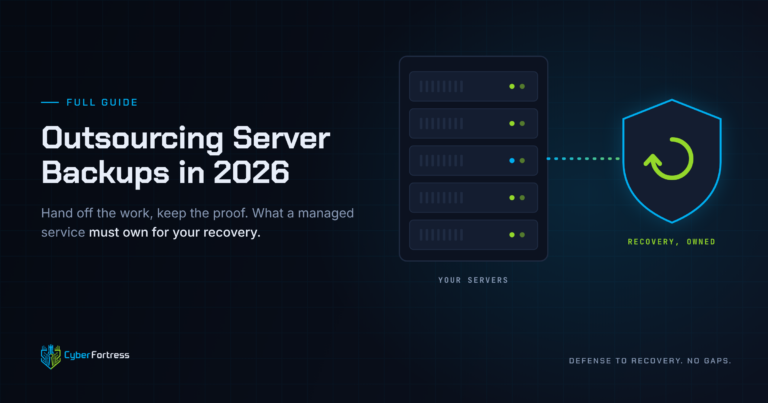
Outsourcing Server Backups in 2026 Full Guide
Outsourcing server backups works when the contract covers monitoring, remediation, verified restore testing, immutable offsite storage, and assisted…
-
You Can’t Out-Patch an Attacker That Adapts in 31 Seconds
Researchers have documented what they are calling JadePuffer: a ransomware operation reportedly run end-to-end by an autonomous LLM…