You Own Veeam. Who Runs It at 2 A.M.?
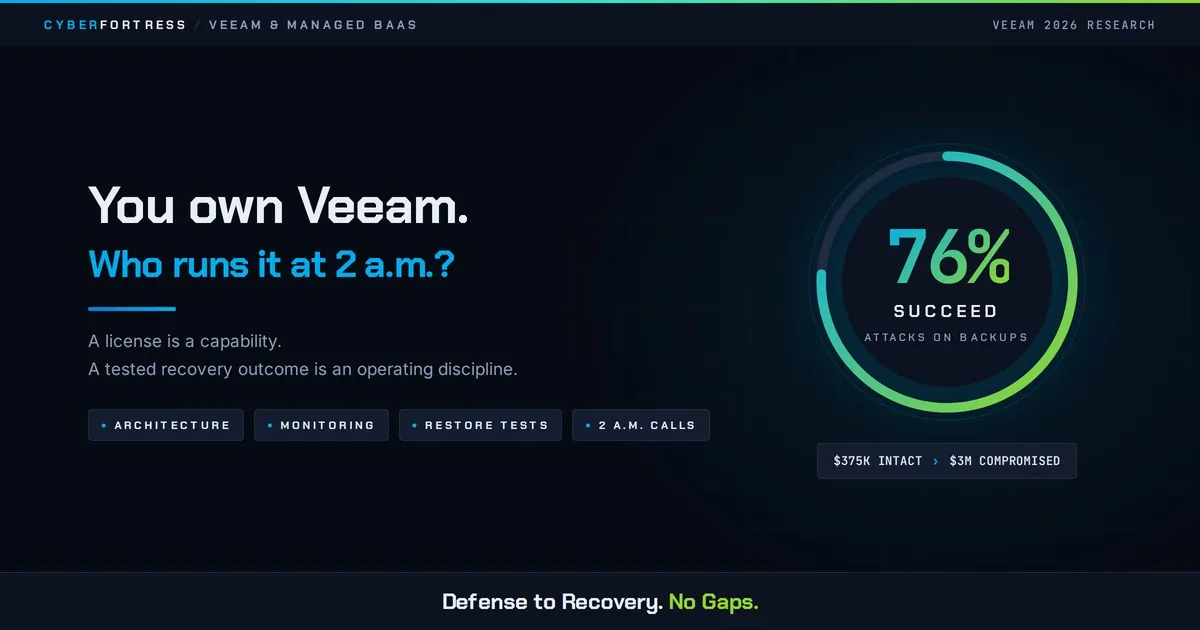
Self-managed Veeam and managed Veeam BaaS run the same proven software, and the difference is who owns deployment, daily operations, recovery readiness, and the 2 a.m. phone call. Veeam’s 2026 research found that 96% of ransomware attacks target backup repositories and 76% of those attempts succeed, which makes the operating discipline around the software the deciding factor in whether a restore works.
Key Takeaways
- Veeam’s 2026 research found 96% of ransomware attacks target backup repositories directly, and 76% of those attacks succeed.
- Companies with intact backups recover from ransomware at a median cost of $375,000. Companies with compromised backups pay $3 million.
- Self-managed Veeam and managed Veeam BaaS run identical backup technology. The variable is the operating model wrapped around it: deployment, daily job monitoring, console hardening, restore testing, and after-hours escalation.
- The four dimensions that separate the two models are deployment (who architects the vault and trust boundaries), operations (who watches failed jobs and patches the console), recovery readiness (who proves a restore works before the incident), and support (who answers at 2 a.m. on a holiday weekend).
- Self-managed Veeam puts the backup console inside the same identity provider and network perimeter as production, which is precisely the path attackers use to reach recovery data before the encryption starts.
Why Buying Veeam Feels Like Finishing the Job
Veeam earned its position in the mid-market. The software does what it claims, the feature set is deep, and the community around it is serious. IT teams who select Veeam are making a defensible technology decision.
The problem starts after the purchase order clears. A license is a capability. A tested recovery outcome is an operating discipline, and the gap between those two things is where mid-market IT teams get hurt.
Nobody fails a restore because Veeam broke. They fail because a job stopped running eleven weeks ago and nobody chased the alert, or because the backup console shared credentials with the domain that got compromised, or because the last verified restore test happened during an onboarding project two fiscal years back.
What Self-Managed Veeam Actually Puts on Your Team
Running Veeam yourself is a staffing decision disguised as a software decision. Four workloads come with it.
Deployment and architecture. Somebody has to design the repository layout, set immutability at the storage layer instead of the application layer, separate the backup identity domain from production Active Directory, and size retention against real regulatory obligations. Those choices get made once and quietly determine whether the environment survives a credential compromise.
Daily operations. Backup jobs fail. Agents drift. Console patches ship. Retention policies need review as data grows and the business adds systems. This work is unglamorous, it never finishes, and it is the first thing that slides when the IT team gets pulled into a migration or an audit.
Recovery readiness. A completed backup job confirms data was written. It confirms nothing about whether that data restores into a working system under pressure. Verified restore testing on a schedule is the only evidence that recovery is possible, and it is the task most self-managed environments skip.
After-hours support. Ransomware fires on Saturday nights and holiday weekends by design. Self-managed means the escalation path is your own staff, on their own phones, without a rehearsed playbook or authority pre-established to start a restore.
The Recovery Readiness Gap Nobody Budgets For
Veeam’s 2026 numbers explain where attackers spend their effort. 96% of ransomware attacks target backup repositories, and 76% of those attempts succeed. Attackers dwell in the network for weeks, locate the backup management console, and neutralize recovery points before the payload triggers.
Self-managed Veeam deployments hand attackers a shortcut. The console typically authenticates against the same identity provider as production and sits inside the same network perimeter. One compromised privileged account reaches both the data the organization wants to protect and the tool that would reverse the damage.
The financial consequence is measurable. Companies with intact backups recover at a median cost of $375,000. Companies with compromised backups pay $3 million. That 8x gap has nothing to do with which backup software was licensed and everything to do with the architecture and operating rhythm around it.
What the Managed Model Changes
A managed Veeam BaaS provider runs the same software with a different set of boundaries and a different set of people accountable for the outcome.
Deployment stops being a one-time internal project and becomes an architecture governed by a separate trust domain. Vault retention policies live outside the reach of the customer’s production management plane, so a compromised admin account in the customer’s Active Directory cannot alter, delete, or encrypt what sits in the vault.
Operations move to a team whose only job is backup and recovery. Failed jobs get chased the day they fail. Console patching happens on a maintenance cadence rather than whenever someone has an afternoon free.
Recovery readiness becomes a contractual deliverable instead of a good intention. Monthly verified restore testing answers the question of whether recovery works before the incident forces the answer.
Support becomes a phone number with a human on the other end at 2 a.m., holding authority to begin the restore without waiting for a manager to wake up.
How CyberFortress Solves This
This is exactly what CyberFortress was built to fix. Managed BaaS powered by Veeam delivers immutable retention in geo-separated, air-gapped vaults governed by a separate trust domain from the customer’s production environment. Managed DRaaS powered by Veeam adds validated failover, rehearsed quarterly, so the recovery path is proven rather than assumed. Managed Veeam Data Cloud brings enterprise-grade Veeam Data Cloud to teams who want the platform without the operational overhead.
LiveVault carries sub-15-minute RPO targets with AES 256-bit encryption for environments where every minute of downtime has a calculable cost. SaaS Backup and Recovery extends the same posture to Microsoft 365, Google Workspace, Salesforce, and Dropbox. The Trinity Platform ties prevention, detection, and recovery into one command center with one team accountable for the result.
Monthly verified restore testing is part of the managed service, not an optional add-on. Twenty years in data protection, 100,000+ machines protected, ISO 27001 certified, and U.S.-based recovery specialists who answer at 2 a.m. We pick up the phone.
Three Questions Worth Asking Before You Renew
If your team is renewing a Veeam license this quarter, take three questions into the next infrastructure review.
Does your backup console authenticate against the same identity provider as your production environment, and if one privileged account were compromised tomorrow, what would that account reach?
When was the last time your Veeam backups were restored into a working system under realistic conditions, and who verified the result?
If the encryption triggered at 2 a.m. on a holiday weekend, who on your team has both the authority and the rehearsed playbook to start the restore before Monday?
Frequently Asked Questions
What is the difference between self-managed Veeam and a fully managed Veeam BaaS provider? Both run the same Veeam technology. Self-managed puts deployment architecture, daily job monitoring, console patching, restore testing, and after-hours response on your internal team. Managed Veeam BaaS moves those four workloads to a provider with a separate trust domain, contractual restore validation, and 24/7 staffed escalation.
Is managed Veeam BaaS more expensive than running Veeam in-house? The license cost is only one line in the comparison. Self-managed adds the staffing hours for architecture, monitoring, patching, and restore testing, plus the cost of after-hours coverage. Companies with intact backups recover from ransomware at a median cost of $375,000 versus $3 million for those with compromised backups, which is the number that settles the budget conversation.
Do I lose control of my backup data with a managed Veeam provider? No. The customer retains ownership of the data and visibility into the environment. What changes is the trust boundary: retention policies are locked at the vault layer, outside the reach of the production management plane, so a compromised admin credential in your Active Directory cannot delete or encrypt the vault.
How often should Veeam backups be restore tested? Monthly, against realistic ransomware conditions rather than clean-lab conditions. A completed backup job confirms data was written. Only a verified restore confirms recovery is possible, and self-managed environments are where that testing slips first.
Can a managed Veeam BaaS provider protect backups from ransomware better than self-managing? Yes, when the architecture separates the backup data, the management plane, and the identity layer into distinct trust domains. Veeam’s 2026 research found 76% of attacks against backup repositories succeed, and most of those succeed because the console shares credentials and network paths with production.
What size company should move from self-managed Veeam to managed BaaS? Mid-market organizations that cannot staff 24/7 backup operations internally, which covers most teams under a few hundred employees. The deciding factor is whether your team can guarantee failed jobs get chased same-day, the console gets patched on schedule, restores get tested monthly, and someone answers at 2 a.m.
CyberFortress provides managed Veeam BaaS with immutable, geo-separated vaults and monthly verified restore testing. Contact us to find out what your current Veeam deployment would surrender to a compromised admin account.
A backup you have never restored is a guess. Trinity turns it into proof.
Seven questions show where your recovery plan stands today. Or skip ahead and talk to a CyberFortress recovery specialist about your environment.
More from the Fortress
-
Whose Database Is Your Data In?
FulcrumSec published roughly 8.8 million people’s data from Manchester Airports Group over the first weekend of September 2026,…
-
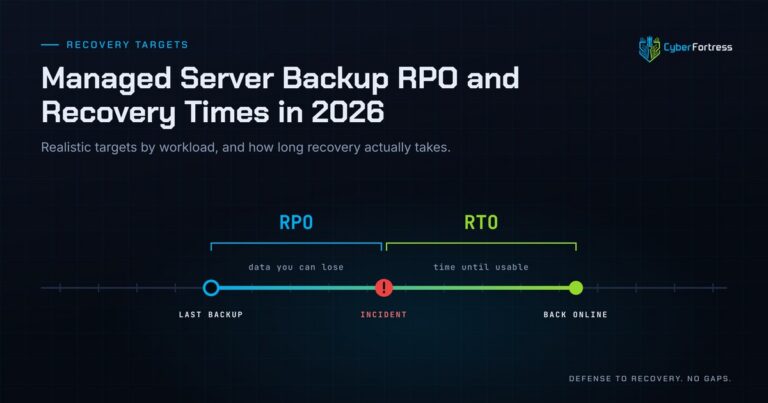
Managed Server Backup RPO and Recovery Times in 2026
For a 200-person company in 2026, a reasonable managed server backup posture is a 15-minute to 4-hour RPO…
-
Outsourcing Server Backups in 2026 Full Guide
Outsourcing server backups works when the contract covers monitoring, remediation, verified restore testing, immutable offsite storage, and assisted…
-
You Can’t Out-Patch an Attacker That Adapts in 31 Seconds
Researchers have documented what they are calling JadePuffer: a ransomware operation reportedly run end-to-end by an autonomous LLM…