DATA PROTECTION TRENDS, NEWS & BACKUP TIPS
Business Continuity vs. Disaster Recovery: Understanding the Difference and Why Both Matter
Introduction
In today’s always-on business climate, unexpected disruptions, from cyberattacks to natural disasters, can strike at any moment. The terms Business Continuity (BC) and Disaster Recovery (DR) often come up in conversations about resilience. While they are closely related strategies to keep a company running through adversity, they are not identical. This article explains what BC and DR mean, how they differ, and why modern IT environments need both. We’ll also dispel common misconceptions, look at real-world consequences of not planning ahead, and explore how modern solutions like Backup as a Service (BaaS), Disaster Recovery as a Service (DRaaS), and Backup Recovery as a Service (BRaaS) can support BC/DR strategies.
Defining Business Continuity vs. Disaster Recovery
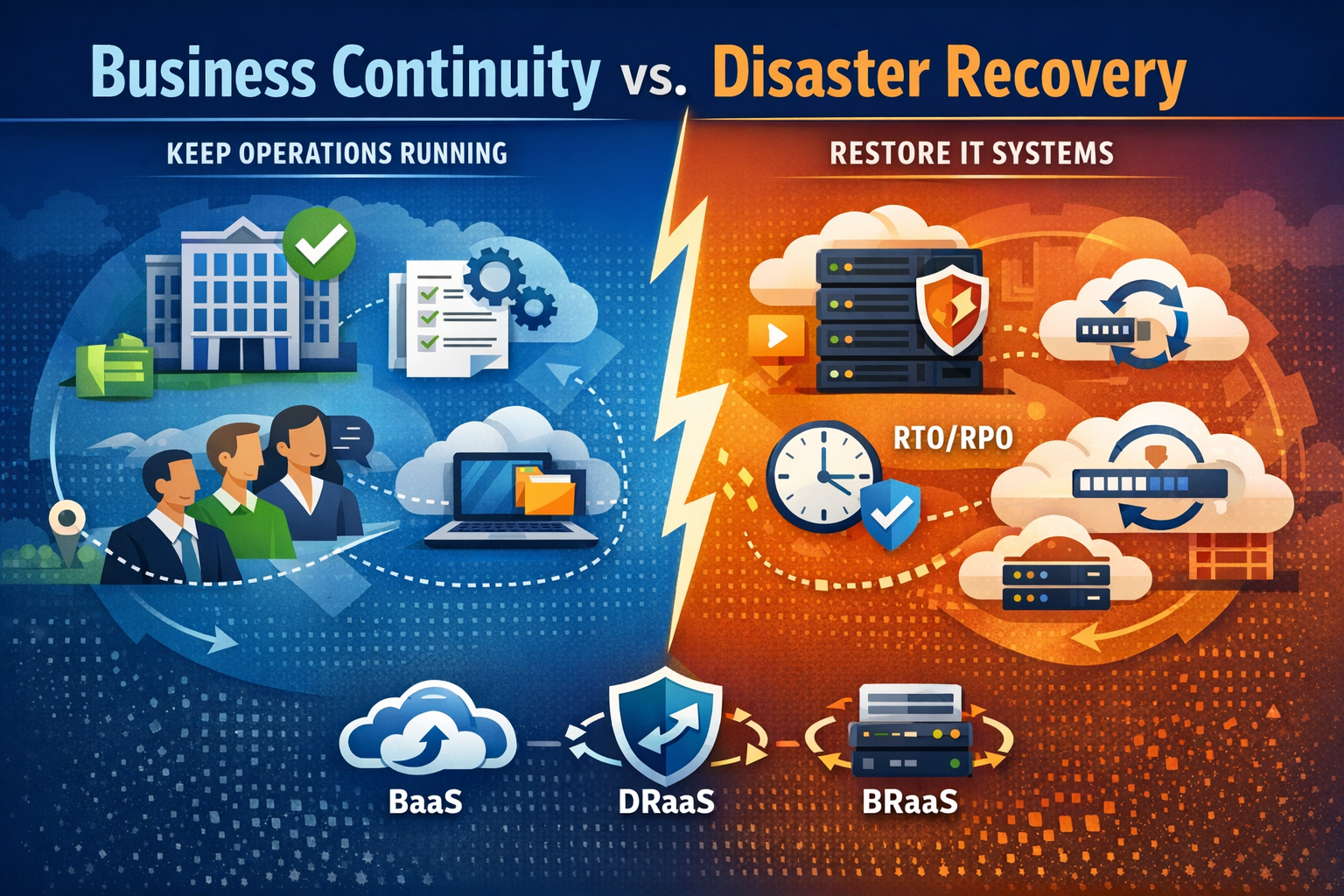
Business Continuity refers to an organization’s ability to keep essential operations running during and after a disruptive event. A Business Continuity Plan (BCP) is a detailed roadmap outlining steps to remain operable through a crisis and return to normal business functions afterward. It takes a broad view of potential threats, whether a natural disaster, fire, cyberattack, or supply chain failure, and focuses on preventing or minimizing downtime and damage to the business. In essence, a BCP addresses “everything it takes to keep the business open”: people, processes, facilities, communications, and so on, not just IT systems.
Disaster Recovery, on the other hand, is a subset of business continuity focused specifically on the IT infrastructure and data. A Disaster Recovery Plan (DRP) details the processes and technical procedures for recovering critical applications, data, and IT systems after a disaster occurs. It answers questions like: How will we restore our data if our servers go down? How quickly can we get our systems back online, and in what order? DR is inherently more technical and reactive, kicking in after an incident to restore IT functionality as soon as possible.
In summary, BC is the overarching strategy to keep the business running, whereas DR is one component of that strategy concentrated on IT systems recovery. Business continuity planning might include finding alternate work locations for staff, maintaining customer service during a disruption, or manual workarounds for critical processes. Disaster recovery planning zeroes in on backing up data and getting servers, networks, and applications back up. It’s helpful to think of DR as a critical building block of BC. You need your technology restored (DR) to support broader business operations (BC) in a crisis. Many organizations now use the combined term BC/DR or BCDR to denote an integrated approach to continuity, but it’s still useful to distinguish the two components.
Why Both BC and DR Are Critical for Modern IT Environments
Downtime and data loss are more expensive than ever, and more likely, given today’s threats. Businesses large and small are increasingly reliant on digital systems and 24/7 data access, meaning that even a few hours of outage can be devastating. A recent study found that a single hour of IT system downtime costs enterprises around $2 million on average. Another report pegged the median cost of an outage at about $33,000 per minute. These losses come from halted sales, lost productivity, remediation costs, and more. Beyond the immediate financial hit, downtime also erodes customer confidence and can trigger regulatory penalties (for example, if SLAs or data protection obligations are missed).
Data breaches and cyber incidents amplify the stakes. The average cost of a data breach reached $4.45 million in 2023, according to IBM. Organizations without robust continuity and recovery plans suffer longer disruptions and higher costs when breaches or ransomware strikes, whereas those with a strong BC/DR strategy can contain damage by shortening the downtime and preserving customer trust. In sectors like healthcare or finance, where sensitive data is regulated, lack of continuity can also mean hefty compliance fines. In short, business continuity and disaster recovery plans are not optional. They are mission-critical insurance against both common outages and worst-case catastrophes.
Modern IT environments face a gamut of risks: sophisticated cyberattacks, cloud service outages, supply chain disruptions, and even global events like pandemics. Both BC and DR are needed to mitigate these risks. A business continuity plan gives your team a playbook to maintain operations (perhaps in a reduced but functional state) during an incident, and a disaster recovery plan ensures you can quickly bring technology back to support those operations. Without both, even a minor incident can snowball. For example, a power failure with no backup site or plan could halt operations entirely, or a server crash with no data recovery method could result in permanent data loss. Companies that invest in BC/DR tend to recover faster and emerge stronger from crises, whereas those that don’t often struggle or fail to recover at all.
Common Misconceptions About BC and DR
There are several misconceptions that decision-makers should guard against when evaluating continuity and recovery strategies. Let’s dispel a few of the most common myths:
“Business continuity and disaster recovery are the same.” It’s a common mistake to use BC and DR interchangeably. In reality, as explained above, BC is a broader concept (keeping the business running) and DR is a focused aspect of it (restoring IT systems). Treating them as identical can lead to gaps. For instance, a company might back up its data (DR) but have no plan for how employees will resume work if the office is inaccessible (BC). Both aspects must be planned in tandem.
“Continuity planning is just the IT department’s responsibility.” Many assume BC/DR is purely a technical issue for IT to handle. In truth, a successful continuity plan must involve the entire business, including leadership and every department. Yes, IT plays a huge role in disaster recovery technologies, but business continuity touches HR (e.g. communicating with employees), operations (e.g. manual procedures when systems are down), finance (assessing impact), and more. It should be aligned with business objectives and have executive sponsorship, not siloed in IT.
“If we have backups, we’re covered.” Reliable data backups are essential, but they are not a complete continuity plan on their own. This misconception can be risky. Traditional backups might protect data, yet recovery could be painfully slow if you have to rebuild systems from scratch or retrieve tapes from offsite storage. Backup is one piece of DR. You also need plans for how quickly you can restore and access that data, where you will run your applications in the interim, and how to keep the business running during the restoration. Without planning, you might have data copies but no fast way to use them to resume operations.
“Only big enterprises need BC/DR plans, our small business can wing it.” This is false and dangerous. Smaller companies are often even more vulnerable because a single disruption can be fatal. Hackers increasingly target small and mid-size businesses, and 28% of cyberattacks in 2020 hit SMBs. Studies also show 60% of small businesses that suffer a major data loss go out of business within six months. Every organization, regardless of size, needs at least a basic continuity and recovery strategy. The good news is that modern cloud-based solutions (discussed below) have made BC/DR more accessible to smaller firms by eliminating the need for huge capital investments in secondary data centers.
“Our data is in the cloud, so we’re automatically protected.” Moving workloads to cloud infrastructure or SaaS platforms does not eliminate the need for BC/DR planning. Cloud providers generally follow a “shared responsibility” model. They ensure their cloud’s uptime, but you are responsible for your data and backups. For example, if you delete important data or a ransomware attack encrypts your files in the cloud, the cloud provider isn’t liable for restoring your data. Additionally, cloud services themselves can experience outages. You still need backup copies of critical cloud data and a plan for alternate operations if your cloud apps go down. In short, cloud can reduce certain risks but doesn’t absolve you from continuity planning.
By understanding these misconceptions, IT decision-makers can better educate their teams and executives. BC and DR require a holistic, proactive approach. It’s not just about data backup, not only for large companies, and not something you create once and forget. Plans should be regularly updated and tested, and everyone from the C-suite to department heads should know their roles when disruptions occur.
The Cost of Not Planning: Real-World Consequences
Failing to implement robust BC and DR plans can have dire consequences. Consider these real-world findings and examples, which highlight what happens when organizations are unprepared:
Business Failure and Financial Loss: According to FEMA and industry statistics, roughly 40% of businesses never reopen after a major disaster. An additional 25% close within one year of the event. In one survey, a staggering 93% of companies that suffered a significant data disaster without a recovery plan were out of business within 12 months. The message is clear: lack of preparedness can literally put you out of business. Even if a disruption isn’t deadly to the company, the financial losses from prolonged downtime can be enormous. Think of e-commerce sites that lose revenue each hour they’re offline, or manufacturers idle for days. Those losses add up quickly, often reaching hundreds of thousands or millions of dollars.
Reputation and Customer Trust: Outages and data disasters can severely damage a company’s reputation. Customers and partners have little patience for service interruptions in the digital age. For example, a high-profile IT outage in 2024 (caused by a faulty software update) crashed over 8 million systems worldwide and disrupted airlines, healthcare, and finance companies, making headlines. Incidents like these not only cost money but also drive customers to competitors and tarnish a brand’s image. Studies even show public companies see their stock price drop after major outages. If clients or the public perceive that you cannot safeguard your services or data, they may lose confidence and take their business elsewhere, long after systems are restored.
Compliance and Legal Risks: In regulated industries, not having a continuity plan can result in non-compliance with laws or industry standards. Downtime in healthcare IT systems, for instance, can lead to HIPAA violations if patient care is compromised. Similarly, losing consumer data in finance could breach data protection regulations. Companies without DR plans may also mishandle incident response (e.g. not notifying customers or authorities in time), leading to legal penalties. In one case, an airline that had an operational meltdown faced not only revenue loss but also hefty civil fines for failing to meet consumer protection obligations. Thus, beyond internal losses, the external penalties and lawsuits following a poorly managed disaster can be significant.
In short, the cost of not having BC/DR is far greater than the cost of investing in it. Loss of revenue, extra expenses, unhappy customers, regulatory fines, and in the worst case, bankruptcy, await those who are unprepared. These real-world outcomes make a compelling argument that IT leaders should use when advocating for BC/DR investments. It’s not just about averting downtime. It’s about ensuring the very survival and credibility of the business.
Leveraging BaaS, DRaaS, and BRaaS to Strengthen Resilience
Building comprehensive BC and DR capabilities in-house can be complex and resource-intensive. This is where modern “as-a-Service” solutions come into play. Backup as a Service (BaaS), Disaster Recovery as a Service (DRaaS), and newer integrated offerings like Business Resilience/Backup Recovery as a Service (BRaaS) allow organizations to outsource and streamline their data protection and recovery needs to expert providers. These services support BC/DR strategies by ensuring you have reliable backups, rapid recovery options, and validated plans without having to maintain all the infrastructure (or expertise) internally. Below is a high-level look at each service and how it contributes to business continuity and disaster recovery:
Backup as a Service (BaaS): BaaS is a cloud-based, managed backup solution. Instead of running your own backup servers or rotating tapes offsite, you contract with a provider to continuously copy and secure your data in an offsite repository. The provider handles the heavy lifting: data is encrypted and transmitted to their cloud, stored on durable, redundant storage, and monitored by specialists. This means your critical files, databases, and system snapshots are safely backed up and readily available for restoration if needed. BaaS ensures that even if your primary systems are destroyed or data is accidentally deleted, you have recent copies to restore from. This is a fundamental part of any DR plan. Modern BaaS offerings emphasize immutability (so backups can’t be altered by ransomware) and regular test restores. For example, CyberFortress’s managed BaaS automatically performs secure, encrypted backups to immutable cloud storage, with experts verifying backups and even conducting restore tests as part of the service. This level of assurance supports business continuity by guaranteeing that data loss is minimized and recovery is possible on short notice. Use BaaS when your priority is safeguarding data integrity and having proof that you can recover important information (for compliance audits or peace of mind).
Disaster Recovery as a Service (DRaaS): DRaaS goes a step further by not just protecting data, but ensuring you can quickly reconstitute your entire IT environment in the cloud if a disaster strikes your primary site. In a DRaaS model, a provider continually replicates your critical servers and applications to a standby cloud environment. If your systems go down (due to hardware failure, cyberattack, etc.), the provider can fail over and spin up the latest copies of your systems in their cloud, effectively keeping your business running on the secondary infrastructure. This dramatically reduces downtime. Instead of rebuilding servers from backups for days, you might be up and running in minutes or hours on the DRaaS cloud. DRaaS is what enables very low RTOs (Recovery Time Objectives) and RPOs (Recovery Point Objectives) for critical applications. It’s like having a mirrored data center maintained by experts, ready to take over. For instance, CyberFortress’s DRaaS (powered by Veeam) maintains continuously updated replicas of chosen systems in a secure cloud, so that if primary systems fail, one-click failover brings those workloads online for users with minimal disruption. This allows organizations to meet aggressive uptime requirements without investing in their own secondary site or complex in-house failover systems. In summary, use DRaaS for systems you absolutely need running all the time. It’s the cornerstone of business continuity for high-priority services, ensuring a disaster doesn’t stop the business in its tracks.
Backup Recovery as a Service (BRaaS): BRaaS is a newer approach that combines elements of backup and disaster recovery to deliver on-demand resilience. Think of it as an optimized middle-ground. You get the cost-efficiency of backups with some of the quick recovery capabilities of DRaaS. In a BRaaS solution, your data is backed up regularly to the cloud (as with BaaS), and when a major outage occurs, the provider can orchestrate turning those backups into live systems in the cloud for you. In other words, you don’t have continuously running replicas (which lowers cost), but you have an automated way to spin up critical servers from your most recent backups when needed. This gives you faster recovery than traditional backup-only methods without the expense of full real-time replication for every system. It’s ideal for organizations that want to improve recovery time for many systems but can’t justify DRaaS for all of them. CyberFortress offers a managed BRaaS solution that leverages immutable off-site backups and on-demand bare-metal cloud infrastructure, so if you need to recover, their platform can rapidly “rehydrate” your backups into running virtual machines, achieving continuity without paying for a hot standby data center upfront. In practice, companies might use BRaaS for secondary applications that are important but not so time-critical as to need full DRaaS. It strikes a pragmatic balance between cost and recovery speed.
Each of these “as a Service” offerings supports BC/DR by addressing different needs: BaaS secures your data (so continuity is not derailed by data loss), DRaaS secures your uptime (so a site outage doesn’t halt operations), and BRaaS provides flexible resilience (so you can recover systems on demand without huge overhead). Importantly, they can work in combination. In fact, an effective strategy often blends all three. For example, you might back up all your workloads via BaaS, protect the most vital systems with DRaaS for instant failover, and use BRaaS for the rest to enable reasonably quick recovery from backups. This tiered approach ensures you’re covered across the board, while optimizing costs by not over-engineering recovery for less critical systems.
How CyberFortress Enables BC and DR
When considering BaaS, DRaaS, and BRaaS solutions, it’s crucial to choose a provider that can deliver reliability and expertise. CyberFortress is one example of a company specializing in these services, and their offerings illustrate how leveraging a third-party expert can strengthen your BC/DR posture:
Managed, Secure Backups: CyberFortress provides fully managed BaaS powered by industry-leading technology (like Veeam). Backups are automated, encrypted, and sent off-site to CyberFortress’s cloud vaults. Their team monitors the backup jobs, fixes any issues, and verifies that data can be restored. This means your organization always has verified, immutable backups ready. This is a cornerstone of both disaster recovery and regulatory compliance. The burden of daily backup management is removed from your IT staff, yet you retain the benefit of reliable data protection.
Rapid Disaster Recovery: For continuity of operations, CyberFortress’s DRaaS keeps replicated virtual copies of your critical servers in sync at their data centers. In the event of a disaster, they handle the failover process, bringing up your systems in the proper order (thanks to predefined runbooks) so that your applications and data are accessible in the cloud with minimal delay. They also assist in configuring network connectivity so that end-users can seamlessly connect to the recovery environment. Essentially, it’s like having a secondary infrastructure and a disaster recovery team on standby 24/7, without having to maintain those in-house. This service directly supports your business continuity goals by dramatically shortening downtime when an incident occurs.
On-Demand Resilience (BRaaS): CyberFortress’s Backup Recovery as a Service (BRaaS) offering combines the above strengths. Your data is stored in immutable backups, and when needed, CyberFortress can spin up cloud-based recovery servers from those backups on-demand. This gives you verified data protection plus a “pay-as-you-need” ability to run critical systems in the cloud during an outage. The advantage is you’re not paying for a live duplicate environment until you actually have a disaster or need to test, yet you still achieve continuity. It’s a cost-effective way to increase resilience, especially for mid-market companies. In CyberFortress’s case, their platform even allows automated recovery testing and provides certification reports, so you can regularly prove that your BC/DR plan works.
Another benefit of partnering with a provider like CyberFortress is access to expertise and support. BC/DR isn’t just technology. It’s also process and experience. CyberFortress, for example, has a team of certified engineers who specialize in backup and recovery and who help clients design the right mix of services for their business needs. They assist with setting RTO/RPO targets, performing disaster recovery drills, and ensuring your continuity plan aligns with best practices. Many organizations don’t have dedicated continuity specialists on staff, so having a trusted partner can fill that gap. This kind of partnership means that in a crisis, you have seasoned professionals on call to help execute the plan and get systems back online.
In summary, services like BaaS, DRaaS, and BRaaS, especially when delivered by a capable provider, act as force multipliers for your business continuity and disaster recovery efforts. They bring robust technology (cloud infrastructure, automation, immutable storage) and human know-how to ensure that your data is protected and your business can rebound quickly from disruptions. For IT decision-makers, leveraging these services can make it much easier to implement BC/DR strategies internally. It reduces the need for large capital expenditures (no need for a second data center) and can often be obtained on a subscription model, which is easier to budget and justify. Plus, the provider’s success can be measured in clear terms (e.g. recovery time achieved, backup success rates), which helps in demonstrating value to stakeholders.
Integrating BC and DR for True Resilience
Business continuity and disaster recovery are two sides of the same coin. You need both a plan to keep operations running and a plan to restore systems quickly. IT leaders must communicate that investing in BC/DR is about protecting the organization’s survival, revenue, and reputation in the face of inevitable disruptions. By understanding the distinctions and dispelling misconceptions, you can avoid gaps in your strategy. By citing real-world impacts, you can build a compelling business case to management: the cost of planning is far less than the cost of failure.
The good news is that achieving strong BC/DR is more feasible than ever, thanks to cloud-based services like BaaS, DRaaS, and BRaaS. These solutions allow companies to tap into expert-managed continuity and recovery capabilities on demand, rather than doing it all alone. Providers such as CyberFortress integrate these services into cohesive offerings that align with your business goals, whether that’s ensuring a critical application never goes down, or that you can recover your data and be back in business the next day even if a disaster strikes.
For IT decision-makers, the mandate is clear: make BC/DR a priority and champion it within your organization. Use the data, the outage costs, the closure statistics, the competitive and compliance risks, to get buy-in from executives for the needed investments. Start by developing or updating your business continuity and disaster recovery plans, then consider where as-a-Service solutions could strengthen those plans cost-effectively. Regularly test your preparedness (many service providers will help with this) and update your strategies as the business and threats evolve. With a solid BC/DR foundation in place, bolstered by reliable backup and recovery services, you can confidently navigate the unexpected and keep your business running no matter what. In today’s world, resilience is a key competitive advantage, and by combining robust planning with the right tools and partners, you’ll ensure that a setback never becomes a business-ending catastrophe. Talk with a CyberFortress expert to get an assessment of your BC/DR strategy.