Backup Is the Easy Part: What Ransomware Has Done to Recovery in 2026
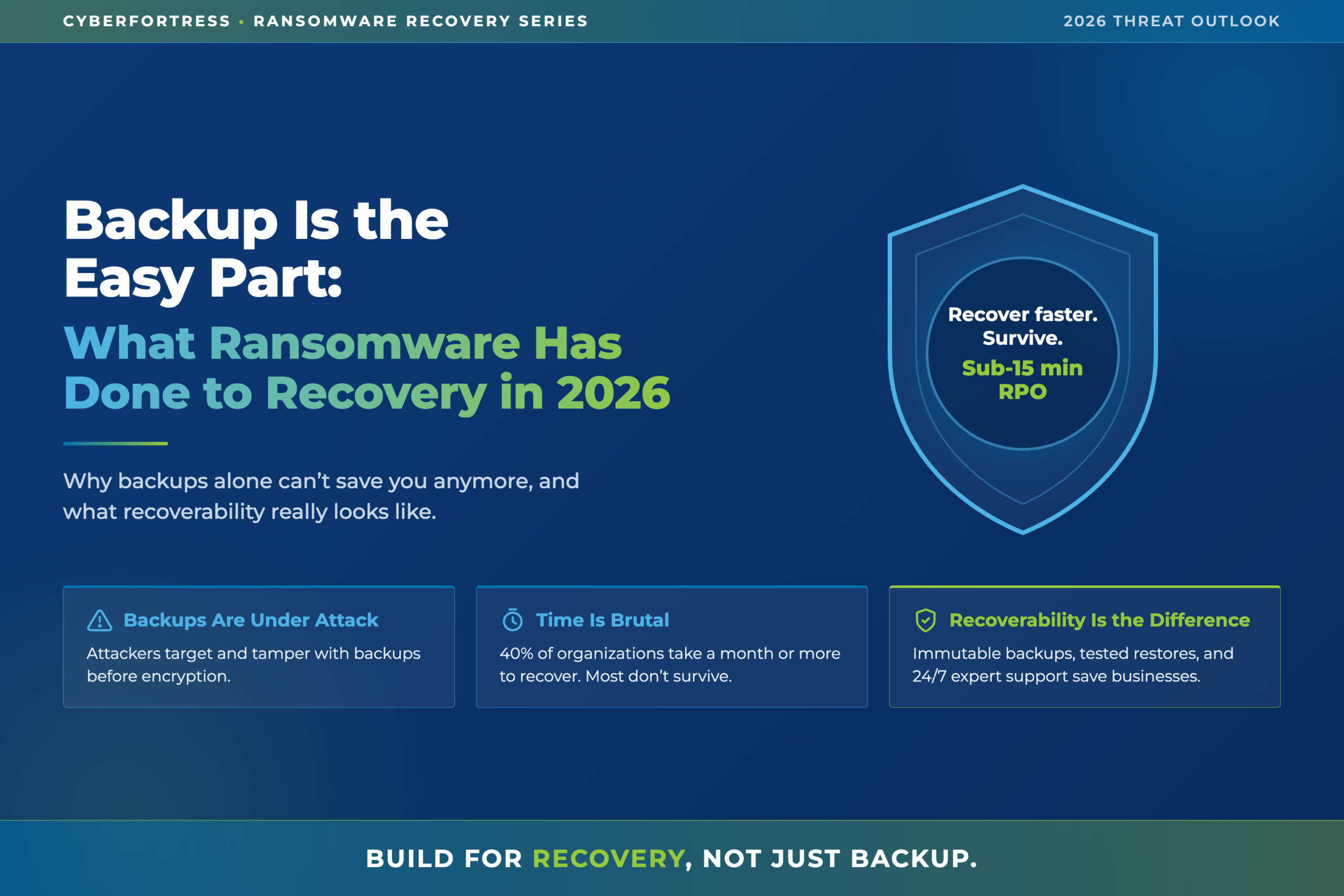
In 2026, having backups is no longer the same as having recovery. Modern ransomware operators spend days inside a network locating and tampering with backup chains before encryption fires. An encryption fire means the restore most organizations plan to reach for is already compromised when they need it. The businesses that recover are the ones that built recoverability as a discipline: immutable copies the attacker cannot reach, tested restores under ransomware scenarios, and expert support available at 2 a.m.
Key Takeaways
- Most disaster recovery plans were built for outages such as hardware failures, floods, botched migrations. Not for an adversary who has been inside the network for days, locating and corrupting backup copies on purpose
- Three failure modes account for most failed recoveries in 2026: corrupted backup chains (tampered during dwell), attacker-deleted snapshots (reached via shared production credentials), and restore times the business cannot absorb
- CISA’s early 2026 reporting puts AI-enhanced attack success rates 73% above traditional variants; the gap between initial access and encryption can now be measured in hours
- Roughly 40% of organizations take a month or more to recover from a ransomware incident and for most businesses, that timeline ends operations
- The shift that matters is from backup-as-product to recoverability-as-discipline: immutable isolated storage, tested restores under ransomware scenarios, and recovery support that operates on the same clock as the attacker
- LiveVault delivers sub-15-minute RPO with immutable, AES 256-bit encrypted retention and 24/7 U.S.-based recovery specialists; built around recoverability, not backup as a checkbox
The Gap Between Having Backups and Surviving a Ransomware Attack
Walk into any IT department and ask whether the company has backups. The answer is yes. It has been yes for twenty years.
Walk in and ask whether anyone has actually restored from those backups under real ransomware pressure, with the timeline collapsed to hours and parts of the backup chain already tampered with. The answer gets quieter.
That gap is where most of 2026’s ransomware victims have ended up.
The Hacker News ran a piece in April with the unsettling title “Why Your Backups Might Not Save You When Ransomware Hits.” BlackFog’s State of Ransomware 2026 report carried the same message with field data behind it. Most disaster recovery plans come from the outage era, when the failure modes were hardware breakdowns, flooded server rooms, and botched migrations. An adversary who has been inside the network for days, located the backup repositories on purpose, and decided which copies to encrypt, delete, or quietly corrupt is a different kind of problem entirely.
The Difference Between Having Backups and Recovering From Them
The vocabulary the industry has used for years has quietly hidden the difference. “We have backups” became a stand-in for “we have recovery.” A backup is data sitting in storage. A recovery is the act of getting a working business back online from that data, on a clock the business can afford, with the data itself verifiably clean.
In 2026, three failure modes account for most of the recoveries that fall apart in real ransomware incidents.
- The first is corrupted backup chains. Modern operators dwell in environments long enough to identify backup software, locate the recovery points, and tamper with them before deploying ransomware. By the time encryption fires, several recent restore points have already been quietly damaged. The IT team finds out when the restore fails.
- The second is attacker-deleted snapshots. When the backup repository sits on the same network as production and uses the same identity provider, a stolen credential hands the attacker the keys to the recovery plan along with the keys to the production environment. They use those keys before any ransom note appears.
- The third is the restore time problem. Even when the backup is intact, restoring it takes far longer than the business can absorb. Industry reporting from earlier this year found that roughly 40% of organizations take a month or more to recover from a ransomware incident. For most businesses, that timeline ends operations.
The Reset of 2026
What has actually changed is the threat clock. Attacker dwell time has compressed sharply. CISA reporting from early 2026 puts the success rate of AI-enhanced attacks 73% above traditional variants, and the gap between initial access and encryption can now be measured in hours instead of weeks.
When the threat clock is measured in hours and the recovery clock is measured in days, the space between those two clocks is where most data dies.
Tightening the recovery clock is the work of the next year for most IT organizations. It is a different conversation than the one most teams have been having, which has tended to focus on backup frequency, retention policy, and storage capacity. Those are the right questions when the threat is an outage, but they are incomplete when the threat is an adversary on a deliberate timeline.
What Recoverability Looks Like as a Discipline
The shift that matters here is from backup-as-product to recoverability-as-discipline. Three parts of that shift are concrete enough to use as a planning lens.
Immutability of the backup itself. The recovery copy has to live somewhere ransomware cannot reach with stolen credentials. Immutable, write-once-read-many storage in a geo-separated, identity-isolated vault has become the baseline architecture for any business holding meaningful data. The “tape in a closet” approach worked surprisingly well against the attacker of ten years ago. Today’s adversary is faster and more thorough, and the architecture has to match.
Tested restore, not assumed restore. A restore that has never been tested under pressure is a hypothesis. Plenty of organizations discover the gaps in their recovery plan during the recovery itself, when there is no time left to rewrite the plan. Monthly verified restores against ransomware scenarios, instead of only hardware failure scenarios, are the only way to know what recovery actually looks like before a real incident demands it.
Recovery support that operates on the same clock as the attacker. Most ransomware actions in 2025 happened outside business hours, when most internal IT teams have nobody at the keyboard. Recovery on a Saturday night requires expert help available on a Saturday night, and the math of staffing that internally rarely works for a small or mid-sized organization. That is why managed recovery has become a baseline service for the segments most exposed to this threat.
How CyberFortress Thinks About Recovery
CyberFortress was built around recoverability rather than backup as a product category. LiveVault delivers sub-15-minute RPO targets with immutable retention and AES 256-bit encryption, and the platform sits behind 24/7 U.S.-based recovery specialists who walk customers through actual restores under real conditions. The Trinity Platform brings that recovery capability together with managed detection and response, so protect, detect, and recover are owned end to end rather than handed off across vendors with different operating models and different on-call hours.
The shift that matters here is the operating posture. The businesses surviving 2026 ransomware incidents share something more specific than backups. They built recovery into a discipline, rehearsed it under pressure, supported it around the clock, and kept their copies somewhere the attacker could not reach.
Three Questions Worth Sitting With
If your IT or security team has not had this conversation in the past quarter, three questions are worth taking into your next leadership review.
If our most critical systems were encrypted on a Friday night, what could we restore from a copy the attacker cannot reach, and have we tested that path against a ransomware scenario in the last 90 days?
What is the actual time from incident declaration to a verified, clean operational restore in our environment, measured against what the business can absorb?
Who is on the keyboard with us at 2 a.m. on a Saturday, and what authority do they have to act?
Backup will keep mattering. The conversation that has to happen alongside it in 2026 is about recovery, and about whether the company has invested in it as a discipline rather than as a checkbox. The right time to find that out is well before the encryption fires.
Frequently Asked Questions
What is the difference between backup and recoverability? A backup is data sitting in storage. Recoverability is the ability to get a working business back online from that data, within a timeline the business can survive, with the data itself verifiably clean. In 2026, most organizations have the data sitting in storage, and have not invested in recoverability yet. This is why many ransomware recoveries are unsuccessful, not because the backup is missing. The backup was tampered with, takes too long to restore, or was never tested under real pressure.
Why do ransomware attacks target backup systems before encrypting production data? Destroying or corrupting the backup removes the victim’s primary exit from the attack, a clean restore. This makes sending payment one of the few options for companties. Modern ransomware operators dwell inside environments for days, locate backup software and repositories, and quietly tamper with recent restore points before deploying the encryptor. By the time the ransom note appears, the backup chain has often already been compromised.
What does “immutable backup” mean, and why does it matter in 2026? Immutable backup means the stored data cannot be altered or deleted for a defined retention period. It matters because ransomware operators who reach backup-admin or domain-admin credentials can delete or encrypt backup copies stored on the same network as production. Immutable, write-once-read-many storage in a geo-separated, identity-isolated vault removes that path. Now, the attacker cannot reach or modify it with credentials stolen from the production environment.
How long does ransomware recovery actually take for most businesses? Industry reporting from 2025 and early 2026 found that roughly 40% of organizations take a month or more to recover from a ransomware incident. Even when backups are intact, restore operations take far longer under real ransomware conditions than under the hardware-failure scenarios most teams have tested. For most businesses, a month of disruption is operationally fatal which is why recovery time is the critical planning variable, not backup frequency alone.
What is sub-15-minute RPO, and why does it matter for ransomware recovery? RPO (Recovery Point Objective) is how much data a business loses between its last clean backup and the moment of an attack. A sub-15-minute RPO means the most data a business can lose is 15 minutes of activity and compared with 24 hours or more under a traditional daily backup model. LiveVault delivers sub-15-minute RPO targets with immutable retention, meaning the recovery copy is both current and unreachable by the attacker.
What should a business do if its backup was tampered with during a ransomware attack? Contact your recovery provider immediately and do not attempt to restore from any backup point created after the attacker’s known or estimated dwell period began — those points may be corrupted. A recovery team with forensic visibility into the backup chain can identify the last verified clean restore point and begin rebuilding from there. This is why 24/7 recovery support with expert operators matters: the window to act is narrow and the decisions require someone who has done this before.
_____________________________________________________
CyberFortress provides managed cyber resilience for businesses that cannot afford to lose their recovery options. Contact our team to audit your current backup trust boundary.
A backup you have never restored is a guess. Trinity turns it into proof.
Seven questions show where your recovery plan stands today. Or skip ahead and talk to a CyberFortress recovery specialist about your environment.
More from the Fortress
-
Small Business Endpoint Backup After Device Loss
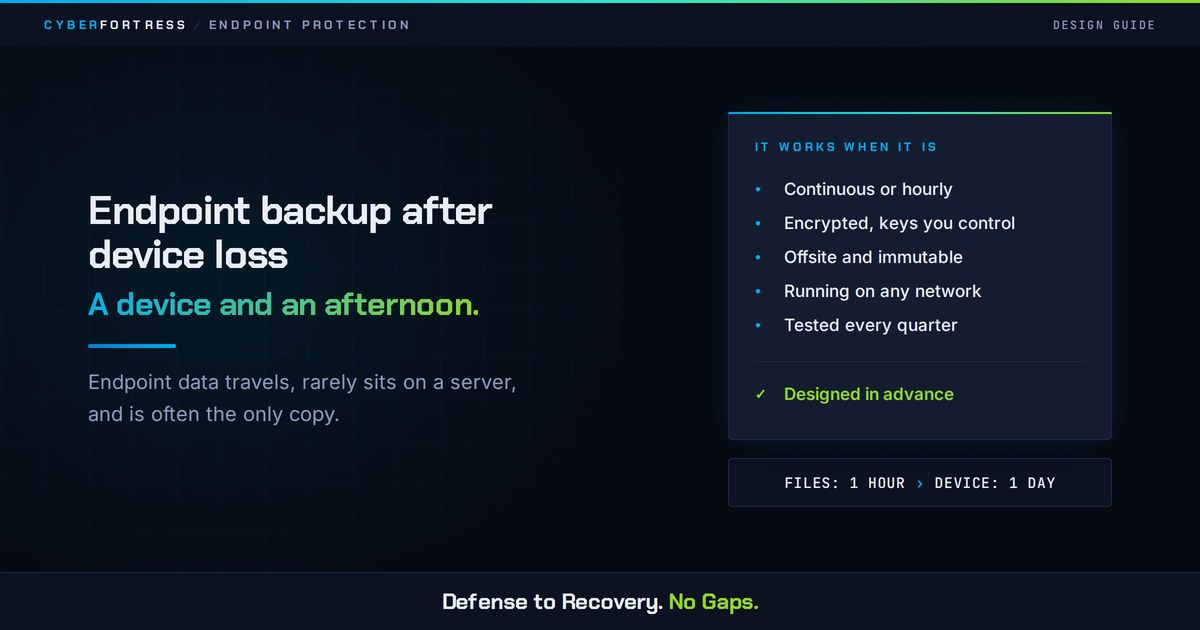
Endpoint backup works when it is continuous, encrypted, offsite, independent of the device, and tested. A stolen laptop…
-
7 Things to Know About Small Business Cloud Backup
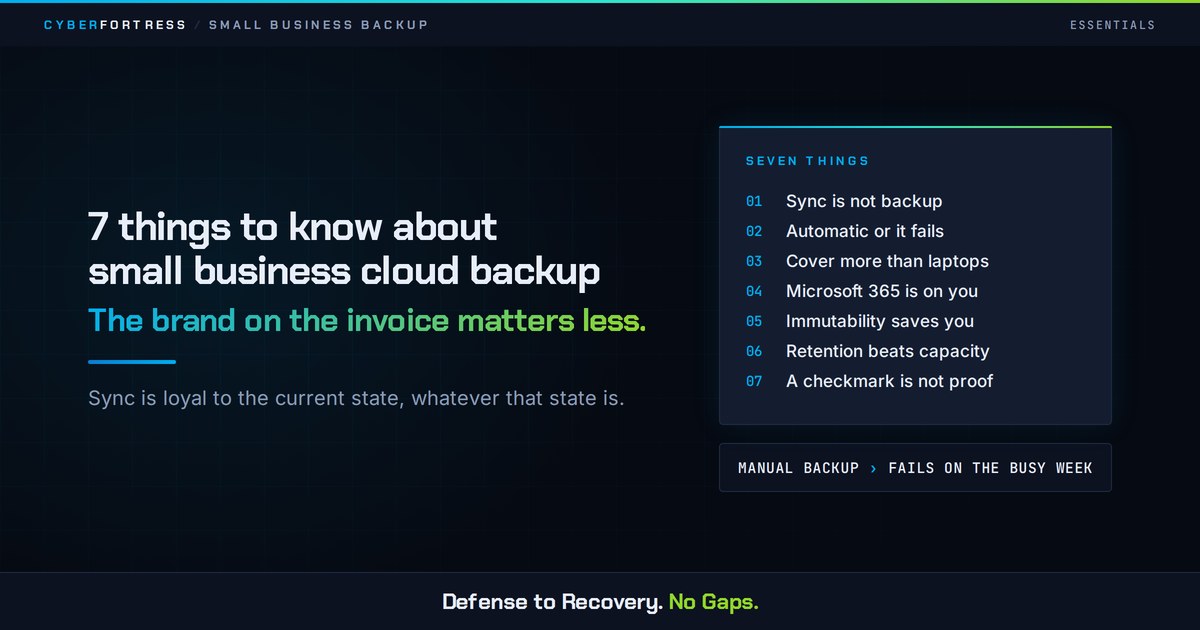
Seven things decide whether small business cloud backup works: sync is not backup, protection must be automatic, coverage…
-
Cloud Sync vs Cloud Backup for File Protection
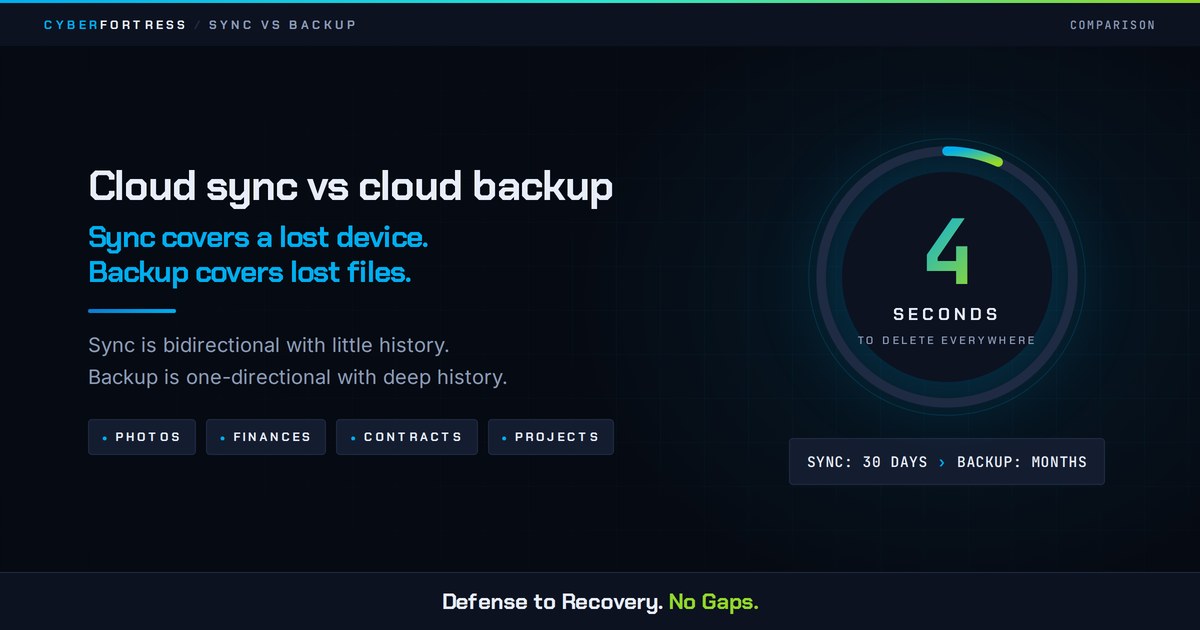
Cloud sync keeps one live copy of a file consistent across your devices. Cloud backup keeps many historical…
-
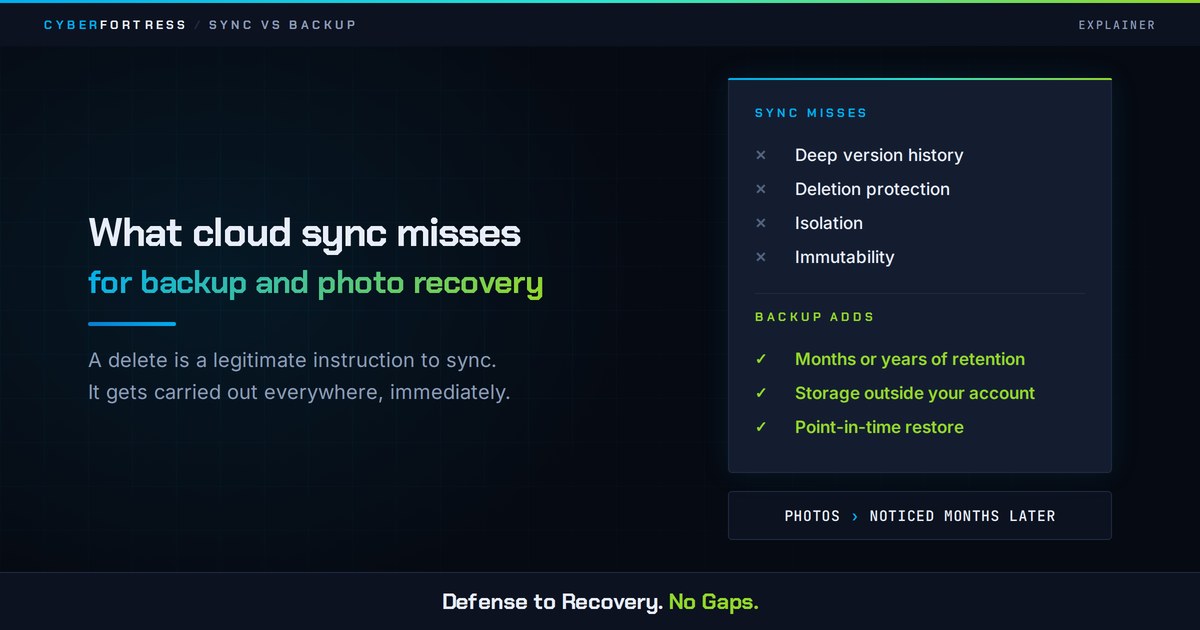
What Cloud Sync Misses for Backup and Photo Recovery
File synchronization misses history, isolation, and coverage. It keeps your current state available on every device, gives you…