8 Ways Managed Server Backup Helps Lean IT Teams
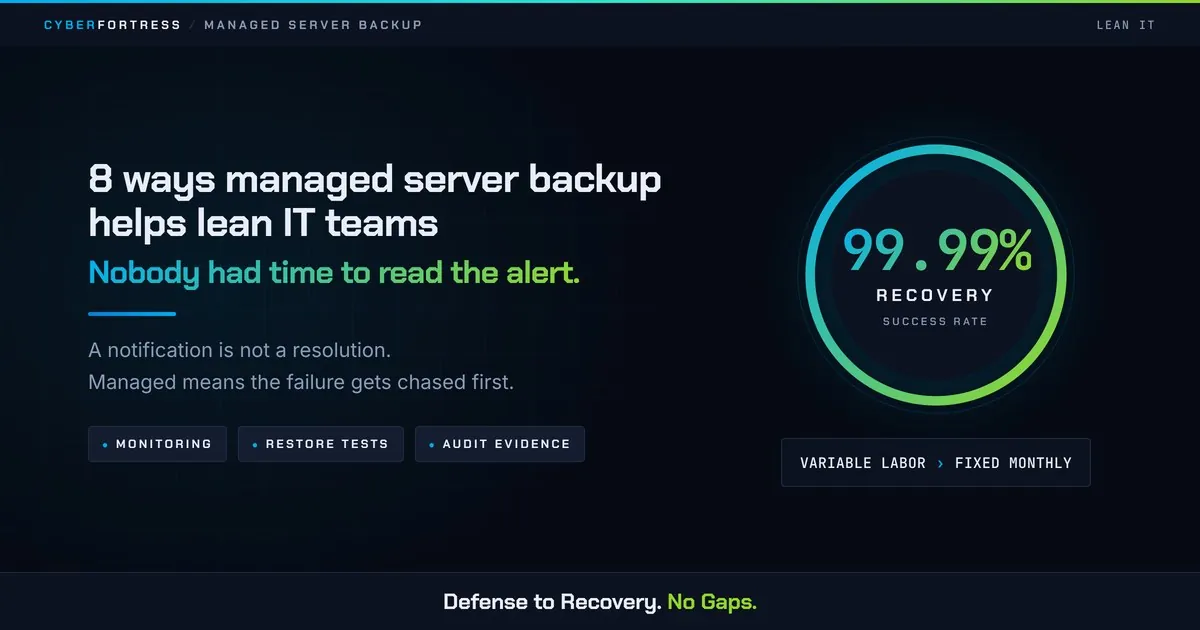
A managed server backup service helps lean IT teams in eight ways: it watches jobs continuously, fixes failures without a ticket from you, verifies restores, keeps coverage current as the environment changes, isolates backups from compromised credentials, produces audit evidence, provides expert help during recovery, and turns unpredictable labor into a fixed cost.
1. Somebody is actually watching
Backup failures are boring until they are catastrophic. A managed service monitors every job, investigates failures the same day, and escalates repeats.
Lean teams lose backups for one reason. Nobody had time to read the alert.
2. Failures get fixed, not just reported
There is a large difference between a notification and a resolution. Managed operations means the provider chases the agent that stopped checking in, the snapshot that could not quiesce, and the credential that expired, before you find out.
Each of those failures is silent, and each one leaves a hole in exactly the recovery point you will eventually want.
3. Restores get tested on a schedule
Recovery readiness comes from testing, and testing is the first thing a busy team drops. A managed service runs verification and periodic test restores, then hands you the evidence.
That evidence is also what auditors and insurers want to see, which makes it the rare control that pays for itself twice.
4. Coverage keeps up with change
New virtual machines, new shares, new applications, and decommissioned hosts all change your protection surface. Policy-driven backup automation plus periodic scope review keeps new workloads from sitting unprotected for months.
Unprotected usually means unnoticed. Scope drift is invisible right up to the moment somebody asks for a file.
5. Backups survive a compromised administrator
A well-designed managed service stores copies immutably, outside your production credential boundary, so an attacker with domain admin cannot delete your recovery path.
Assume they already have domain admin, then look at what still exists. Most DIY deployments cannot answer that question well.
6. Audit evidence arrives as a byproduct
Retention settings, job history, restore test results, and access logs get compiled into reporting you can hand over. Assembling that from scratch during an audit consumes days a lean team does not have, usually in the same week as everything else.
7. Expert help shows up during recovery
Recovery is where experience compounds. Sequencing identity before applications, choosing instant recovery over bare-metal restore, and recognizing a corrupted recovery point are judgment calls made faster by people who do it weekly.
Your team will do it once. Ours has done it thousands of times.
8. Cost becomes predictable
Managed pricing converts variable labor and emergency overtime into a fixed monthly line item. That is easier to defend in a budget conversation than an unquantified risk, and far easier than explaining the invoice from the week everything stopped.
Frequently asked questions
Does managed server backup mean giving up control? No, when the service includes your own console access, visible retention policy, self-service restores, and a documented exit path. Ask about all four.
Can a managed service protect on-premises servers? Yes. Most protect physical servers, virtual machines, and cloud workloads under one policy, with local copies for speed and offsite immutable copies for resilience.
Next step
CyberFortress watches the jobs, fixes the failures, tests the restores, and produces the evidence, with 99.99% recovery success behind it.
Test Your Fortress · Talk to a Recovery Specialist
Related reading: A smarter approach to server backup and recovery for SMBs
A backup you have never restored is a guess. Trinity turns it into proof.
Seven questions show where your recovery plan stands today. Or skip ahead and talk to a CyberFortress recovery specialist about your environment.
More from the Fortress
-
Whose Database Is Your Data In?
FulcrumSec published roughly 8.8 million people’s data from Manchester Airports Group over the first weekend of September 2026,…
-
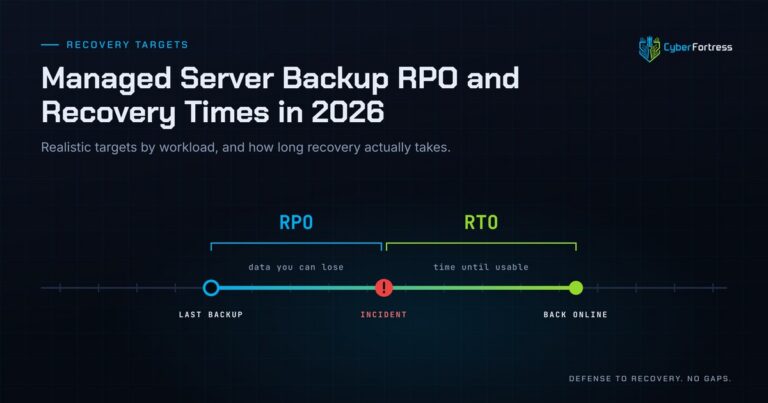
Managed Server Backup RPO and Recovery Times in 2026
For a 200-person company in 2026, a reasonable managed server backup posture is a 15-minute to 4-hour RPO…
-
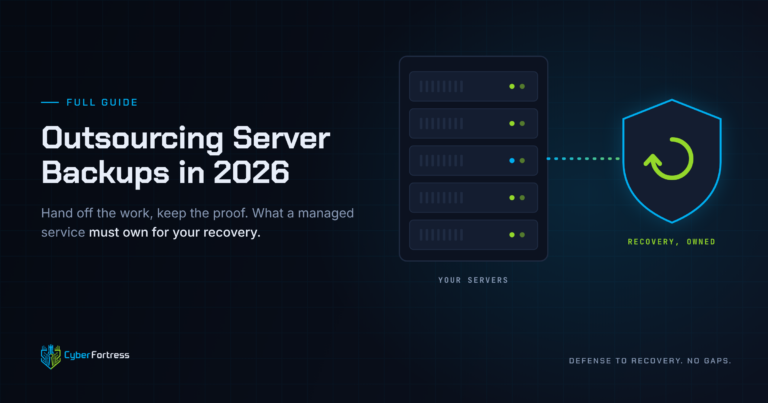
Outsourcing Server Backups in 2026 Full Guide
Outsourcing server backups works when the contract covers monitoring, remediation, verified restore testing, immutable offsite storage, and assisted…
-
You Can’t Out-Patch an Attacker That Adapts in 31 Seconds
Researchers have documented what they are calling JadePuffer: a ransomware operation reportedly run end-to-end by an autonomous LLM…