DATA PROTECTION TRENDS, NEWS & BACKUP TIPS
When the Ransom Note Is a Disguise: Recovery in the Era of False-Flag Ransomware
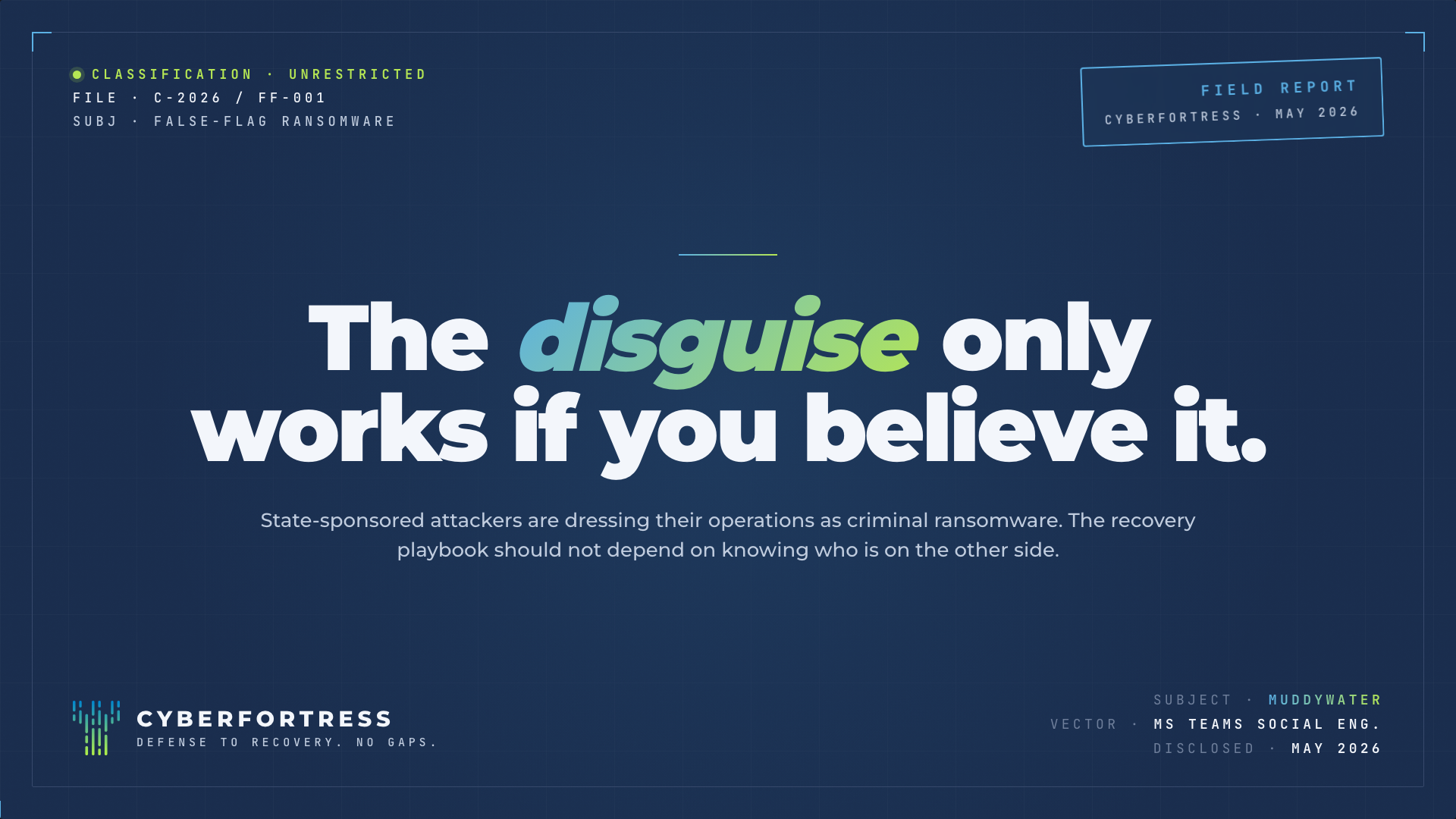
In May 2026, security researchers disclosed a campaign tracked as MuddyWater that should change how every executive thinks about ransomware attribution. The actor is nation–sponsored. The technique used Microsoft Teams social engineering to compromise targets. The ransom note presented the operation as Chaos-brand ransomware-as-a-service, a known criminal RaaS family, in what appears to have been a deliberate effort to obscure attribution.
The attack would have looked, to most incident responders in the first 48 hours, like a standard criminal extortion operation. The ransom note was on-brand. The tooling was consistent with what RaaS affiliates have been deploying. The attacker behavior, until the analysis went deep, fit a familiar pattern. The actor’s actual goals had little to do with the ransom payment.
For business leaders, this development is uncomfortable in a specific way. The instinct to ask “who attacked us” is natural. The instinct to use the answer to shape the response is also natural. In 2026, both instincts can lead organizations into incident response playbooks that miss the moment.
Why the Disguise Matters
The motivations behind a state-sponsored false-flag operation are different from those of a criminal RaaS gang in a few important ways.
A criminal operator wants the ransom paid. The financial transaction is the operation. The data destruction or release is leverage. Once the payment clears, the operator’s incentive is to deliver the decryption key and move on.
A state-sponsored operator may have other goals entirely, with the ransom note serving as cover. The actual operation could be data exfiltration for intelligence purposes, the destruction of specific systems for strategic reasons, the planting of access for later use, or the disruption of a sector for geopolitical effect. The decryption key may not exist, may not work, or may have been intentionally compromised before delivery.
When the operator is pretending to be a criminal, the playbook the customer follows by default may include behaviors the attacker counts on. Negotiation. Time on the clock. Disclosure that follows the criminal-incident calendar. A focus on the financial impact rather than the operational and informational impact.
The attacker chose the disguise because it produces a predictable defender response. The disguise works as long as the defender believes it.
The Defender Insight Is Simpler Than It Sounds
The implication of MuddyWater for incident response is more useful than it might initially appear: it points toward a simplification.
If the recovery requirements for a criminal incident and a state-sponsored incident are similar, then the playbook should not depend on attribution. The actions the customer takes in the first 24 hours, in the second week, and in the months that follow should be driven by what the attacker did rather than by what the attacker calls themselves.
The technical and operational answers overlap heavily. Compromised systems have to be isolated before lateral movement continues. Recovery has to come from copies the attacker could not reach. The restored environment has to be verified clean before operations resume. Executive communications have to account for regulators, customers, and partners. The flag the actor is flying barely changes any of that.
Building the playbook around recovery rather than attribution has a useful side effect. It reduces the leverage the attacker gains from the disguise. A defender whose response does not depend on knowing the actor cannot be misled by a fake ransom note.
What Resilience Looks Like Under This Threat Model
A few principles follow from the MuddyWater pattern that any executive can take into a planning conversation.
Recovery copies must be unreachable. Whether the attacker is a financially motivated criminal or a state-aligned operator, the recovery copy has to live somewhere a stolen credential or a compromised administrator account cannot reach. Immutable, write-once-read-many storage in a geo-separated, identity-isolated vault is the architecture that satisfies both threat models.
Restore environments must be isolated. When restoration begins, the team needs a clean environment to bring the data back into, with assurances that the underlying infrastructure has not been compromised. This is true regardless of the attacker’s identity. State-sponsored actors are particularly likely to leave persistence behind, but criminal operators do as well.
RTO and RPO must reflect operational reality. The financial impact of a ransom payment can be modeled with a calculator. The operational, regulatory, and reputational impact of an extended outage cannot. Recovery point and recovery time objectives built for routine criminal extortion will be inadequate for any actor whose primary goal is disruption.
Decision authority must be pre-established. In a state-sponsored incident, the natural urge to negotiate may be a trap. In a criminal incident, the natural urge to pay may be a different kind of trap. A pre-established decision tree, owned by the executive team and reviewed periodically, removes the question of who has authority to do what during the 48 hours when the answer matters most.
How CyberFortress Approaches Recovery That Doesn’t Depend on Attribution
CyberFortress builds recovery infrastructure assuming attribution may not be available, may be misleading, or may take weeks to clarify. Immutable retention, geo-separated air-gapped vaults, isolated restore environments, and 24/7 U.S.-based recovery specialists are part of the core architecture rather than premium options. The Trinity Platform brings detection, response, and recovery into a single accountable team, so the customer’s incident response posture is the same on day one of an attack regardless of whether the actor turns out to be a criminal affiliate or a state-aligned operation.
The underlying principle is straightforward: recovery posture cannot be conditional on knowing who the attacker is, because the attacker now has reasons to mislead about that.
Three Questions for the Executive Team
Three questions are worth taking into the next executive risk conversation, especially if your organization has not formally addressed the false-flag scenario.
If we received a ransom note tomorrow, would our response playbook change based on who we believed the actor to be, and is that dependence intentional?
What in our recovery architecture assumes we know what kind of attacker we are dealing with, and would that assumption hold if the ransom note turned out to be a disguise?
Who has the decision authority to choose between negotiation, disclosure, and refusal, and have we walked through the scenario in which the actor’s stated identity is not the actor’s real one?
The MuddyWater campaign will not be the last false-flag ransomware operation to reach the public record. The defenders who weather the next one are likely to be the ones who built their recovery posture around what attackers do, not around what attackers call themselves.