DATA PROTECTION TRENDS, NEWS & BACKUP TIPS
Cyber Attacks on Retail: How They Happen, What They Cost, and How to Recover
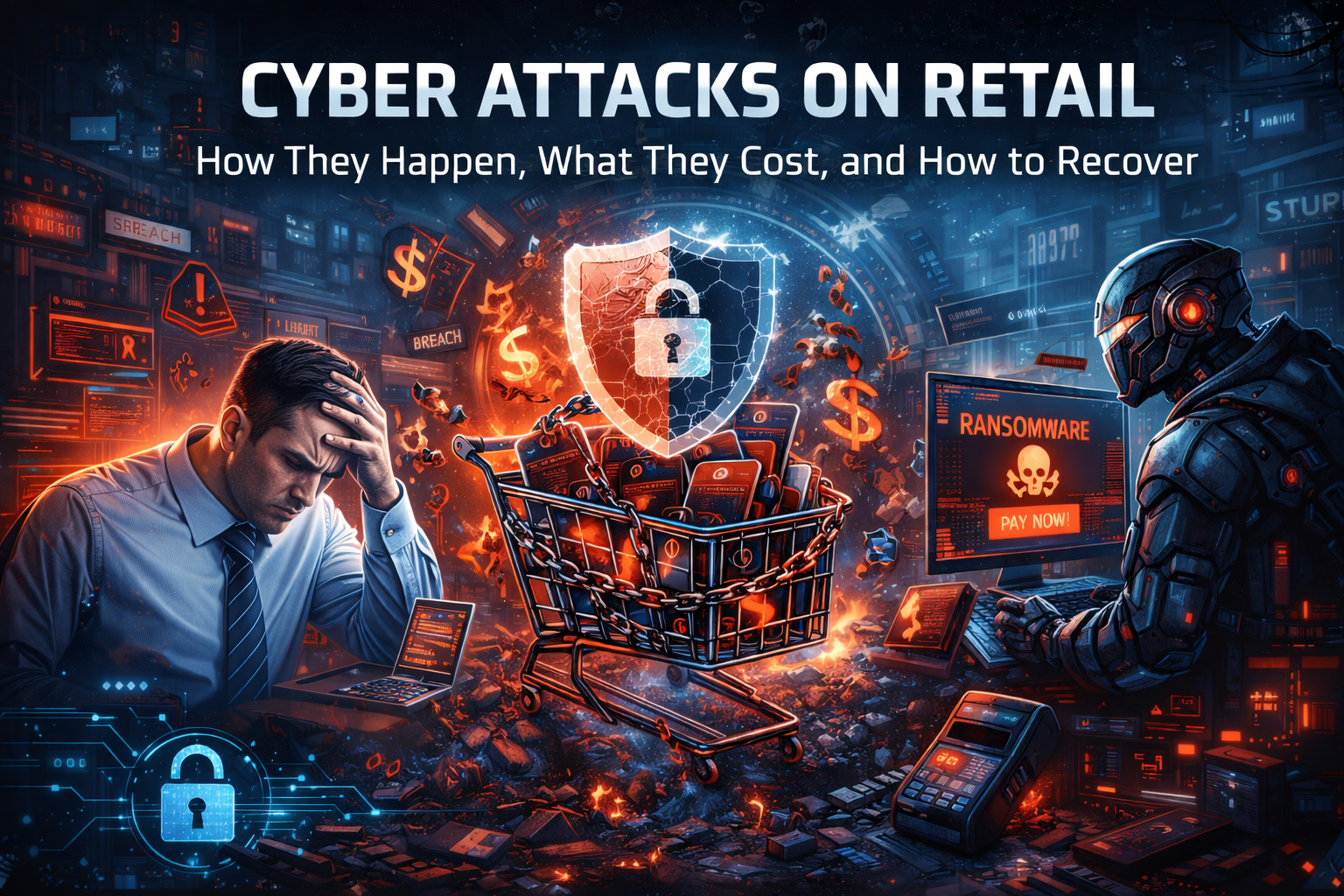
Retailers collect and store massive amounts of customer data: names, addresses, payment details, purchase histories. They operate in a high-volume, always-on environment. That combination makes the sector a consistent target for cybercriminals. In October 2025, Canadian Tire Corporation disclosed one of Canada’s largest retail data breaches, exposing personal information from over 38 million customer accounts on its e-commerce platform. Names, addresses, email addresses, dates of birth (full DOB for fewer than 150,000 accounts), encrypted passwords, and truncated credit card numbers were compromised. The vulnerability was fixed quickly, in-store systems, the bank, and loyalty program were untouched, and affected customers were offered credit monitoring. Yet the incident underscores a harsh reality: even a “contained” breach can erode trust and trigger regulatory scrutiny.
In 2025, ransomware attacks on retailers jumped 58% in Q2 alone, and sophisticated groups like Scattered Spider repeatedly targeted big-name chains. Understanding how these attacks unfold, what happens next, the real costs, and how to prevent or rapidly recover from them has become a baseline requirement for any retailer.
Potential PCI and Other Compliance Penalties
Beyond direct financial losses and reputational damage, retailers face steep regulatory penalties when customer payment or personal data is compromised. These can quickly turn a bad situation into an existential threat.
PCI DSS Violations
Since retailers process millions of credit and debit card transactions daily, failure to maintain PCI DSS compliance after a breach triggers immediate enforcement by card brands (Visa, Mastercard, American Express, Discover) and acquiring banks. Monthly fines typically range from $5,000 to $100,000 until full compliance is restored, with some incidents reaching $500,000 or more. Additional per-card fees of $20–$90 per impacted account are common. For a breach the size of Canadian Tire’s (38 million accounts), these charges alone can exceed tens of millions of dollars. In extreme cases, merchants can lose the ability to process credit cards entirely—devastating for any retail operation.
GDPR, CCPA/CPRA, and Other Privacy Regulations
If your business serves EU customers or stores EU resident data, GDPR fines can reach €20 million or 4% of global annual revenue—whichever is higher. In the U.S., CCPA/CPRA penalties start at $2,500 per violation (up to $7,500 for intentional violations), with no statutory cap—potentially totaling hundreds of millions for a large-scale breach affecting millions of consumers. Canadian retailers face parallel enforcement under PIPEDA and provincial privacy laws, plus mandatory breach notifications that often lead to class-action lawsuits and heightened scrutiny from regulators.
These penalties stack on top of forensic investigations, customer notification costs, credit monitoring, and lost revenue, adding significantly to the total cost of any cyber attack.
How Cyber Attacks on Retail Typically Happen
Retail environments are complex webs of point-of-sale (POS) systems, e-commerce platforms, third-party vendors, employee devices, and supply-chain partners. Attackers exploit any weak link.
- Phishing and Social Engineering (the #1 entry point)
Groups like Scattered Spider impersonate IT staff or third-party vendors to trick helpdesk teams into resetting credentials. Once inside, they move laterally, steal Active Directory databases, and deploy ransomware or exfiltrate data. This exact playbook hit Marks & Spencer (M&S) and Co-op in the UK in April–May 2025. - E-commerce and Web Application Vulnerabilities
The Canadian Tire breach appears tied to a flaw in its online platform. Attackers scan for unpatched APIs, SQL injection points, or misconfigurations, then exfiltrate customer databases—often without triggering immediate alarms. - POS Malware and Endpoint Compromise
Older but still effective: malware scrapes payment data from memory in real time. Modern variants combine this with ransomware. - Supply-Chain and Third-Party Attacks
Compromising a vendor (HVAC contractor at Target in 2013, or Blue Yonder in 2024) gives attackers a backdoor into the retailer’s network. - Credential Stuffing and Ransomware
Stolen credentials from one breach are reused across others. Once inside, ransomware encrypts servers or exfiltrates data for double-extortion.
What connects all of these? Retailers often lack 24/7 visibility into endpoints and reliable recovery options, giving attackers days, weeks, or months of dwell time.
What Typically Happens During and After an Attack
- Initial access and dwell: Attackers move quietly for weeks or months (global average identification time: 60 days).
- Exfiltration or encryption: Customer PII and payment data are stolen or systems are locked.
- Disruption: POS terminals go down, online ordering stops, warehouses can’t ship. M&S saw weeks of disrupted click-and-collect and online sales.
- Public disclosure and chaos: Regulatory notifications (CCPA, GDPR, provincial privacy laws), customer panic, stock-price drops, and media frenzy follow.
- Ransom demand or data sale: Some groups demand millions; others simply dump the data on forums.
The True Cost: Damages That Go Far Beyond Ransom
The IBM Cost of a Data Breach Report 2025 puts the average retail breach at $3.54 million—up slightly from the prior year and excluding massive lost-revenue hits. When you factor in operational disruption, the numbers explode:
- M&S: ~£300 million ($400 million) in lost revenue and profit impact from weeks-long outages.
- Co-op (UK): £206 million revenue loss.
- Notification, credit monitoring, legal fees, fines, and customer churn add millions more.
- Reputational damage is harder to quantify but real—competitors gain market share while customers shop elsewhere.
Ransomware groups know retail’s peak seasons (holidays, back-to-school) create maximum leverage. Lost sales during downtime often dwarf the ransom itself.
How Long Does It Take to Repair the Damage?
- Detection & containment: Global average now 241 days total lifecycle, but many organizations still take months.
- Operational downtime: Ransomware victims average 22–24 days of significant disruption; some (like M&S) suffer partial outages for 6–8 weeks or longer.
- Full recovery: Forensics, system rebuilds, regulatory reporting, and customer communication can stretch 3–6 months or more. Even “quick” remediations (Lovesac contained its February 2025 incident in three days) still trigger credit-monitoring offers and ongoing monitoring.
Without clean, immutable backups, organizations face the nightmare choice: pay the ransom or rebuild from scratch—often paying anyway in lost revenue.
Preventing the Next Breach: CyberFortress Delivers Data Resilience and Cyber Resilience
Retailers don’t have to choose between expensive downtime and paying criminals. CyberFortress offers a layered defense that combines DeepSeas Endpoint MDR with ransomware-resilient, air-gapped backups to deliver genuine cyber resilience and data resilience.
1. DeepSeas Endpoint MDR – Stop Attacks Before They Spread
Powered by 24/7 AI-driven monitoring plus human experts, DeepSeas Endpoint MDR delivers:
- Real-time threat detection across every laptop, POS terminal, server, and device.
- Measured Time to Detection (MTTD) in minutes, not months.
- Immediate investigation and containment: compromised endpoints are isolated, encryption and lateral movement are blocked, and data exfiltration is stopped cold.
- Proactive threat hunting and industry-specific intelligence.
In a retail environment, this means a phishing email that slips past an employee or a rogue POS device never reaches your core systems or customer database.
2. Ransomware resilience
CyberFortress delivers true ransomware resilience through air-gapped backups—copies that are physically or logically isolated from your production network, making them completely unreachable by ransomware, even if attackers gain full domain admin rights.
How block-based storage is made ransomware-resistant
Block-based storage (high-performance SAN or array snapshots powered by Veeam) creates immutable point-in-time copies. Once locked, these snapshots cannot be encrypted, modified, or deleted by ransomware—even if the attacker compromises your admin credentials. This delivers the fastest possible local recovery for retail-critical systems such as POS terminals, inventory databases, and e-commerce servers—often restoring operations in minutes.
How object-based storage is made ransomware-resistant via S3 Object Lock
For unbreakable offsite protection, CyberFortress uses S3-compatible object storage (or Azure Blob) with S3 Object Lock. This enforces true WORM (Write Once, Read Many) policies: once an object is written and locked, no one—not even a privileged admin or ransomware—can alter, overwrite, or delete it for the entire retention period (Compliance mode makes it legally immutable).
The 3-2-1-1-0 rule + WORM
CyberFortress follows the gold-standard 3-2-1-1-0 backup rule, supercharged with WORM immutability:
- 3 copies of your data
- 2 different media types
- 1 copy offsite
- 1 copy air-gapped / immutable / offline
- 0 errors or restore failures
This eliminates every single point of failure that ransomware relies on.
Combining object-based and block-based storage for fast recovery + ransomware resilience. Using both approaches together is what makes recovery practical: block-based immutable snapshots enable fast local restores (minutes for store operations), while object-based air-gapped WORM copies provide an untouchable safety net for full disaster recovery. You get both speed and durable protection, which means minimal downtime and no need to pay a ransom.
3. The Powerful Combination: True Cyber Resilience
DeepSeas MDR prevents or contains the attack at the endpoint. Air-gapped, immutable backups (block + object) mean you can recover cleanly and quickly, without paying a ransom. In practice, that means:
- Minimal or zero operational downtime (critical for retailers).
- Protected customer data integrity.
- Business continuity even on your worst day.
- Lower total breach costs and faster return to normal.
CyberFortress delivers a complete resilience strategy with expert-managed services, tested recovery plans, and 24/7 Instant Response Recovery Hotline support.
Time to Build Real Resilience
The Canadian Tire breach, the M&S ransomware saga, and dozens of others in 2025 make one thing clear: hope is not a strategy. Attackers are faster, better resourced, and more persistent than ever. Retailers that rely on reactive, under-resourced security teams will keep paying for it in lost revenue, eroded trust, and regulatory headaches.
CyberFortress changes the equation. With DeepSeas Endpoint MDR for prevention and air-gapped, ransomware-resilient backups (block + object, 3-2-1-1-0 + WORM) for recovery, you get proactive cyber resilience and dependable data resilience, exactly what retail requires in 2026 and beyond.
Ready to protect your retail operation and your customers? Schedule a no-obligation demo of Endpoint MDR with CyberFortress backup solutions today.