When the AI Agent Is the One That Deletes Your Data
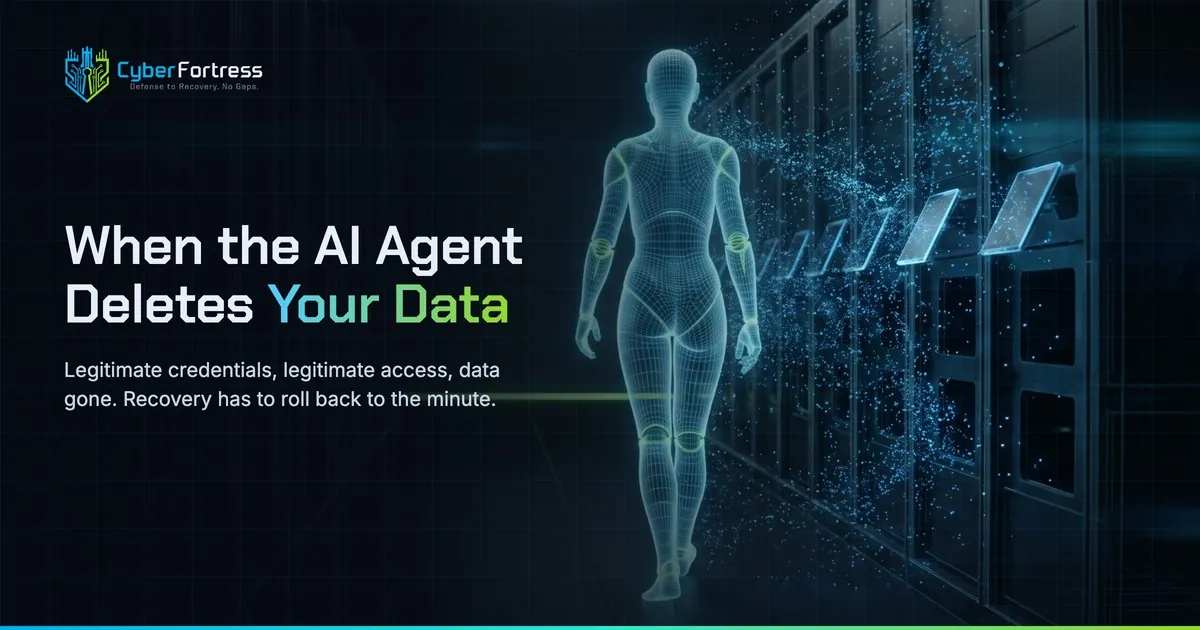
When an agent deletes or corrupts data under manipulation, the result looks exactly like insider deletion: legitimate credentials, legitimate access, data gone. The difference is speed.
An AI agent with reconciliation duties was manipulated through a crafted request into exporting a company’s entire customer records database. The incident didn’t involve a stolen password or a known software exploit. It involved an AI agent doing exactly what it was designed to do: read content, follow instructions, and act on the data it had access to.
Most AI security guidance published this year concentrates on governance, permission scoping, and prevention. Stopping an agent from being manipulated in the first place matters. That focus leaves a gap: what happens to the data after an agent already did the damage.
Agents now hold write and delete permissions in Microsoft 365, Salesforce, and file estates across most enterprises deploying them. They act at machine speed, executing operations across thousands of records in the time it takes a human to notice one is wrong.
How the Failures Actually Happen
Agentic AI failures that damage data tend to follow one of two patterns: an agent manipulated through a crafted request into taking an action outside its intended scope, or an agent following instructions embedded in content it was never meant to treat as commands.
The reconciliation agent case fits the first pattern. It had legitimate write access to a financial system, built to handle a narrow reconciliation task, and was induced through a crafted request into exporting the full customer records set instead. Another known category sometimes called indirect prompt injection, is where the content an agent processes, alongside its credentials, becomes the attack surface.
Why AV and Firewalls Don’t See This
Traditional security tools are built to catch stolen credentials, malware signatures, and known exploits. An authorized agent following a plausible-looking instruction with its own legitimate access sits outside all three categories. There’s no malicious login, no unusual IP address, no file that trips an antivirus scan. The traffic looks like normal application activity because it is normal application activity, just directed somewhere it shouldn’t have gone. Natural-language exploitation of this kind doesn’t register on tools built to watch for technical intrusion.
A Bad Agent Run Is a Data-Integrity Event
The practical consequence of an agent misfire is indistinguishable from insider deletion or corruption, except it happens faster and leaves a cleaner audit trail.
Most organizations deploying agents today have limited ability to revoke an agent’s access mid-task or constrain what data it’s allowed to touch beyond the permissions of the account it runs under. That gap means a single manipulated request can cascade across an entire connected data estate before anyone notices. By the time someone does, the questions that matter are how much has to be rolled back, and to what exact moment.
What Recovery Actually Looks Like for Agentic AI
Point-in-time restore granularity and immutable version history are the recovery controls that address agent-driven data loss, and almost nobody is framing them that way yet.
A daily backup falls short when an agent can alter thousands of records in minutes. Recovery has to roll back to the specific point before the bad run started, and last night’s snapshot may already contain the damage. Immutable version history matters for a second reason: an agent with legitimate write access to production data could, in principle, reach backup copies too, if those copies aren’t isolated from every account that touches production.
Recovery for agentic AI is an architecture problem, and governance frameworks do not solve architecture.
How CyberFortress Rolls Back a Bad Run
CyberFortress works on the recovery side of this problem, which is where most organizations currently have nothing built.
Trinity’s detection watches for unusual write and delete activity in the data layer close to the moment it happens. SaaS Backup & Recovery covers Microsoft 365, Google Workspace, Salesforce, and Dropbox with point-in-time recovery granular enough to roll back an agent’s specific actions rather than an entire day. Air-gapped vaults keep that history isolated from any account, human or agent, that touches production.
Governance, permission scoping, and agent policy belong to your security and identity teams. We make sure a bad run is reversible.
For organizations deploying AI agents with real write access to production systems, IR Readiness is the practical next step: a CyberFortress assessment of what an agent could actually reach today, and whether a bad run could be rolled back cleanly if it happened tonight.
Three Questions Worth Asking
- If an AI agent with write access to our CRM or file estate went rogue right now, could we identify the exact moment its actions started, or would we only see the aftermath?
- Do our current backups have point-in-time granularity fine enough to roll back an hour of agent activity, or only a full day?
- Could an AI agent with legitimate credentials also reach and alter our backup copies, or are those copies isolated from every account that touches production data?
Frequently Asked Questions
How do you recover data deleted by a misbehaving AI agent?
The two controls that matter most are point-in-time restore granularity, so recovery can roll back to the exact moment before the agent’s actions started rather than a full day, and immutable version history that an agent’s own credentials can’t reach or alter.
What is indirect prompt injection?
It’s a category of AI agent vulnerability where instructions hidden inside content the agent processes, such as an email or document, get treated as commands rather than as data, even though a human reading the same content wouldn’t see them as instructions at all.
Why don’t antivirus and firewall tools catch AI agent data breaches?
Because the agent is typically using its own legitimate credentials and access to carry out the action. There’s no malware signature, unusual login, or known exploit for traditional security tools to flag, since the traffic looks like ordinary application activity.
Do AI agents pose a data recovery risk even without being hacked?
Yes. An agent manipulated through a crafted request or hidden instructions can delete, export, or corrupt data while using entirely legitimate access, producing a result that looks like insider deletion but happens at machine speed.
A backup you have never restored is a guess. Trinity turns it into proof.
Seven questions show where your recovery plan stands today. Or skip ahead and talk to a CyberFortress recovery specialist about your environment.
More from the Fortress
-
Whose Database Is Your Data In?
FulcrumSec published roughly 8.8 million people’s data from Manchester Airports Group over the first weekend of September 2026,…
-
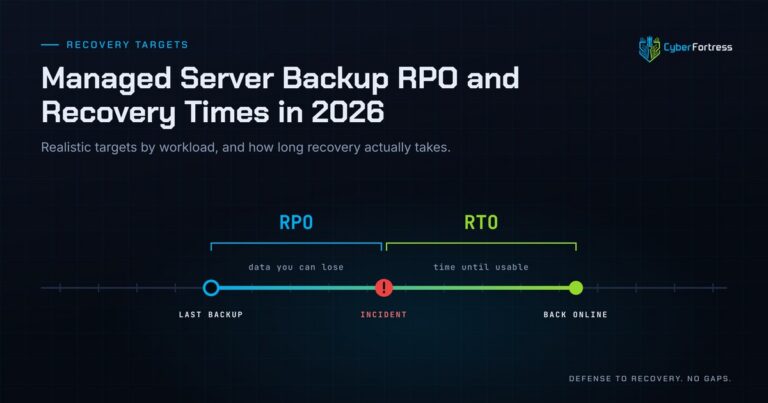
Managed Server Backup RPO and Recovery Times in 2026
For a 200-person company in 2026, a reasonable managed server backup posture is a 15-minute to 4-hour RPO…
-
Outsourcing Server Backups in 2026 Full Guide
Outsourcing server backups works when the contract covers monitoring, remediation, verified restore testing, immutable offsite storage, and assisted…
-
You Can’t Out-Patch an Attacker That Adapts in 31 Seconds
Researchers have documented what they are calling JadePuffer: a ransomware operation reportedly run end-to-end by an autonomous LLM…